





Affinities in Motion: Ten Years of the Pejman Foundation at Argo Factory
19 Nov 2025What makes Phony Wars so compelling as a 10th-anniversary exhibition for the Pejman Foundation is that it never behaves like a typical institutional milestone show. There is no neat retrospective arc, no parade of greatest hits. Instead, Argo Factory becomes a living diagram of the question that preoccupied Jean-Luc Godard to the end, where the line between reality and image begins to break.
Hamidreza Pejman’s exhibition statement names affinity, “a form of elective fusion… unburdened by prior expectations”, as the thread tying these works together, and describes the show as an “in-between space where past and future transform into living memories.” This language is not just poetic framing; it is embedded in the exhibition’s use of Argo’s architecture. The courtyard, cellar, brick halls, stair, chimney, and library become thresholds where different image-making regimes meet, documentary and fiction, surveillance and intimacy, spectacle and fatigue.
Courtyard: Facing Backwards, Moving Forwards
The first encounter with Phony Wars does not begin with a wall text but with a body in the courtyard, a dervish, in glossy fiberglass, riding a donkey the wrong way. Slavs and Tatars’ Molla Nasreddin the Antimodern (2012) stages the folk figure as a coin-operated arcade ride, complete with spiral spring, placed at the center of Argo’s iconic brick courtyard. Nasreddin, facing the past while moving toward the future, becomes a kind of unofficial thesis for the show. As Slavs and Tatars write, he is a “Sufi superhero” who “faces the past, but trots into the future,” and here that paradox is doubled by the architecture. The sculpture’s shiny, toy-like materiality pulls a classical satirical figure into the register of contemporary entertainment and commodity culture, while Argo’s reinforced roofs translate the industrial ruin into a contemporary museum crowned with a post-industrial skyline. The courtyard thus reads as an opening montage: a dialectical shot in which past and future, brick and concrete, folk satire and glossy spectacle, occupy the same frame. Looking toward history while being propelled forward, Nasreddin prefigures the logic of Phony Wars, this is not a nostalgic anniversary, but a show that insists on the friction of temporalities, on movement without a stable vantage point.
From this open-air prologue, the exhibition immediately sends you downwards.

Descent into the Understory: Newsha Tavakolian’s I Am Still Here
The former cellars of the Argo factory, now excavated into sunken galleries with raw concrete walls and an L-shaped plan, hold the emotional core of the anniversary exhibition: Newsha Tavakolian’s new project I Am Still Here (2025), curated in collaboration with Azin Nafarhaghighi. The decision to place this work in the basement is not incidental. Architecturally, it is the most “lifeless” part of Argo, bare concrete, no natural light, a cool, bunker-like atmosphere. Conceptually, it becomes the underlayer of Phony Wars: the space where questions of representation, power, and the “image” are pushed to their most ethically charged limits.
The project, created in collaboration with women from African countries who survived sex trafficking, is introduced as “a statement by the survivors.” Tavakolian explicitly “questions the dominant gaze that has long failed to humanize the women,” and the installation is structured to redistribute authorship rather than simply “give voice.”
Along the L-shaped gallery hang five monumental portraits printed on industrial banners. Crucially, these are not Tavakolian’s photographs. They are images from the women’s own archives, studio portraits taken while they were still trapped within trafficking circuits, produced to beautify and market them. Tavakolian enlarges these images to confrontational scale and returns them to the women, who then paint directly over their own faces and bodies.
Each woman’s intervention is distinct: splashes and drips of bright color, handprints, slogans like “I was born to fight” and “Faith,” and, in one case, red tape dissecting the portrait, drawing boxes around the eyes. In nearly all of them, the paint obscures the face almost completely and only the eyes remain visible. The gesture is powerful in its ambiguity. It can be read in multiple directions at once, as protection against the exploitative gaze, an insistence on anonymity against the voracious gaze of documentary and humanitarian photography, as an obliteration of a prior image fashioned for others’ desire, and as a reassertion of the eyes as the site of agency, the point from which the gaze is returned.
Here, Michel Foucault’s question “What is an author?” moves from theory into practice. Authorship becomes a circulating function. The original portraits, once instruments of objectification, are overwritten by the women. Tavakolian becomes facilitator and collaborator rather than sole image-maker. The project refuses both the classical documentary mode and the overly romantic ethics of “giving voice.” Instead, it stages what might be called feminist co-authorship, grounded in solidarity and process.
A small but telling curatorial decision reinforces this, the flakes of dried paint that fall from the banners are allowed to remain on the floor, forming colorful piles beneath each image like petals or shed skins. These residues record the act of repainting as labor and gesture; the cold concrete floor itself becomes a witness to the work’s affective intensity.
Next to each banner, a large sheet of paper collages Polaroids and photographs Tavakolian took while staying with each woman. They include images of their homes, families, villages, personal belongings, local landscapes. Their visual language is markedly different from the archival portraits. They are warmer, more open, fused with the saturated colors of nature and domestic life. If the archival studio images belonged to the time of captivity, these new photographs belong to the time of survival. They are, as you observe, “romantic,” but not in a sentimental sense; rather, they insist on complexity, on a life that cannot be reduced to victimhood.
The project then shifts to a smaller room. Here, five posters made of contact strips are taped directly to the concrete walls with yellow duct tape. These are not Tavakolian’s images, but frames shot by the women themselves on disposable cameras she provided, views of their surroundings, children, landscapes, food, the painted portraits, and Tavakolian herself. Each poster corresponds to one woman; alongside it hangs her statement, printed under the shared title I Am Still Here, narrating how she was trafficked, how she escaped, and where she is now.
The concrete walls, marked, scratched, and reminiscent of prison cells, intensify the sense of confinement and history. The numbered frames on the contact sheets suggest both bureaucratic control and self-archiving. Again, authorship is a shared practice as the women literally compose their own sequences, using the camera to document lives after freedom.
Sound completes the installation. Through speakers, the women’s voices, speaking in English, recount their stories of recruitment, exploitation, and escape. The recordings are slightly distorted, the loops not entirely smooth, adding a ghostly texture. Themes of survival, strength, womanhood, and hope recur, but so does the acknowledgment of damage. That these testimonies are delivered in the first person matters as they refuse the third-person narratorial voice of NGO reports or news coverage, even as they inevitably enter that same media ecosystem.
A long yellow table in the center of the room holds a scatter of Polaroids, more intimate still: close-ups of hands, flowers, domestic details, moments of quiet. Short texts written on the tabletop speak of comfort, peace, and the desire not to be defined solely by the past. Visitors must move slowly around the table, stooping to read, inhabiting a posture somewhere between archival research and domestic browsing. The space choreographs a slow, embodied engagement, no single overview shot is possible.
The choice to keep this entire installation in the basement is a powerful curatorial decision. The basement’s concrete shell thus becomes a dialectical partner to the work. Architecturally, the concrete gallery recalls confinement and symbolically, it evokes the “underworld” of trafficking. Yet, bright colors, fragile paint flakes, Polaroids, and voices, insistently push back against this heaviness and bring to the space new life. The contrast is not simply aesthetic; it mirrors the tension between institutional structures and feminist solidarity. I Am Still Here work turns the basement into an ethics of looking and pushes an important point, that the politics of images today are inseparable from questions of who controls representation and how agency is (or is not) redistributed.

Windows, Surveillance, and the City as Maze: Nazgol Ansarinia
Ascending from the basement, one climbs into a brick-walled gallery whose semi-circular niches and exposed masonry recall Persian domestic architecture more than industrial infrastructure. It is here that Nazgol Ansarinia’s Instruments of Viewing and Obscurity unfolds, a complex installation that takes the brutalist apartment blocks of Tehran as both subject and apparatus.
Ansarinia’s own description of her practice as a form of “critical materialism” is helpful. She works across sculpture, installation, drawing, and video to examine how everyday structures, especially housing and urban infrastructure, encode social control, memory, and desire. In this project, she focuses on the apparatus of the window, the architectural element where seeing and being seen, protection and exposure, converge. The installation functions as a human-scale city maquette, a maze of glass-like structures interwoven with video projections and specialized viewing devices.
Two large video projections anchor the space, showing the facades of Tehran apartment blocks. In one video, we see a wide shot of a modernist residential building at night, its grid of windows revealing multiple apartments at once. Each lit rectangle is a stage: someone watering plants, watching TV, moving between rooms. The frame recalls Hitchcock’s Rear Window, but displaced onto Tehran’s 20th century housing blocks, with its heavy reliance on fossil fuels and its history of post-revolution urbanization.
The second projection moves closer, zooming in and out of individual windows. Some have clear glass, others are covered by patterned, semi-opaque screens reminiscent of traditional Iranian stained glass or mashrabiya. The camera lingers on the texture of these screens, the patterns of light and shadow they cast, and the silhouettes moving behind them. The image goes in and out of focus, evoking both surveillance footage and art-house cinema.
In the center of the gallery stand two window-like sculptural structures which echo these video façades. From one side, they look like conventional window frames. From the other, they reveal a dense interior geometry of triangular ridges and prismatic forms, essentially the backstage of obscurity. When visitors pass behind them, their bodies are reduced to ghostly shadows, fragmented by the glass surface. The sculptures are both objects and instruments, they allow the viewer to enact the position of the person behind the window and the person watching from outside.
Ansarnia’s installation re-stages the act of looking. Three triangular viewing devices echo the ridged interior of these sculptures. Each is aimed at the projections but at a slightly different angle, so that looking through them produces different framings of the same video. There is no total view as every act of seeing is partial, mediated by an apparatus. The installation gently but firmly materializes Foucault’s notion of the panopticon, not as a single watchtower but as a distributed condition of life in a city of windows and screens.
The work explicitly addresses the shift in Iranian domestic architecture, from inward-facing houses organized around introverted courtyards to outward-facing apartments whose windows address the street. Whereas traditional houses oriented their gaze toward a private garden, the contemporary brutalist apartment exposes life to an infinite public, neighbors, pedestrians, cameras, and now, the lens of the artist. Curtains, blinds, and architectural ornamentation become responses to this structural exposure, temporary acts of refusal in a regime of enforced visibility.
Argo’s own architecture again plays a role. One actual window in the gallery faces the city, allowing passers-by to peer into the museum. They become unwitting participants in the work’s logic. At the same time, a glass-covered vertical shaft in the floor reveals a deep void descending through the building, a literal hole into the factory’s infrastructural core. Standing between this downward view and the outward view to the city, the visitor is suspended in a precarious position very much in tune with Phony Wars as a whole: caught between looking out, looking down, and being looked at.
If Tavakolian’s basement is about reclaiming authorship at the level of the portrait, Ansarinia’s gallery works at the scale of the city. Her critical materialism, her attention to concrete, fossil fuels, building codes, and window assemblies, reframes minimalism as a political language rather than a purely formal one, where surveillance, privacy, and control are written into concrete and glass. It asks: who gets to look, who is to be seen, and how do built forms encode these power relations?

Hyperactive Still Life: Meriem Bennani’s Cursed Objects
From Ansarinia’s brick labyrinth, the visitor moves into Argo’s cinematheque, a screening room equipped with a large projection, low ottomans, and individual headphones. Here, Meriem Bennani’s Cursed Objects (2023) plays on a loop.
The five-minute animation, with its acidic color palette and frantic editing, compresses many of Bennani’s signature moves, the blending of documentary, telenovela, science fiction, and cartoon. It also focuses on Moroccan and diasporic life and the preoccupation with how objects, images, and identities circulate in a networked world. In Cursed Objects, everyday things become “cursed” not in a folkloric sense but through their entanglement with media, technology, and consumerism.
We meet a flower-influencer who wakes up and speaks directly to her followers in Arabic, recording a kitchen vlog. The camera then pulls back to reveal that we are watching this on a phone held by someone cooking, laughing, adding surreal ingredients like “5G” to a pan. The animation flickers between the influencer’s staged self and the unseen viewer’s perspective. When the flower is violently attacked, the scene cuts to a mock talk-show interview between a burnt match and a cigarette butt, dissecting the crime scene with deadpan seriousness.
The work literalizes the exhibition’s title: “phony wars” waged through memes, influencer culture, and the quiet violence of connectivity. Objects are no longer neutral still life components but agents of chaos, their meanings warped by the LSD like circuits they travel. Within the broader exhibition, Bennani’s piece resonates strongly with Godard’s long engagement with advertising, television, and the banal brutality of everyday images. If Tavakolian and Ansarinia ask how images wound and protect bodies and cities, Bennani asks how seemingly minor things, phones, cigarettes, kitchen tools, become conductors for larger forces.
Installing this work in the cinematheque, with its cinema-style seating but intimate headphone sound, reinforces Argo’s identity as both museum and moving-image space. It is one of several points where the foundation’s commitment to film, video, and experimental moving images becomes structurally legible.
Steel, Resin, and Panic: Neïl Beloufa and Anne Imhof on the Stair
If the courtyard and basement define the horizontal axis of Phony Wars, the museum’s dramatic curved staircase provides its vertical spine. In Phony Wars, it becomes a central stage where two different registers of anxiety meet: Neïl Beloufa’s materially grounded response to Argo’s own construction, and Anne Imhof’s post-pandemic performance cinema.
Beloufa’s installation of steel bars and resin was conceived specifically for Argo. When he first visited during restoration, he encountered the building in a state of suspension, brick walls propped up by rebars, the factory neither ruin nor museum. His work freezes that moment. The welded steel rods and translucent resin panels recall scaffolding, exoskeletons, and circuit boards all at once. Down the corridor, a large photograph of the building mid-construction, rendered in negative tones, looks like an x-ray of the museum’s skeleton, the rebars glowing like bones.
Beloufa has often described himself less as a sculptor than as an “editor” of structures and images. Here, his editing focuses on infrastructure, what are the hidden frameworks, economic conditions, and technological systems that underpin contemporary culture. In the context of Argo’s 10th anniversary, the work functions almost as a meta-archive of the institution’s becoming.
Suspended directly in front of Beloufa’s structures, two large screens hang from chains, playing a 40-minute video montage drawn from Anne Imhof’s Nature Morte (Jester), first performed at Palais de Tokyo post-Covid. On the screens, scenes oscillate between a drummer pounding out a relentless rhythm while a young man moves through the audience as his body jerks in irregular, seizure-like motions that feel both choreographed and involuntary. In another, a group of young people sit in a red-lit room that evokes a dark-arts/punk ritual. Finally, in the last section, that of the “Jester”, a performer wearing a clown T-shirt speaks in spiraling monologues, repeating phrases and sliding between confession and nonsense.
The two screens sometimes show different views of the same event and sometimes entirely different scenes. The sound, loud and anxiety-inducing, fills Argo’s high ceilings and brick surfaces, making it physically impossible to ignore. Watching the work means constantly shifting one’s gaze from one screen to the other, never fully catching up. You are always a beat behind the montage.
Imhof’s work, often described as “tableaux vivants” for the age of social media, operates in constant dusk, “neither day nor night,” as Hans Ulrich Obrist once put it. Imhof’s practice has long blurred the boundaries between performance, installation, concert, and fashion shoot. Here, the presence of covid-masks on the audience, the cold lighting, and the theatrical aggression of the gestures make Nature Morte (Jester) directly reference post-Covid sociality, a hyper visibility full of exhaustion and psychic episodes. The jester, a figure historically deprived of agency in the court, performing for power, becomes a stand-in for subjects caught in systems they cannot control, acting out, licking shoes, screaming, moving compulsively.
Placed opposite each other, Beloufa and Imhof stage two different but related forms of structural instability. Beloufa’s rebars and resin point back to Argo’s precarious construction process in a sanctioned economy, where steel prices and trade conditions forced the architects to redesign the structure mid-project. Imhof’s restless bodies, masked audiences, and jester figures channels the difficulty of being together again and collapse of boundaries between performance and real life. Again, the exhibition’s idea of “affinity” is not about harmony but about productive dissonance. In Godard’s late films, the screen is often split, layered with text, or disrupted by sudden shifts in sound and color. Nature Morte (Jester), encountered in this setting, feels like a kind of post-Godardian performance cinema.

Lying Under a Militarised Sky: Lawrence Abu Hamdan
Further along the upper level, Lawrence Abu Hamdan’s The Diary of a Sky is installed with creative simplicity, the video is projected onto the ceiling, headphones are provided, and scattered pillows invite viewers to lie down on the floor. Formally, this is a brilliant inversion of conventional viewing. To watch the work, you have to assume the position of someone lying in bed or on a rooftop, looking up at the sky. As the ceiling becomes a shared sky, the headphones isolate each listener in an intimate bubble.
The work’s premise is sharp and disturbing. While large parts of the world were in the stillness of pandemic lockdown, Beirut was experiencing an increase in noise. the relentless sound of working generators in spite of chronic electricity shortages, overlaid with the dull roar of Israeli fighters and surveillance aircraft violating Lebanese airspace. Abu Hamdan, known for his long-term investigations into sound and politics, began to document and catalogue these aerial incursions. He combined phone videos, social media posts, and data from UN digital archives to map days and months of overflights, only to discover that some of the most intense periods were missing from official records.
The video is made mostly of shots of the sky, moving clouds, traces of passing jets, and occasional aircraft, combined with Abu Hamdan’s Arabic narration and simple on-screen notes showing dates, numbers, and observations. It is part forensic report, part essay film, part conspiracy archive. He importantly notes the documented effects of such noise on human bodies, elevated blood pressure, sustained stress, and sleep disorders.
What makes the installation especially effective in Phony Wars is the friction between bodily comfort and conceptual unease. Lying on pillows is relaxing and the sky imagery is visually calm. Yet the content, descriptions of sustained sonic occupation, the indifference of state structures, and the gaps in UN records, undermines that comfort. The viewer occupies the paradoxical position of the person who can “enjoy” the sky as image while being told that for others, the sky is an instrument of war.

Chimney Room: Reza Aramesh’s Actions and the Archive of Violence
From the sky, Phony Wars pulls us into one of Argo’s most distinctive spaces: the chimney room, or “doodkesh”, where the old smokestack pierces the building. Here, a circular white platform is installed before Reza Aramesh’s Actions series, directly beneath the chimney’s ocular opening.
Large black-and-white photographs occupy adjacent walls, dominating the space. These photographs are staged reenactments of documented scenes of violence from conflicts in places such as Lebanon and Iraq, showing men in moments of distress, forced submission, or fear. Aramesh restages these episodes with non-professional male models, often immigrants or working-class men, and photographs them in the opulent interiors of the Palace of Versailles.
Bodies that evoke victims of war and occupation are placed amidst marble columns, baroque ceilings, and gilded ornamentation. The weapons are absent. It is only through the titles and source references that one learns the original contexts. The erasure of arms and perpetrators has the effect of abstracting the violence, rendering the images emblematic rather than illustrative. They become studies of posture and of how domination is written onto bodies.
Installed in Argo’s chimney room, the work articulates a striking vertical metaphor. Historically, the smokestack channeled the factory’s exhaust into the sky. Now, beneath that same vertical axis, Aramesh’s images channel behavioral and visual “exhaust” from global conflicts into a Tehran museum. The exposed brick walls, with their industrial roughness, stand in stark contrast to Versailles’ polished interiors, yet both architectures are implicated in systems of power, one as a site of production, the other of monarchy and colonial spectacle.
Aramesh has long been interested in how news images circulate and how their aesthetic codes shape our perception of suffering. By merging reportage and staged photography, he collapses what the exhibition statement calls “the opposite ends of the photographic spectrum.” In Phony Wars, his work resonates with Tavakolian’s and Abu Hamdan’s in a different register. Where Tavakolian negotiates co-authorship and Abu Hamdan dissects sound archives, Aramesh dissects the aestheticization of violence itself, asking what it means to reenact and reframe scenes of subjection for the art institution.

Library Overlook: Tala Madani’s Men and Godard’s Last Scrapbook
The final movement of the exhibition unfolds in Argo’s library, a space that literally overlooks the gallery spaces below. Here, Tala Madani’s stop-motion animations are shown on an older, boxy Panasonic television. The choice of hardware is emblematic as the 2000s TV set roots the work in a pre-streaming, pre-flat-screen era when cartoons and political satire were consumed in a more circumscribed way.
Madani’s animations, built from thousands of paintings on a single canvas or board, loop scenes of bald, middle-aged men engaged in acts that are simultaneously ridiculous and brutal. In Ol’Factory (2014), a caveman-like man molds excrement as if it were clay and launches it towards the viewer. In another animation, an escalator scene stages a disfigured man going up and down while blood saturates the steps. Bodily fluids, beams of light, and grotesque misuses of space are recurring motifs.
The men in Madani’s universe are both tragic and comical, they are embodiments of patriarchal power stripped of dignity. By presenting them in states of abjection, humiliation, or nonsensical activity, she performs a critique of patriarchy, xenophobia, and the masculinized political sphere. Yet this is not simple inversion as the humor is uneasy and closely tied to violence.
In the context of Phony Wars, Madani’s men echo and complicate the male bodies we have seen elsewhere, such as Aramesh’s kneeling figures, Imhof’s convulsing performer, and the male technicians and bureaucrats behind Abu Hamdan’s generators and drones. Her work brings a clear focus to gender without becoming overly didactic.
And then, in the same library, we arrive at the work that gives the exhibition its title, Jean-Luc Godard’s Phony Wars, a trailer for a film that will never exist, assembled in the last years of his life before his assisted death in 2022.
Two old televisions sit on a desk, headphones attached. On their small, bright screens, a stream of still and moving images unfolds. They include collaged photographs, reproductions of paintings, Xeroxed pages, handwritten notes, crossed-out words, ink stains, and paint streaks. Classical music alternates with silence, with a woman’s voice, and finally with Godard’s own fragile, raspy French. Texts flicker into view: aphorisms, quotations, slogans “Notre guerre”, jokes about black cats in dark rooms, notes on writers like Charles Plisnier and on unrealized film projects.
The work feels less like a trailer and more like a notebook made visible, a cinematic sketchbook where thinking is rendered as collage. Godard had long experimented with this form in works like Histoire(s) du cinéma, cinema as montage of quotations, as writing with images, and as a way of thinking historically. Phony Wars pushes this further. It is not a prelude to a finished film, it is the film, and at the same time the trace of one that will never come.
Sitting at the desk, wearing headphones, watching the luminous, overexposed images on small screens, you feel pulled into a very intimate proximity with an artist contemplating both cinema and his own mortality. The work is a fragment, a “communique from beyond the grave,” but it is also a method. It offers, in Pejman’s words, “less a linear or logical narrative and more an unfolding… inviting the viewer to a process of personal discovery… not shaping a final conclusion, but a subjective and affective experience.”
Placed at the end of the exhibition, overlooking the spaces where all the other works are installed, Phony Wars functions as a meta-frame. It distills the exhibition’s wider concerns, using fragments and contradictions to reflect on war, images, memory, and how dialogue can still emerge from conflict.
Affinity, Architecture, and the Work of a Decade
What, then, does this exhibition tell us about the Pejman Foundation at ten years? It would have been easy to use the anniversary to stage a linear retrospective, a narrative of growth and success. Phony Wars does something more difficult. It acknowledges that the Foundation’s real work has taken place in the in-between. Between private and public, local and international, industrial ruin and award-winning museum, between artists who live in Tehran and those who move between Berlin, New York, Beirut and Casablanca; between film, photography, installation and performance.
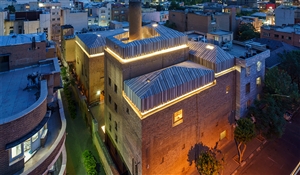
Argo Factory is central to this story. Its transformation from abandoned beverage factory to museum of contemporary art has become a symbol of cultural regeneration in Tehran. But Phony Wars refuses to turn Argo into a mere backdrop. The building’s architecture, the courtyard, the basement, the brick hall, the cinematheque, the stairs, the chimney, the library, are used as collaborators. Each work is placed in a way that makes the architecture speak loudly; Nasreddin against concrete roofs, Tavakolian in the stark basement space, Ansarinia among bricks and a literal city window, Bennani in a small cinema, Beloufa and Imhof on a dramatic stair, Abu Hamdan on the ceiling, Aramesh under the smokestack, Madani and Godard in the overlook.
If we take Pejman’s notion of affinity seriously, the exhibition is less about unity than about coexistence in difference. The artists do not line up neatly, but what binds them is an insistence on the instability of images and the necessity of attending to that instability, in bodies, in cities, in skies, and in archives.
As an anniversary exhibition, Phony Wars refuses the temptation of closure. It presents the Pejman Foundation not as an institution that has “arrived” at a fixed identity, but as a site still under construction, structurally, conceptually, politically. In that sense, it is remarkably faithful to Godard’s own understanding of cinema. That is, not as an industry of finished products, but as a continuous construction site where thinking and making are never really done.
One leaves Argo much as one entered, back in the courtyard, under the faceted concrete roof, with Nasreddin still facing backwards on his spring-mounted donkey. The joke now lands differently. After moving through basements and chimneys, skies and screens, you realize that riding backwards into the future is not just a playful gesture, it is a deliberate approach. Phony Wars proposes that the only honest way to inhabit this moment, politically, aesthetically, and institutionally, is to keep looking back and forward at once, refusing to resolve the dissonances, and letting the gaps between artist and visitor, between ‘you’ and ‘me,’ become spaces where dialogue can actually form.

12 Jun 2022
Argo Factory and Two Other Iranian Projects in the Aga Khan Award for Architecture 2022 Shortlist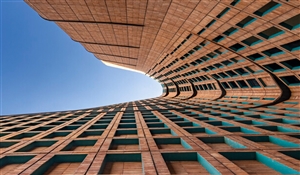
08 Aug 2022
Argo Factory on the Dezeen Awards 2022 Architecture List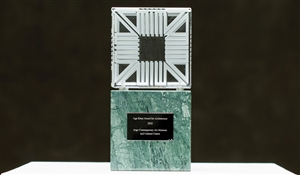 News-Argo factory wins AGA KHAN ARCHITECTURE AWARDS
