

Ehsan Barabadi
22 May - 2 Jun, 2026

Statement:
Ehsan Barabadi’s works are, at first encounter, striking both formally and conceptually. Yet this initial shock alone cannot account for their significance—or even their appeal—nor can it determine their quality.
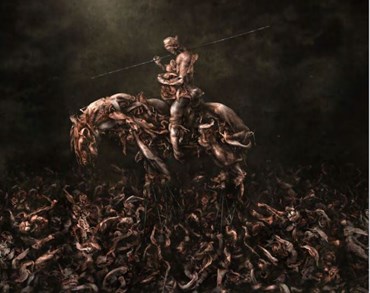
These photographed forms, meticulously and delicately assembled, are printed on a monumental scale that competes with the viewer’s own physical presence; in part, their impact derives precisely from this magnitude.
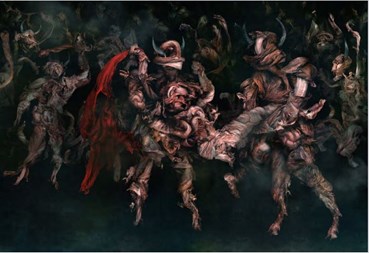
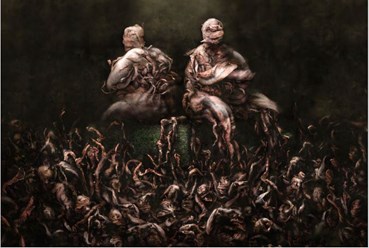
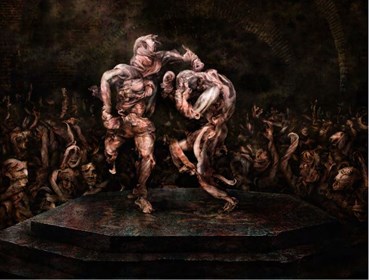
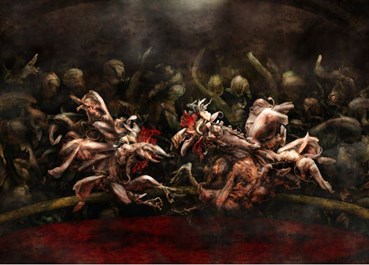
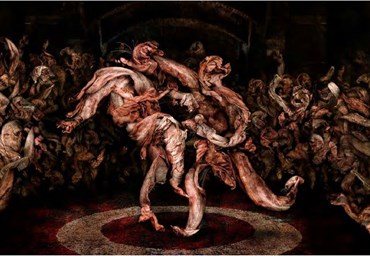
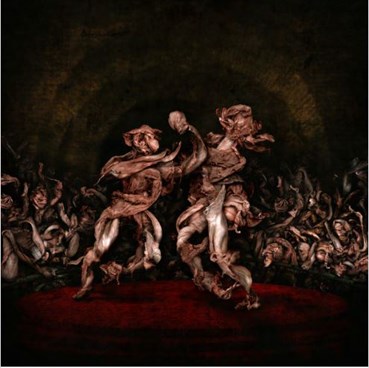
Ehsan begins his process by photographing withered and decaying plants. These photographic images are then placed within a digital environment before the artist’s creative gaze.
Through experimenting with them—shifting, recomposing, and constructing various digital collages via photomontage—a human-like or animal-like form suddenly captures his attention. ///
This moment marks the beginning, or more precisely, the germ from which, through repeated trial and exploration, the final composition gradually emerges in the artist’s vision and takes shape in the digital realm.
The final stage of this process is the high-quality, large-scale printing of the resulting digital image.
Once the initial shock of encountering the work subsides, Ehsan’s monumental images may at times seem to echo the heroization and myth-making found in earlier traditions of art history.
However, a closer look—at the emergence of figures from within decaying vegetal forms—begins to unravel this conventional structure of heroization.
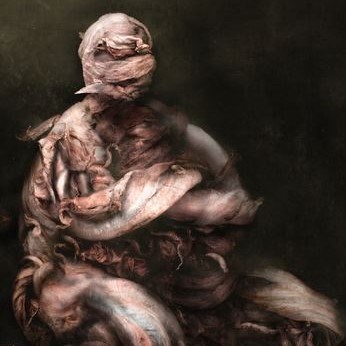
Humans that are not quite human, animals that are not quite animal, forms that hover at the threshold of being or not being human or animal—these now come into view.
In these works, human and animal forms take shape from plant matter—plants that resemble flesh and skin, internal organs, stretched or compressed muscles; raised hands in a silent scream; faces contorted by pain, anger, or helplessness.
On closer inspection, they may even resemble crumpled paper or worn fabric.
This oscillation—this dwelling in a liminal space shaped by the memory of perception—is a defining quality of the entire series Survival – Day of Judgment, intensifying its unsettling force.
The word “judgment” in the title may initially suggest an apocalyptic “day,” yet it can also be understood as referring to the viewer being called to judge.
In confronting the work and what we perceive within it, can we truly distinguish between decayed plant matter, animal flesh, or the textures of inanimate objects? Can we isolate just one of these in the images before us, or does our visual memory leave us suspended among them, unable—or unwilling—to pass judgment?
Ehsan’s works draw upon the forms and narratives of Western mythologies while simultaneously eroding them from within.
This dissolution opens up the possibility for new, contemporary meanings to arise in the mind of today’s viewer—meanings rooted in lived experience and shaped by the social contexts where the viewer lives.
The metaphorical ambiguity of these works introduces another dimension of liminality: they seem to belong neither to here and now nor to distant past, but remain suspended in time and space, oscillating between endurance and collapse.
Ehsan links artistic creation to the natural cycle of life, death, and rebirth. The plants that wither and decay, before returning to the soil, become the material for forms that themselves stand before our gaze at the threshold between life and death, transformation and becoming.
Yet the return of decayed plants to the soil is not their final fate; over time, they become part of the earth that nourishes the roots and seeds of other plants. This is a return to life—and the cycle continues.
—Parisa Hakim Javadi
In this show
Ehsan Barabadi
Ehsan Barabadi
Ehsan Barabadi
Ehsan Barabadi
Ehsan Barabadi
Ehsan Barabadi