





Two Solo Shows by Bita Razavi in Vienna and Kerman
04 Jul 2022Hinterland Galerie in Vienna will host an exhibition by Bita Razavi titled "Erased Images of a Work About Historical Erasure" from July 7 to 30, 2022. This is the censored part of a detailed installation by Razavi, the representative of Estonia in the 59th edition of the Venice Biennale. The show will also be held for one week in a gallery in Kerman, Iran, starting from July 15.
The show consists of a series of archive photographs that are documents of ruined natural landscapes of the Dutch East Indies, one of the most important areas colonized by the Dutch empire. After the Second World War, the Dutch East Indies declared independence and was then called Indonesia. The photographs display the workers' living conditions and the plunder and wasteful extraction of the natural resources in the area. These photographs are, in fact, the main part of a kinetic sculpture titled "Kratt: Diabolo No. 3," which was supposed to be exhibited at the Estonian Pavilion in the Venice Biennale 2022. However, the photos were removed from the show because of the curator's influence and insistence.
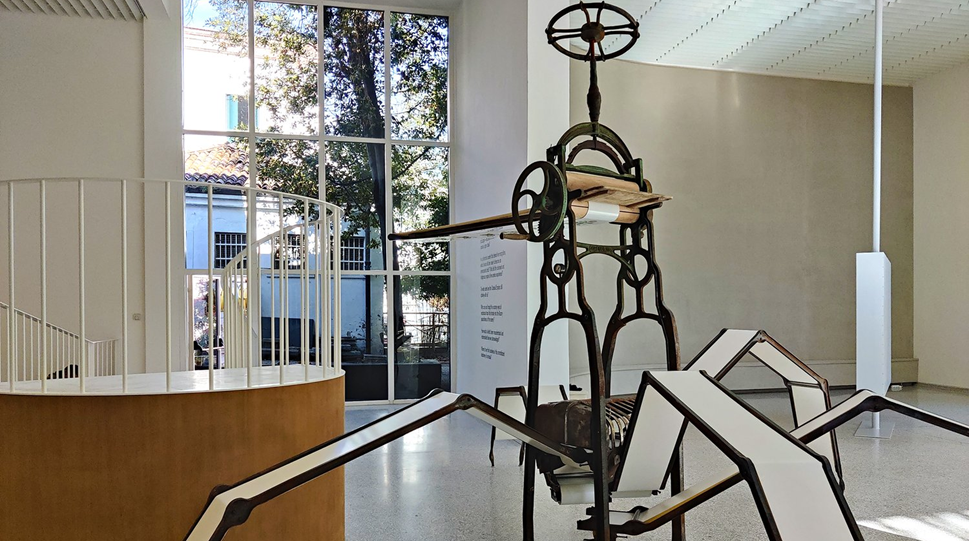
With its spider-like design, the kinetic sculpture is made up of metals, electrical motors, patterns of various plant species, and archive photographs printed on white strips. The sculpture produces pictures by moving its inner parts. The basic idea of this installation is derived from Estonian folklore, in which a mythical creature called Kratt is created by its master with dry grass or old home furniture. According to fiction, the master had to endow the devil with three drops of blood to take full control of the creature.
By rotating its top rollers, the machine reproduces images of paintings by Emilie Rosalie Saal, the Estonian painter who painted tropical plants growing in the colonized territory. These images are then placed on the white strips to erase the history, just as Emilie painted the plants on a white background to detach them from their colonized context. The machine represents a servant working for a servant, based on Emilie's attitude toward Indonesian women workers who worked at her house. These beautiful images, produced by the central printers of the machine, refer to the technological advancement background of modern printing and also prints by Andres Saal, the Estonian writer and photographer who directed the photography division of the Dutch colonizing army for many years. By creating images of plants, maps, and information related to the colonized area, the artist has clarified the colonizer countries' approach for a broader audience.
The installation is designed in a way that it would be difficult for the viewers to see images of plants from below. Instead, they can see pictures passing through rollers like spider's legs. So the legs spin a web of archive photographs to document the colonized landscapes. In fact, in this show, Razavi tries to present another narrative about this colonial history to challenge the European narratives, some aspects of which are concealed while others are highlighted.
Bita Razavi (b. 1983, Tehran) is an interdisciplinary artist living and working in Helsinki, Finland, and Mõhu, Estonia. The main elements of her works include sociopolitical criticizing, collective-cultural memory, reflections and observations on daily life conditions, especially in regions from which her subjects originate.
Source:
- www.bitarazavi.com
Slider and cover image:
- Installation views of the censored work at the Estonian Pavilion | 59th Venice Biennale | Photos by David Koza

03 Oct 2021
Two Iranian Artists at Greater New York 2021
20 Apr 2022
Iranian Artists at Venice Biennial 2022
07 Jun 2022
Meysam Hamrang and Sina Shiri at the Exhibition of Street Photographers in Paris