

7 Aug - 1 Sep, 2026

Statement:
By choosing “Lifelessness” (Hour Gallery, 2026) as the title of his latest collection of painting, he ignites the spark of an unanswerable question in the minds of his viewers: “How are we afflicted with lifelessness when everything around us is so volatile, precarious, confused, and on the verge of explosion?”
In other words, can what we are going through be called “lifelessness”? It’s true that as human beings we have one foot in the cold world of melancholy and, depending on the scale (going through change, being torn from a womb, having fallen from heaven, and being cut from umbilical cord of nature itself) of our encounter with “reality”, we have to grapple with despair throughout our lives, but “lifelessness” is the last word I use to describe the molten state of affairs in our country and our world.
No doubt one reason for choosing the title was the painter’s choice of “still life” as the medium of expression. Calling his collection “Lifelessness”, however, tells me more about the artist’s relationship to his time and age more than anything else. ///
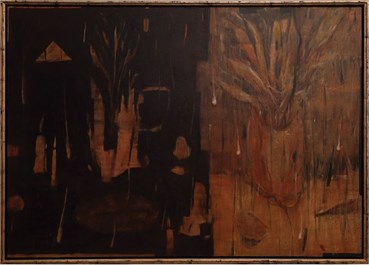
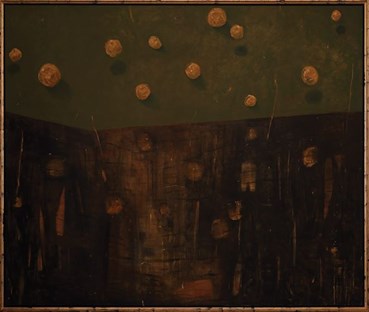
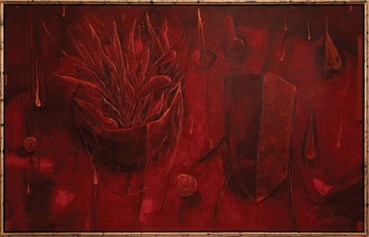
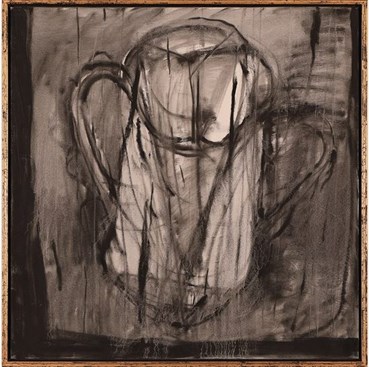
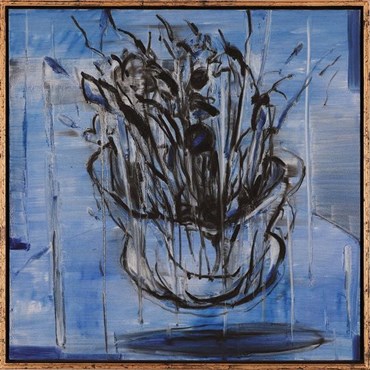
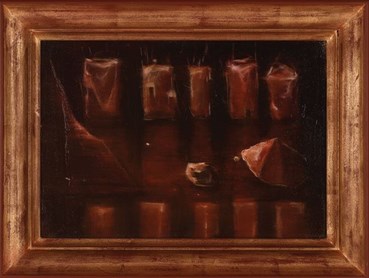
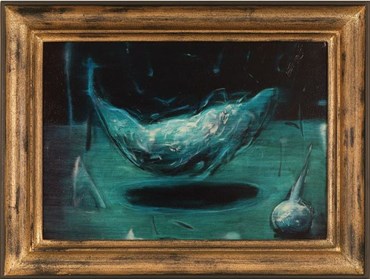
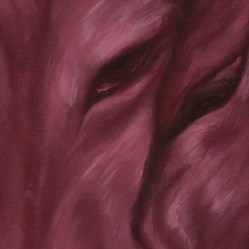
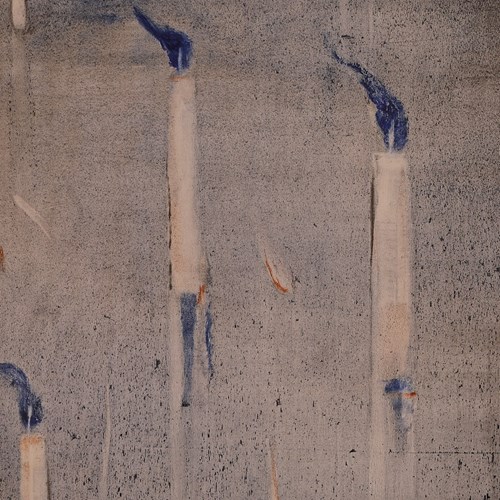
When I look at the canvases of this collection, I see no sign of lifelessness in any of them! Two dominant reds that strike a thunderbolt, candles whose flames dance, a vimba vimba fish suspended in midair, busts that take a free fall with pride before my eyes, all indicate an abundance of life force.
The names of each canvas (“Once upon a time under the sun,” “Vimba Vimba,” “Happy Christmas, Mr. Dali,” “My Name Is Red,” and “Good Night Ashkan) appear to be chapters from a novel in which I find herself.
In “Freedom” (Dastan Gallery, 2021), in the interaction between brush and canvas, he was trying to go beyond a painterly “essence” to a painterly “act” whereby he could arrive at the contentious kernel of freedom – he saw freedom as a battle within the conflicting forces at work in the world.
In “Lifelessness” he decides (even before choosing a name for it) to avoid picking a subject matter altogether.
He asks, “Why can’t society reach the objectives that it has set itself and pursues with earnestness?” He shuns a subject matter to avoid any disappointed when he is incapable of bringing it out to the light of day.
He wants to cut any attachments that hope for a result engenders, for hope is sister to fear.
He thus chooses a genre of painting that painters go to for ground, for balance, and empowerment beyond existential cogitations, as if he wants to return to the most basic relationship of the eye with the outside world, with the relativity of things, with emotional expression unsullied by concepts.
He wants these canvases to be girded by a frame with which he can guide the way his viewers behold the subject.
The frame that he picks encourages “observation” (rather than engrossment), in touch with waves created by a direct confrontation but not swayed by them.
When the dates and venue for his show are set and he has to choose a title, what keeps suggesting itself to him in a refrain is “Lifelessness.” When names come, concepts follow – “objects” become conceptually tied – exactly what he initially set out to avoid. “Lifelessness” becomes an organizing agent of meaning.
This collection, then, turns into a tribute to all those lifeless souls, the ones who lost their lives in political strife, those that mourn their dead, those besotted by quite desperation.
It is exactly at this time that one of the most influential painters of his life, Ahmad Amin Nazar, is belatedly found dead in his house in March 2026.
There may be a huge or tiny chasm between what he wants to suggest to us in “Lifelessness” and how we interpret these painting, for we live in the time of parallel universes.
Straightforward principles have lost their simple measures to complexity.
In “Lifelessness,” Aydin Xankeshipour makes this cognitive dissonance, this evaluative discombobulation, the material for his aesthetics.
Forms and colors strive for the stability of still life painting, suppress their objective essence, for the lifeless to become animated and for the animated to become lifeless again.
Sohrab Mahdavi | June 2026