

28 Feb - 22 Apr, 2025
Statement:
Illusion, Imagination, Surrealism
Surrealism, or the pursuit of the surreal, is an artistic movement aimed at embodying higher truths and a reality beyond the material world, emerging through the mind and spirit.
Its roots trace back to the intellectual landscape of 1920s France, and it remains an enduring concept in visual arts. ///
However, it would be misleading to suggest that surrealism suddenly emerged after World War I.
In fact, from the earliest times of human creativity, art has always contained an element of the strange, inviting viewers into a world of fantasy.
This enigmatic quality lies deep in the subconscious and creative mind, where the boundaries between reality and fantasy, truth and dream, are indistinguishable. In this realm, the mind gives form to desires, hopes, fears, and dreams, preserving them in poetic words, colors, lines, and other enduring forms.
Thus, dreamlike imagination has roots as ancient as humanity itself, and one can trace this visionary thought through works preserved through history.
The connection between this imaginative thought and the mind, further explored by psychology and notable thinkers such as Freud, has deepened over time, fueling artistic questioning and inquiry.
In 1924, André Breton, the founder of surrealism, declared that in the creation of art, the artist’s mind must be freed from the constraints of logic and morality, for only through this liberation can the imagination reach its full potential and reveal its true power.
Breton defined surrealism as "pure psychic automatism, by which we express, either verbally or in writing, or in any other form, the real process of thought, free from the control of reason and from any aesthetic or moral preconception.
Surrealism seeks to turn the previously imagined contradiction between dream and reality into an absolute reality, a new level of existence beyond the tangible."
Thus, surrealism was built on the freedom of imagination, dream, illusion, and fantasy, enabling the artist to access a hidden truth that lies beyond the material world.
Dream and everything that fuels it—intuition, sleep—became essential sources of inspiration. Breton defined two principles for creating surrealistic art: The fusion of strange, unrelated, and irrational elements in an unfamiliar environment; Automatism or the free flow of unconscious mental images, liberated from the control of reason, during the act of creation.
This led to two distinct methods in surrealist painting: one, a form of realism (verism) that depicted a chaotic, dreamlike world by placing unrelated phenomena together in an imaginative, surreal manner; and the other, focused on technical innovation, blending lines and colors in a way that reflected the inner impulses of the artist, resulting in representations of their mental images.
In both cases, the aim was to create a new reality by blending rational and irrational elements, producing visions that reflected a dreamlike state and visual associations.
Though surrealism gradually gave way to other movements in the course of art history, its approach to artistic expression and conceptualization has remained influential.
In particular, the integration of surrealist thought into Iranian modern and contemporary art is visible today.
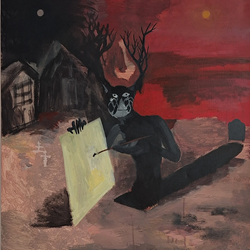
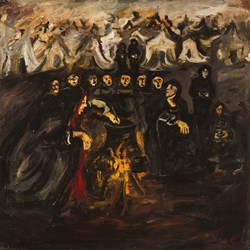
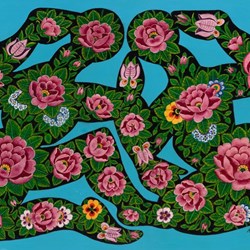
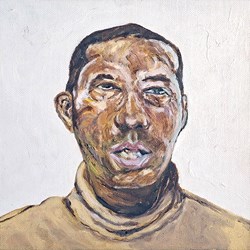
Iranian artists have embraced surrealism and combined it with Eastern imagination, creating unique stylistic approaches, many of which are on display in this exhibition.
For the Iranian artist who lives in a land rich in history, the realm of dreams and fantasy has always been intertwined with historical consciousness, producing a hybrid and enigmatic quality.
Often, these dreams are tied to a glorious past, evoking a sense of nostalgic longing, as artists search for lost identities. At other times, these fantasies propel the mind into the future, representing the collective hopes and fears of a nation shaped by the labyrinth of history.
The form of artistic expression has no boundaries; depending on the artist's mindset, it spans from realism to abstraction, unrestricted by any style or norm.
In this exhibition, these diverse perspectives are brought to life.
Some artists, such as Ali Akbar Sadeghi, remain faithful to the core principles of surrealism, assembling disparate objects to form strange worlds that carry traces of ancient Iranian culture.
Others, such as Vahid Khakdan, transport the mind to a forgotten past, weaving nostalgic memories from discarded objects in old rooms. Iran Darroudi, for example, uses mythological symbols to display collective fears, regrets, and hopes, while Meghdad Lorpour and Hamed Sahebi portray dreamlike depictions of nature.
Artists like Aydin Aghdashloo, Vahid Chamani, and Hamid Arabi explore the reconstruction of lost identities through their re-imagined historical figures, while Afshin Pirhashemi, Mehrdad Mohebali, and Alireza Fani look toward the future, blending faces and figures to portray both hope and anxiety.
Nosratollah Moslemian, Ali Nassir, and Yousha Bashir take the form to the brink of abstraction, using lines and colors inspired by internal motivations to create surreal spaces. Arsia Moghaddam, drawing from expressionism, uses it to convey the global reality of the mind.
To express this collective dream, as seen with Bahman Dadkhah, Fatemeh Emadiyan, Behrooz Darash, Amir Masoud Akhavan Jam, and Kambiz Sabri, it is sometimes the form of sculpture that becomes the vehicle.
In all of these works, the collective experiences of the people, their past, and the memories embedded in the collective consciousness of this land are brought forth, often depicted in faces, through the interplay of lines and colors, and in symbolic language.
What is presented at Mellal Gallery is the result of the collective memories of a past nation and the collective dreams of a future people—those who live today in this land, striving to find truth in the surreal and to preserve its meaning for future generations through art.
Somayeh Ramezanmahi
Artists
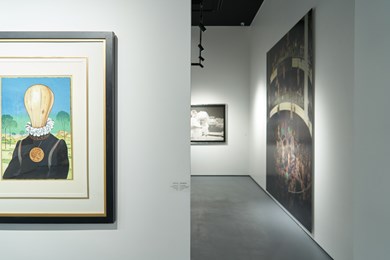
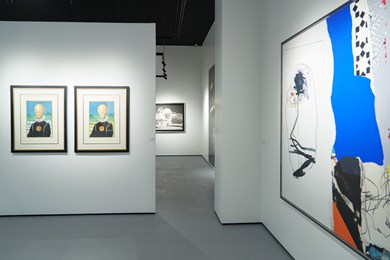
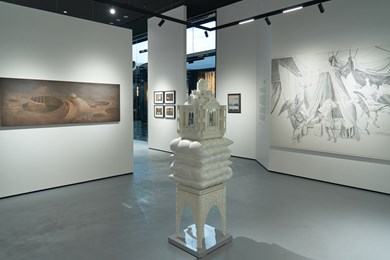
Installation view