

20 days to the ending
21 Aug - 11 Sep, 2026

Statement:
One of the most prolific and conceptually fluid artists of his generation, Mohammad Fassounaki (b. 1943) grew up in a well-established family in Tabriz and began his artistic education with music.
He first began his studies at Tabriz Music Conservatory, but while music has remained one of his most beloved mediums, he soon shifted his studies to visual arts. Leaving the conservatory, he was admitted into the Mirak Fine Art School where he studied until 1965.
After graduating, Fassounaki decided to move to Europe to continue his studies. He arrived in Germany in 1967, when he was still in his twenties at a moment when student movements and political unrest were transforming European cultural life.
For him, Europe offered an encounter with modern art, but also a new sense of freedom within.///
He studied painting at the Städelschule in Frankfurt, before moving to Italy to continue his education at the Accademia di Belle Arti in Rome. There, Fassounaki started a series of fresh explorations in different mediums, including printing and sculpture.
These led to a deeper fascination with sculpture-making, inspiring him to enroll in the sculpture program at the Academy after his graduation in painting.
In 1974, Fassounaki returned to Tabriz and began teaching at Mirak, the school where he had once studied. His students gradually became part of the history of his work. The studio became part of the way his work was transmitted.
Following the 1979 Revolution and the breakout of the Iran-Iraq War, Fassounaki moved away from teaching at Mirak and resigned in 1981. In 1984 he left again for Berlin. But Fassounaki’s movements between Iran and Europe never produced a clean break.
He returned, and Tabriz remained the place to which his work repeatedly led him back. It was also the place from which many of his images and inspirations seem to come.
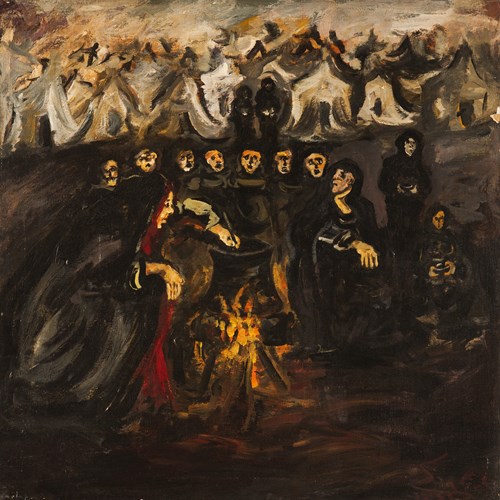
His paintings are full of people he appears to have carried with him. Faces occur everywhere, sometimes singly, sometimes in groups, sometimes almost hidden inside the paint.
They do not resemble portraits in the conventional sense. He is interested in the people he encounters, but not necessarily in recording their exact appearance.
A face might remain in his memory as an arrangement of eyes, a particular expression, the shape of a head, the color of a coat. When it reaches the canvas, it has already passed through memory.
This is why the people in his paintings can look familiar without being identifiable.
Now in his eighties, Fassounaki has remained as prolific as ever, continuing to work on his paintings and sculptures and exhibiting his work. His work does not resolve his different experiences into a single conclusion.
Memory, observation, material and lived experience remain entangled. Fassounaki does not elaborate or explain; he remembers, creates, and exposes.