

12 Jun - 10 Jul, 2026
Statement:
In Rotanomicon, two artists from a generation shaped both by Iran’s cultural memory and by global digital culture build a world in which war, faith, and image are in constant circulation.
Abolfazl Harouni, drawing on Persian miniature painting, geometry, and manuscript design, is placed alongside Parham Ghalamdar, an artist whose path began with graffiti and led to painting, AI image-making, and experimental cinema.
This collaboration maps a territory where the battlefield is no longer a place, but a cycle: a system of signs that reproduces itself.
The logic of the exhibition is fed by Reza Negarestani’s Cyclonopedia, the spatial memory of the de_dust2 map in Counter-Strike 1.6, aerial warfare, and fake digital content. War here is not an event. It is a self-rotating apparatus.
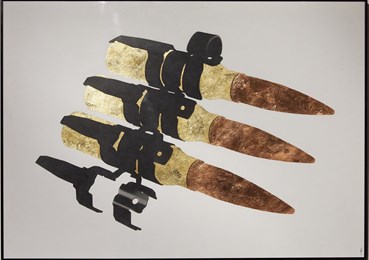
Dust, rather than being mere ground or background, becomes the main material. Weapons appear as signs and diagrams. Victory, defeat, and aim have ceased to function. What remains is repetition: a form that turns, pauses, and returns again.
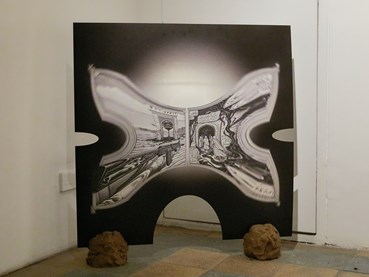
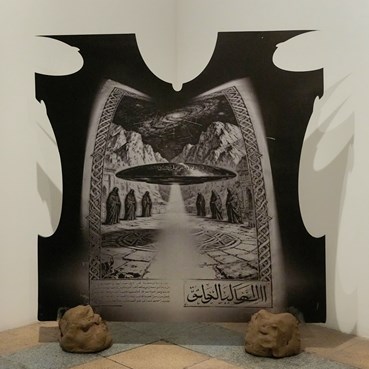
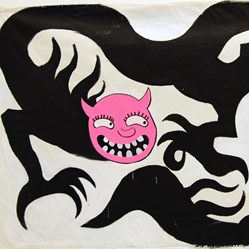
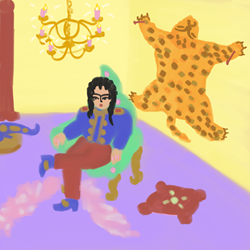
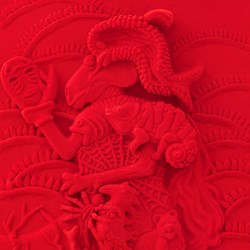
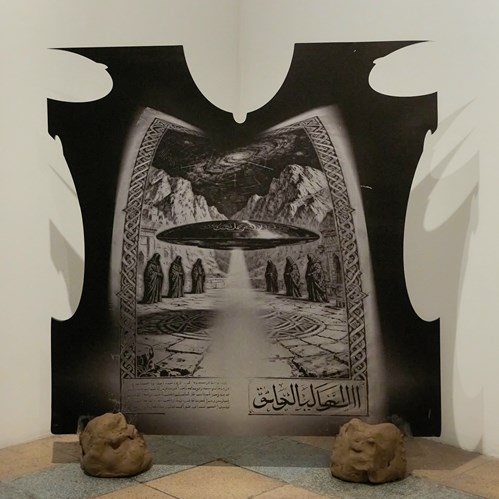
The works in the exhibition move between manuscript and simulation. Decorative frames and the logic of traditional image-making sit alongside aluminium prints, silkscreen, stencil, sculptural pieces, and AI-generated images. ///
This encounter does not turn past and future into two separate poles. It places them within a shared field: a field in which the image no longer merely records violence, but takes part in its function.
Reza Negarestani’s text, The Sun of God, the Sun of the Desert, opens this field through the sun and the desert. In this text, the sun is not only a symbol of light. It is a regime of seeing: a force that reveals and burns, that witnesses and erases.
The desert, too, is neither empty space nor poetic background. It is a deep object: a simple surface that hides within itself techniques of survival, navigation, burial, erosion, memory, and reconstruction.
Seen from this angle, Rotanomicon is not about war in the usual sense. It is about the conditions in which war becomes image, game, faith, archive, and ritual.
The battlefield in this exhibition is not only soil and border, but time, repetition, waiting, and permanent readiness. The map may not change, yet the system keeps working.
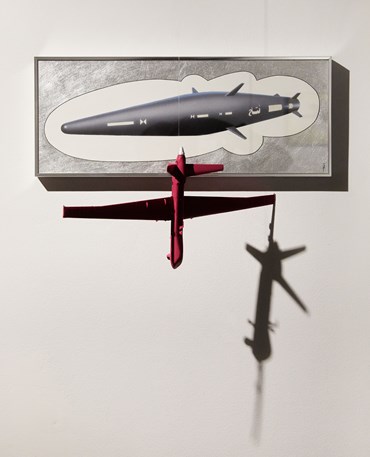
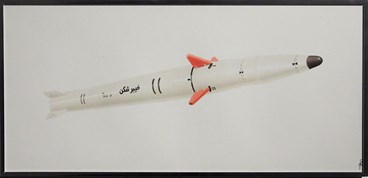
In this exhibition, Harouni uses a precise and compressed language of drawing, together with Iranian visual traditions, to reconstruct weapons and space as cold, ritual objects.
In his work, missile, frame, and ornament move close to one another. The tool of war moves away from its direct function and becomes a sign of power, order, and display.
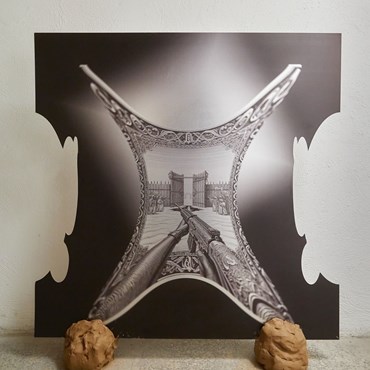
Ghalamdar, from another direction, brings the logic of artificial images and game space into the field. His aluminium panels and looped video show a world in which the first-person gaze, military architecture, the game map, and manuscript-like imagery collapse into one another.
His works deal with the digital memory of war: the moment when the image no longer lags behind reality, but rehearses it in advance.
Together, Harouni and Ghalamdar’s works form an exhibition about the endless circulation of signs. The sun and the screen can both blind. The desert and the archive can both bury. War and image can both keep themselves alive through repetition.
Rotanomicon asks whether art can disrupt this cycle, or whether we too are part of the same system that keeps turning.
Artists