

Ebrahim Barfarazi
12 Jun - 3 Jul, 2026

Statement:
Before Identity: Humanity in Waiting
Look into the mirror and into the water, for there is no savior but ... you.
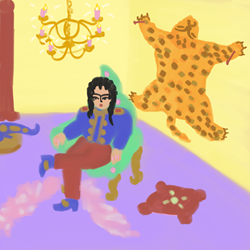
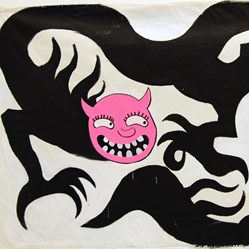
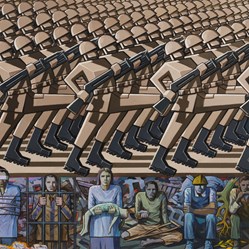
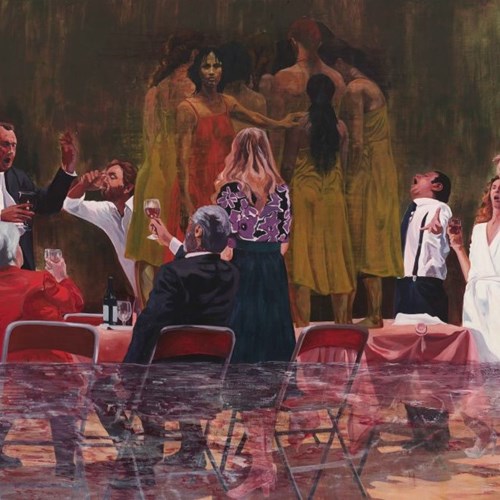
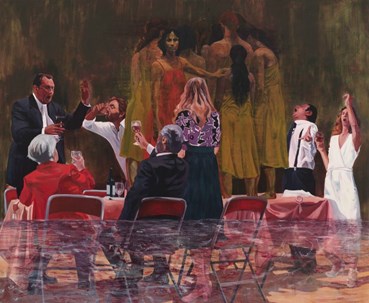
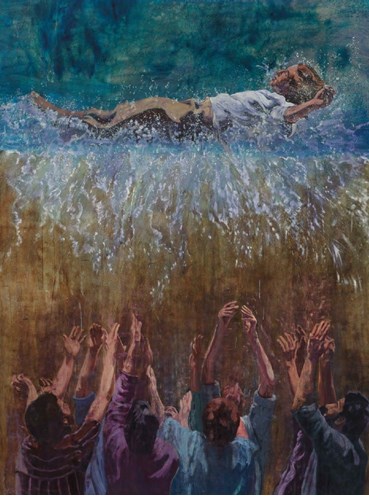
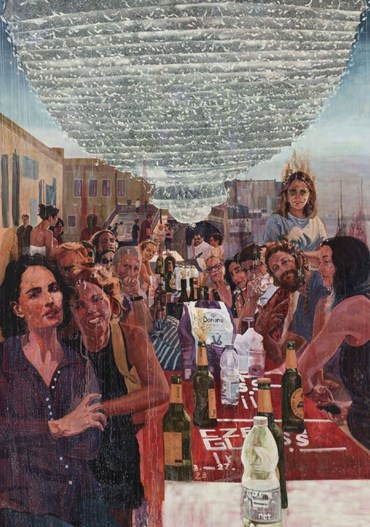
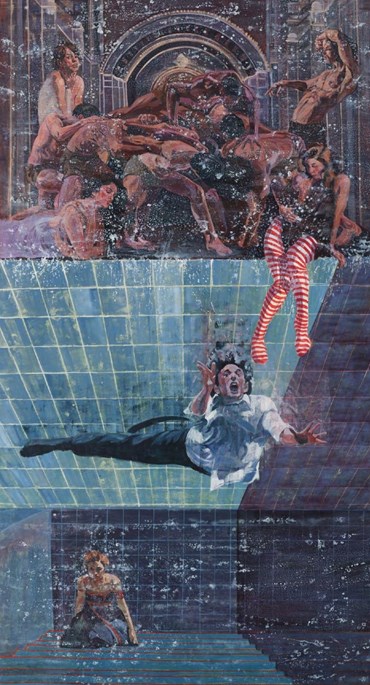
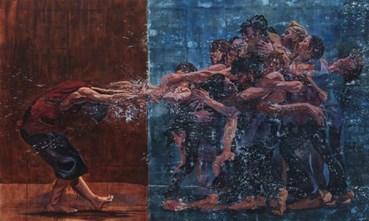
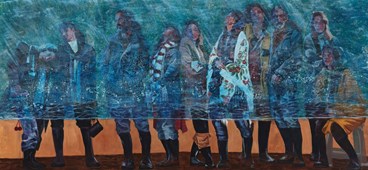
In his second solo exhibition at Iranshahr Gallery, and in continuation of his previous bodies of work, Ebrahim Barfarazi places the human body and the emotions manifested within it at the center of his gaze.
He began working on this series in 2024, shortly before his first solo exhibition at Iranshahr Gallery.
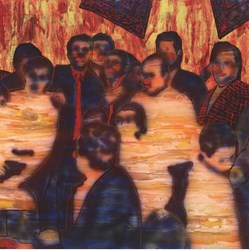
Films, theatrical productions, and dance performances serve as Barfarazi’s visual sources for the compositions of his paintings. The connection thus established between painting—as a motionless image—and moving images in other media is complex and worthy of close attention.
Part of the narrative quality through which these works engage the viewer emerges precisely through this connection to moving images, both formally and in terms of the emotions they evoke and the affects they produce.
A significant dimension of Barfarazi’s practice revolves around affect—a concept that emerged in psychology during the second half of the twentieth century, later entered the field of cultural studies, and was subsequently employed in discussions of how works of art exert their impact. ///
Unlike emotion, which is produced and experienced at both personal and social levels, affect refers to a pre-personal emergence: the unconscious experience of intensity.
This pre-personal quality grants affect a collective and shared dimension, freeing it from the complications associated with identity.
Why, then, is this concept particularly useful for understanding Barfarazi’s paintings? In his work, he seeks to avoid those visual features that would confer a distinct and readily identifiable identity upon either the figures or the pictorial space.
His ambition is to offer a painterly representation of humanity beyond the constraints, boundaries, and distinctions through which identity is defined. By returning to a stage prior to the establishment of such divisions, Barfarazi foregrounds the human condition itself at a visual level.
From this perspective, approaching the works through the lens of affect—which likewise regards viewers as fundamentally human rather than as bearers of specific identities—resonates with the manner in which humanity is represented in these paintings.
Viewing Barfarazi’s paintings through this framework shifts attention more evenly between the work itself and the viewer’s response to it, drawing focus toward non-cognitive modes of experiencing art. Such modes were largely marginalized in the wake of conceptual art and the analytical approaches developed around it.
Their marginalization was also a consequence of efforts to interpret artworks primarily through their relationship to the socio-political contexts in which they were produced.
Yet perhaps, in the specific case of the works comprising Godot Will Never Come…, it is possible to think these two modes of reading together: on the one hand, the works’ affective impact on viewers through their cinematic rendering of bodies; on the other, the fact that they emerged from a moment in Iran and the wider world marked by emotional turbulence, when unfolding events—and their consequences—were actively reshaping our collective psyche.
Such an interpretation is not necessarily the correct one, but it is one that has the capacity to expand and enrich our engagement with contemporary painting.
This reading may not prioritize what the artist—and perhaps the viewer as well—considers the central content of the works, a content already reflected in the title of the exhibition. Here, the artist’s own account may be more direct: these paintings depict the futility of waiting for a savior.
Human beings are compelled to create meaning in the face of life’s absurdity and, through this act of meaning-making, to see and be seen. Perhaps, as the poet Forough Farrokhzad once wrote, the savior lies asleep in the grave.
—Parisa Hakim Javadi
In this show
Ebrahim Barfarazi
Ebrahim Barfarazi
Ebrahim Barfarazi
Ebrahim Barfarazi
Ebrahim Barfarazi
Ebrahim Barfarazi