
Loading magazine…
Loading magazine…
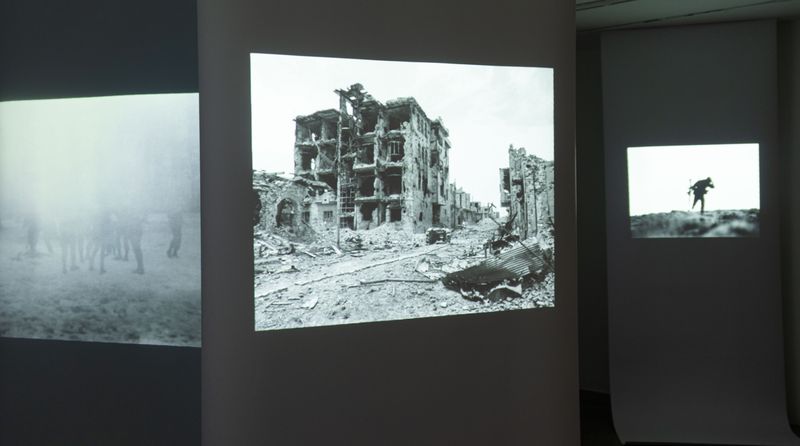
Sam Keshmiri: That was exactly the central point. One of the main impulses behind organizing this exhibition was the selective behavior we observed among people around us, on different levels, both socially and politically. Something as seemingly straightforward as war is, of course, a horrifying phenomenon, with consequences ranging from loss of life to serious environmental damage. Yet it seems to have either been forgotten or approached in an entirely different way. Our society experienced such a war less than half a century ago. Even today, the physical traces of that earlier war remain visible in some Iranian cities. The effects of the Iran-Iraq War on the physical and psychological health of certain communities, as well as on the natural environment in parts of Iran, are still evident. What is astonishing is that we sometimes approach that war as though it happened centuries ago and has already been forgotten. Or we respond to it in ways that seem incompatible with something defined by destruction and devastation. It is almost as though something has interfered with the mind's process of evaluating these events. An unnatural intervention has taken place, and the conclusion no longer seems to follow logically from the event itself. Something has disrupted the process. This reminded me of the procedure of lobotomy, which has long since been abandoned. In that procedure, parts of the brain were severed or altered in a way that could leave a person emotionally detached from their surroundings. Their responses to what was happening around them could become profoundly indifferent, almost zombie-like. For us, it seemed that some kind of unnatural intervention had taken place, as though something had been removed from the normal process of forming conclusions. Either people had become indifferent, or their conclusions no longer corresponded to the circumstances.
Maryam Takhtkeshian: When I first heard the title Selective Lobotomy, I was particularly drawn to the word 'selective.' The idea of lobotomy already involves a process in which something is deliberately removed or disrupted. Placing the word 'selective' beside it creates a very interesting play on words. If I relate this to my own work, and more broadly to war, it becomes meaningful to me in another way as well. It is almost as though we photographers are constantly trying to respond to the circumstances around us in order to keep memory alive.
Alborz Kazemi: The issue is partly the medium itself. There is an important aspect of documentary photography that is gradually being forgotten, and this exhibition in some ways reinforces it: photography produces our historical visual memory. Even if we do not actively study history, documentary photographs allow us to compare the visual conversations that have developed from one decade to another. The problem begins when media becomes monopolized. Selective forgetting occurs when we follow the news through only one source and begin to believe that the truth is contained entirely within a single headline or narrative. To some extent, this exhibition attempts to break that monopoly of narrative. It tries to say that what is being simplified so dramatically is actually an extremely significant phenomenon.War, death, and destruction have been simplified and even aestheticized or turned into fantasy to such an extent that they begin to erase history. Even unintentionally, through our own behavior, we contribute to reducing these events to something superficial.
Alborz Kazemi: Personally, I do not believe that photography is simply a representation of reality. But photography can give you an atmosphere. It can communicate a mood, or offer an archival way of looking.
Even within documentary photography, from Robert Capa to many Iranian photographers, there have been forms of deception, instances in which staged photographs have been presented as reality. That problem exists within photography, but it does not mean that we cannot look carefully at photographs. In fact, we have to move beyond the event itself and begin looking at the objects within the photograph, the particular moment, the appearance of the people, or even the writing on the walls. All of these elements become things we can return to and examine.
Maryam: To continue Alborz's point, one of the interesting things about photography, and particularly about this exhibition, is that we are not only looking at news photographs. War is not limited to news photography. What interests me as a photographer is the question of how I can photograph the effects of an event that has entered our everyday lives, something we are continuously struggling with. For me, that is one of the most compelling and also one of the most difficult aspects of documentary photography.
Alborz: Exactly. In fact, I prefer this approach to a purely photojournalistic one. I am more interested in photography that has a particular point of view, rather than an image that simply says, 'Look, a bomb exploded here.' What matters is what the photographer wants to show you from within that situation.
Maryam: Or what that bomb did to people's lives, or what kind of process that event initiated in the photographer's mind. For me, that is fundamental to photography. It is precisely where photography becomes art.
Sam: To continue what they are saying, I do not think truth is something fixed. No one can record history without their personal ideology entering into the process. Everyone records events through their own judgments, values, and criteria. I also think that an event does not end once it has been recorded. This is why I say that truth changes. The original moment no longer exists, but the recorded moment continues to live in different forms and gradually changes in character. One thing that interested all of us was what happens when these different moments of truth are placed beside one another. Does our understanding of one individual truth change when another truth is placed next to it? Do these different truths together begin to form a new truth, or a new narrative?
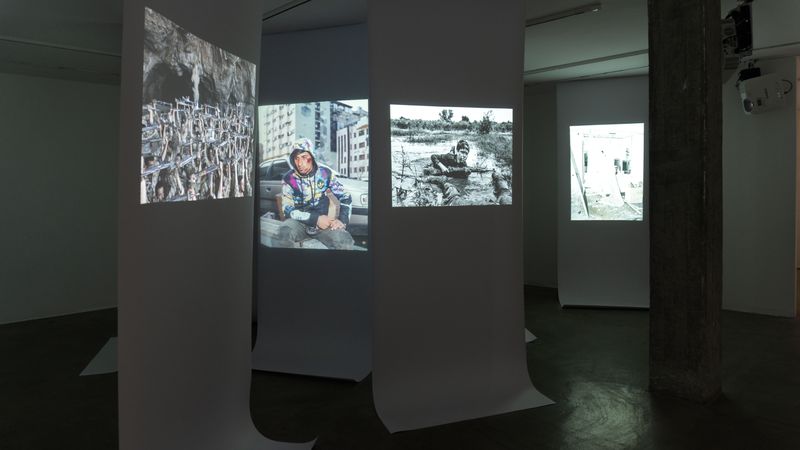
Sam: Before the exhibition, I had conversations with all of the participating artists, and different ideas emerged through those discussions. Although war is the central subject of the photographs, we tried to follow the different contexts affected by these events. We wanted to look at the people who existed between these two historical turning points rather than focusing only on the immediate moment of war. We were interested in the environments affected by these events, the people who lived within those environments both now and in the past, and even other living beings and the natural environments surrounding them. Essentially, we used these two wars as two points through which we could look at the lives and environments affected by them. We deliberately removed the exhibition statement and press release. We wanted to leave the process of interpretation to the audience. They could evaluate what they saw according to their own criteria. Our role was simply to place these images beside one another. Whatever conclusion the viewer reaches belongs to them.
Alborz: I would add something to what Sam said. As he mentioned, we removed the exhibition statement, but we also removed the artists' names. There was a deliberate effort to reduce explanatory information so that the works could establish a visual dialogue directly with the audience. The question for us was: separate from the identity of the person who made each photograph, how do the images themselves communicate with one another? That is why the names were removed from the equation. I think the particular format of the exhibition, including the use of slideshows, allowed us to reach a point where viewers were not constantly asking who had made each image. We are interested in experimenting with new forms of presentation, new structures, new spatial experiences, and unexpected ways of placing different artists' works beside one another. Everyone involved in this project, in one way or another, accepted the risk involved in that experiment.
Maryam: To continue Alborz's point, we also applied the idea of lobotomy to the artists themselves. In a sense, we began by removing part of their identity, and we realized that the exhibition actually worked better that way. The effect of the photograph became more important than the identity of the photographer. Of course the photographer matters, but perhaps not at that particular moment.
Sam: Some of the artists told us that we were giving the audience too little information. But I do not think the audience is ignorant, and I do not think everything needs to be explained to them. The viewer is part of the work. Without an audience, the work has a different meaning. Even though the artists' names were absent and there was no preliminary explanation, audiences were able to engage with the narrative we were trying to create. We wanted these works, when brought together, to become something new, almost a new entity or subject, and to acquire a new definition through their relationship with one another.
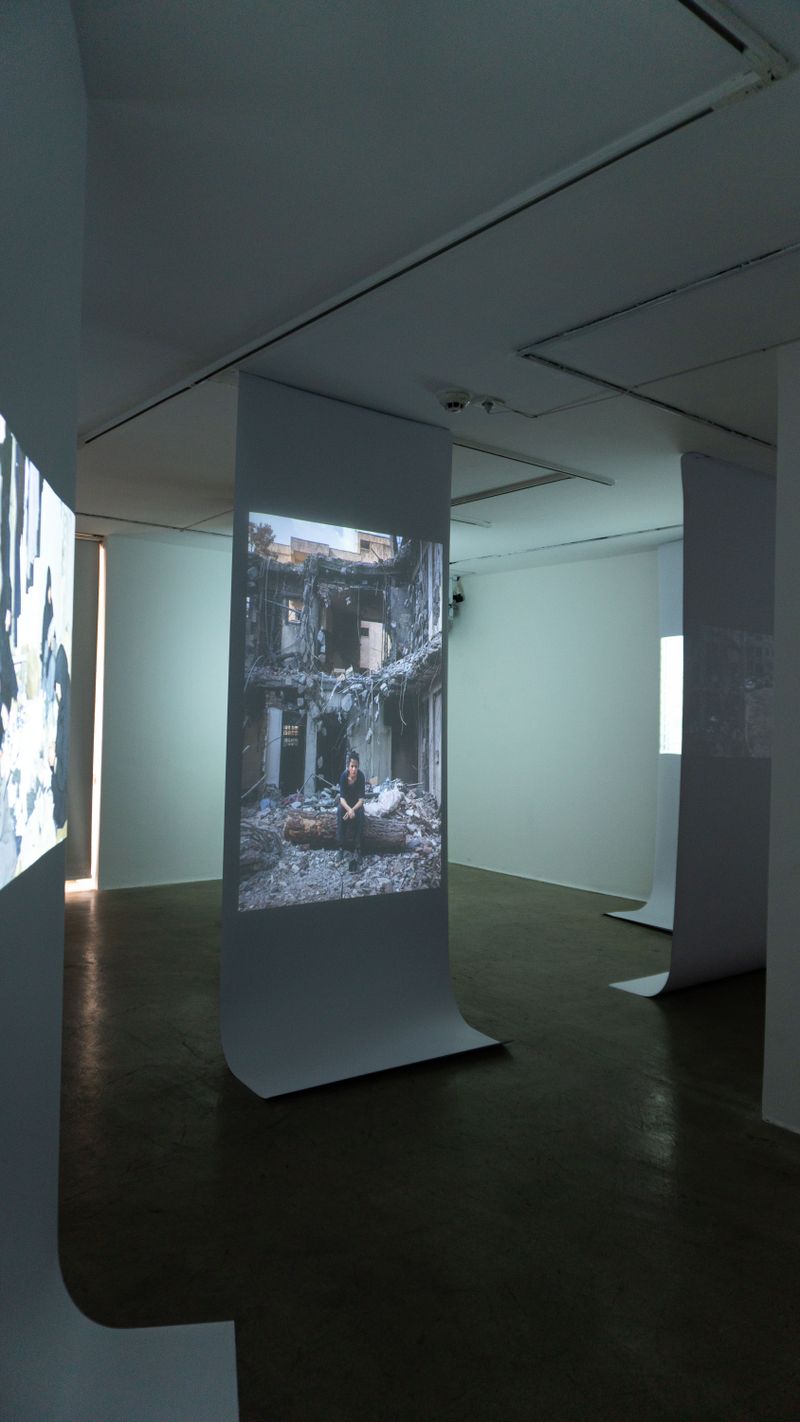
Maryam: Another important aspect is the installation itself, particularly the corridors created between the sheets of paper. They seem to invite the viewer to enter something. It is almost as though you are entering history, or entering the event itself. The installation draws you into the war and says: look, this is war. There is destruction, but life continues within it. Those entrances and passageways complete the narrative that Sam wanted to construct.
Sam: One visual aspect of the exhibition that interests me is the fact that the relationship between a concept and the way that concept is communicated to an audience has changed. The audience itself has changed. Because of the technologies and media people now encounter twenty-four hours a day, their patience and the ways in which they receive information have changed. That does not mean that a concept should completely adapt itself to its audience. But we have to recognize that today's audience is not the audience of twenty years ago. I think this transformation has also affected the way ideas are communicated through artworks. The relationship between the audience, the space in which an artwork is displayed, and the artwork itself has changed completely. That is why we turned the viewer into part of the work.
When viewers stand in front of the projected images and their shadows fall across the paper, they temporarily remove part of that truth. The viewer's presence, their shadow, then becomes part of the truth itself. The other truths continue around it, while the audience can intervene in them, alter them, and in some sense take possession of them. The material of the paper was chosen for a similar reason. As viewers walk between the hanging sheets, the air generated by their movement causes the paper to move. For us, the movement of the audience among these images became extremely important. In my view, this exhibition is almost meaningless without its audience.
Maryam: Another interesting point is that after you pass an image, you can still see its trace through the back of the paper. It creates the feeling that the photograph is still present even after you have physically moved beyond it. For me, that is where memory enters. When I see an image through the back of the paper, it feels almost exactly like seeing an image within my own memory.
Sam: When choosing the material, we noticed that the projected image appeared differently on the front and back of the paper. It is almost as though you encounter different versions of the same image simultaneously.
Alborz: The use of projection also refers back to something fundamental about photography itself. Photography is fundamentally light, both at the moment an image is made and when it is printed or presented. Presentation is particularly important to us. We know that contemporary audiences increasingly expect a spatial experience from an exhibition. Simply standing in front of an individual work is no longer always sufficient. So we used this particular possibility within photography as part of the exhibition. There were shadows that disrupted the act of seeing, and there was also the possibility of continuously transforming the image. For me, this became a model that could be developed further in future exhibitions.
Maryam: I think this relates directly to the way photography affects us. The question is what an event does to you, and how that experience changes the way you look at it. You are not only photographing the event itself. You are also photographing life as it continues within that event. It is almost as though you are placing a fragment of life into memory, something that allows anyone who later encounters the photograph to relate it back to their own life. Perhaps that is why viewers feel a certain familiarity with these images. We did not make the photographs luxurious or exotic. We tried to show reality.
Alborz: This exhibition is really only a drop in the ocean. The history of photography in Iran began perhaps ten or twenty years after the invention of the camera. In that sense, the history of photography in Iran developed almost alongside the history of photography internationally. Iran also has an extraordinarily rich visual memory and photographic record of its modern history. What we are presenting here is only a very small point within that much larger history. This kind of visual conversation can be traced throughout the entire history of Iranian photography.
Maryam: When a war takes place, photographers often feel that it is their responsibility to photograph it. As Iranian photographers, our own visual understanding was shaped partly through the photographs produced by the previous generation during the Iran-Iraq War. But today, we read the photographs of someone like Maryam Kazemi or Alfred Yaghobzadeh differently because we are now closer to an experience of war ourselves. Both we and the audience can enter each of these photographs individually and see aspects of ourselves and our own lives within them.
Sam: Something that was particularly interesting to me was the presence of Kaveh and Alborz, as father and son, within the same exhibition. The difference between their perspectives, and the fact that their works could be placed side by side, was fascinating.
Alborz: My father worked during what could be considered a golden period of documentary and war photography internationally. At that time, the photograph had a very different status. During my own lifetime and career, photography has changed dramatically. It shifted from analogue to digital, and shortly afterward it became something almost universally accessible. Gradually, we stopped understanding wars primarily through the cameras of famous photographers. For example, our visual memory of the Abu Ghraib photographs from the Iraq War comes partly from images made with an ordinary compact camera by a soldier. So the structure of the medium changed. The idea of the 'decisive moment' that Cartier-Bresson spoke about gradually began to lose some of its dominance. For that reason, the medium of photography itself became increasingly important for me and for the generations after me. Even among the generation immediately before mine, photographers such as Mehran Mohajer, Shahriar Tavakoli, and Farshid Azarang can be seen as figures who helped bridge this transformation in photographic language. I do not look at subjects in the same way my father does. My father may approach an image believing that the photograph should exist within a particular framework and that he has captured a certain truth. But for my generation, surrounded by artificial intelligence and social media, making certain kinds of photographs or photographic series no longer carries the same meaning. A series like Martin Parr's photographs of food, for instance, exists very differently today, when millions of people upload photographs of food to social media as part of everyday life.
We are therefore in a moment when the language of photography itself is changing. What becomes particularly visible in this exhibition is the tone of the younger photographers, whose work does not necessarily emphasize the decisive moment or the direct recording of an event. In that sense, we can see two different photographic approaches in the exhibition. I see myself and my father as representing two different approaches, and war has brought our works together within the same space.
Sam: Seeing these works together, and encountering their differences, is very interesting. You can observe shifts in photographic language and changes in photographic tools. You can also see how the relationship between the artist and the moment being recorded has transformed over time, and how systems of value and judgment have changed. And you can ask whether these photographs are actually in dialogue with one another, whether they reinforce one another or perhaps even challenge one another. Another interesting difference concerns the photographer's trajectory and process, something that is particularly visible in the work of someone like Alfred. For example, Alborz made one of his photographs from the rooftop of his home. That is a very different process from the path taken by Kaveh or Alfred in making their images.
Maryam: The painful difference is that Alfred went to the war in order to photograph it, whereas war came into our homes. In the past, a photographer might decide to travel to a war and photograph it. Today, we can photograph war at the end of our own street. Perhaps that is one reason why the younger generation's photography of war is more concerned with everyday life.
Sam: The smartphone has created the citizen journalist. As a result, the artist's relationship with the tools used to record events and produce artworks has changed. It has made the process faster, but in some ways it has also made it more difficult.
Maryam: Artists now have a much wider range of tools available to them. Sometimes you can take your time and photograph something using an analogue camera. At other times, you need to quickly record something with your phone. Today, I think expression is much more important than the particular tool being used.
Sam: Although the tool itself can also become part of that expression. A tool does not make someone an artist, but it can serve the artist's means of expression.
Sam: I think the presence of war exists within the spirit of those images. War, like other major events, has a direct effect on people's lives. It influences their clothing, their musical tastes, and even their lifestyles. We can ask, for example, what effect war or an internet shutdown has had on the lives of these young people.
Maryam: Everything you mentioned is itself, in some sense, caught within a kind of war. These young people are themselves, in a way, soldiers within it. There is no real separation between these things.
Alborz: I do not think we should begin by separating young people, music, or the other things you mentioned from society in the first place. Separating them first and then trying to reconnect them afterward is already a mistake. Society, young people, lifestyles, and all of these other elements exist together.
Alborz: The photographer's narrative is essential. Ultimately, the issue is what the photographer has decided that you, as the viewer, should look at. Personally, I do not believe photographers carry some universal mission or obligation. No single photograph can show an entire event. This exhibition can perhaps contribute to our understanding of a very small fragment of history, but nothing more than that.
Maryam: It comes down to each photographer's individual perspective and the decisions they make about what to photograph. And Sam's role was to create the relationships between those different perspectives.
In fact, the attraction of the exhibition goes back to something we discussed at the beginning of this conversation: the exhibition invites the viewer to come and look at all of these things together.
Sam: Whether a photograph is interesting or not is ultimately determined through each artist's personal perspective and their own criteria. What we tried to do was allow all of these photographs together to construct a narrative. The images continuously change one after another. They alter one another. In that sense, the viewer encounters a kind of visual bombardment similar to what we experience on social media.
Sam: I am not particularly concerned with determining what happens in the viewer's mind. That does not mean that the viewer's response is unimportant. Rather, I have completely left the process of interpretation to them. Whatever effect the exhibition has on them belongs to them. It does not alter my own experience of the exhibition, because their interpretation belongs entirely to them.
Sam: I would like to thank everyone who helped collect the photographs and install the exhibition. This exhibition was genuinely a collective experience, and it took shape through everyone's contributions.
Alborz: For me, the final point is that what you see here is part of Sam's particular ability: the way he takes his ideas and turns them into something tangible. But there are also challenges within that process, and those challenges are precisely what make working as a team interesting. A certain trust develops between people. Maryam, for example, gives her work to Sam and trusts him to present it in this particular way. That, for me, is exactly what collective work means: all of us stand behind the outcome, whether it succeeds or fails. We are all experimenting. We want to try new models and new ways of working, and some of those experiments may fail. What matters is that mutual trust.
P.s: Translated from the original Persian roundtable transcript. The English has been lightly edited for clarity and readability while preserving the speakers' conversational tone and conceptual framing.
Cover & Slider Images: