





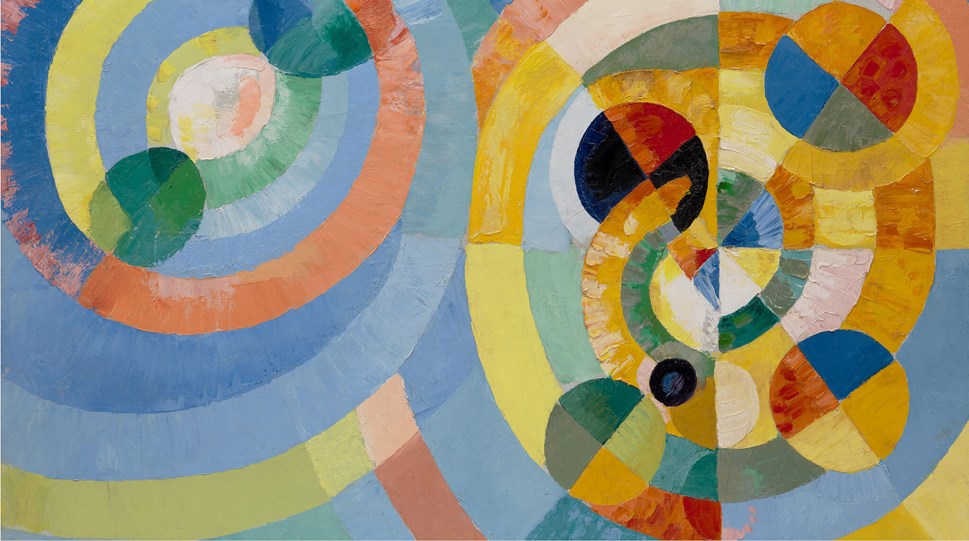
The Birth of Orphism: A Fusion of Harmony and Poetic Dissonance
26 Nov 2024
The following note provides a brief history of the Orphism art movement as well as, an overview of the recent exhibition at the Guggenheim Museum in New York, titled "Harmony and Dissonance: Orphism in Paris, 1910–1930" , dedicated to the artworks associated with the Orphism movement. The exhibition has been on public view since November 8, 2024, and will run until March 9, 2025.

On the Left: Robert Delaunay | "Red Eiffel Tower (La Tour rouge)" | Oil on canvas | 125 x 90.3 cm | 1911–12 and On the Right: Albert Gleizes | "On Brooklyn Bridge (Sur Brooklyn Bridge)" | Oil on canvas | 161.8 x 129.5 cm | 1917
In simple words, the Orphism movement can be described as a branch of Cubism. However, its foundational philosophy and distinctive visual structures have carved out an independent space for Orphist works in the history of arts. The unique characteristics of Orphist art continue to establish a poetic connection with audiences to this day, something that the structure-focused language of Cubism often lacks.
The primary distinction between the Orphism and Cubism's artworks lies in the use of color. Additionally, Orphism's resonance can be attributed to its direct engagement with scientific advancements and the emergence of modernity in the early 20th century. Orphists reflected the spirit of their rapidly changing era with the use of live colors, emphasizing light, musical rhythm, and abstract forms to capture the essence of modern life.
Initially, Orphism was introduced under the name "Simultaneousism" , a term coined by its primary founder, Robert Delaunay. In his work, Delaunay sought to achieve a harmonious and aesthetically rich composition with a musical quality, experimenting with colors and forms. In the early 20th century, following the birth of Cubism, Delaunay, along with other artists including Sonia Delaunay (his wife), Fernand Léger, František Kupka, Francis Picabia, and Jean Metzinger, established the Orphism movement.
Although Orphism remained limited to a small group of artists in Paris and enjoyed its peak for only a few years, it had a profound and lasting influence on modern art. Its impact can be traced in the works of prominent artists such as Wassily Kandinsky, Paul Klee, Marcel Duchamp, and many others.

On the Left: František Kupka | "Disks of Newton (Study for Fugue in Two Colors)" | Oil on canvas | 100.3 x 73.7 cm | 1912 and On the Right: Mainie Jellett | Untitled | Oil on canvas | 76 x 64.6 cm | 1938
To better understand the intellectual and social origins of Orphism and its influence on later movements, the Guggenheim Museum in New York is hosting the exhibition "Harmony and Dissonance: Orphism in Paris, 1910–1930". This show features a collection of the most significant works associated with the movement.

Giacomo Balla | "Mercury Passing Before the Sun" | Opaque watercolor over graphite on textured wove paper adhered to canvas | 64.8 x 50.5 cm | 1914
The exhibition includes 90 pieces, drawn from the Guggenheim's own collection as well as private collections across the United States and Europe, with many being displayed publicly for the first time. Curators Tracey Bashkoff and Vivien Greene have researched historical archives to assemble this series of artworks. They have also included audio recordings of classical and modern music pieces that inspired Orphist works, alongside a selection of poetry influenced by the movement, further enriching the sensory experience for visitors and emphasizing the lyrical aspect of the Orphism.
The Orphism movement encompasses a wide range of artworks, from depictions of urban elements in a Cubist style to entirely abstract compositions. Inspired by modernity's dynamism and movement, as well as music, poetry, and dance, Orphists sought to create a perfect harmony of contrasting colors and forms. Curator Vivien Greene highlights the movement's social context, noting, "On one hand, there is all this incredible innovation; the city has been transformed, and there is a lot of utopian thinking about social change, she continues, But just like living in New York City, we know better than anyone that modern life can also disrupt—the noise, the chaos, and so forth,".
Astronomical discoveries in the 20th century also influenced the Orphists. This is particularly evident in the emphasis on circular and spiral forms, which became some of the movement's most iconic motifs. Greene references Giacomo Balla's "Mercury Passing Before the Sun" (1914) to illustrate this point; "It's the science of the moment. People have access to microscopes. They also have access to telescopes. There are also a lot of planetary events that just happen to be in this time: Halley's Comet, a full solar eclipse, another comet, and several lunar eclipses".
In this piece, Balla abstracts an astronomical phenomenon into a dynamic, rotating composition dominated by orange color. After observing the event through a telescope, the artist employed Orphist techniques to convey his exciting experience.
Despite everything Orphism achieved, the outbreak of World War I in 1914 brought profound changes to European society and, consequently, the art world. While these changes left a significant mark on Orphism, its visual innovations, particularly in the use of color and abstraction, continued to influence art into the late 20th century. Movements such as Surrealism and Abstract Expressionism drew inspiration from Orphism, further expanding its legacy of poetic harmony and dissonance.
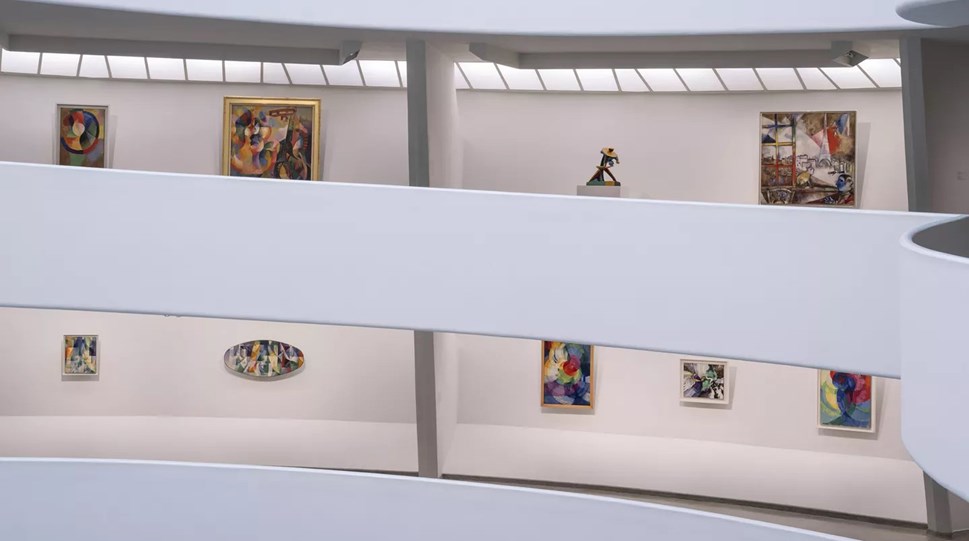
A view of the show "Harmony and Dissonance" at the Guggenheim Museum in New York | Photo: Artsy.net
Cover and slider image:
- guggenheim.org
- Robert Delaunay | "Circular Forms (Formes circulaires)" | Oil on canvas | 128.9 x 194.9 cm | 1930

