





"The World in the Image of Man"; Lebanon pavilion at "Venice Biennale" 2022
12 Sep 2022For the world and Lebanese people, especially those living in the "bride of the Middle East", Beirut, the 4th day of the 8th month of 2020 is an unforgettable date; Around 3000 tons of ammonium nitrate exploded in Achrafieh port, destroying many buildings, killing many citizens, and adding to the homeless population. After six years of being stored without adequate security in the port of Beirut, the cargo's sudden explosion acted as a magnitude 4 earthquake and changed the face of the city and its inhabitants forever.
Therefore, visualizing the city for the Lebanese pavilion artists at the 59th edition of the Venice Biennale was neither ordinary nor easy. "The World in the Image of Man" is the title of the exhibition currently on display in the Lebanese pavilion of the Venice Biennale 2022. It is curated by Nada Ghandour. Constant action brings to life the imaginations of Lebanese artists about the "city"; the "city" has been embodied in a dialogue with a political and aesthetic theme about the city and the works of two artists participating in the pavilion. The main content of the show is the daily life of Beirut, the capital city of Lebanon. The Lebanese pavilion's visual identity is created by Ayman Baalbaki's monumental installation and Danielle Arbid's video art. There is an attempt to embody the infinite chaos of the Middle Eastern countries in this show.
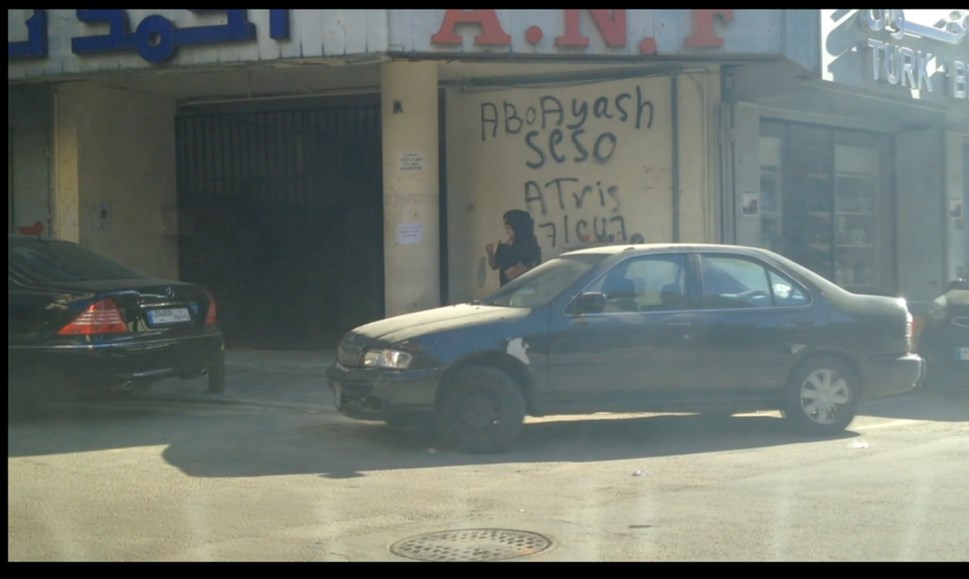
Danielle Arbid's video entitled "Allô Chérie" transfixed the visitors of the Lebanese pavilion; a split-screen video combining the pursuit and the movement of a car in Beirut with a woman's voice in the background. Regarding the sound that plays during the video, the artist says: "I installed a spying machine in her mobile phone with her consent. I thought she had a very quiet life but then discovered she had a secret and was running her own banking system." It has been 3 years since this audio was recorded, but the video is produced in 2022. Following the intense explosion at the Beirut port that changed the city's external and internal identities, the importance of this video and its voice emerged. Daniel Arbid's video shows a crazy competition for money that is tied to violence. Companies associated with real estate that normalize everything to hide destructions are messengers of hope that will rise through the dust, blood, and chaos of the city, bringing a splendid appearance to a city that is ruined inside.
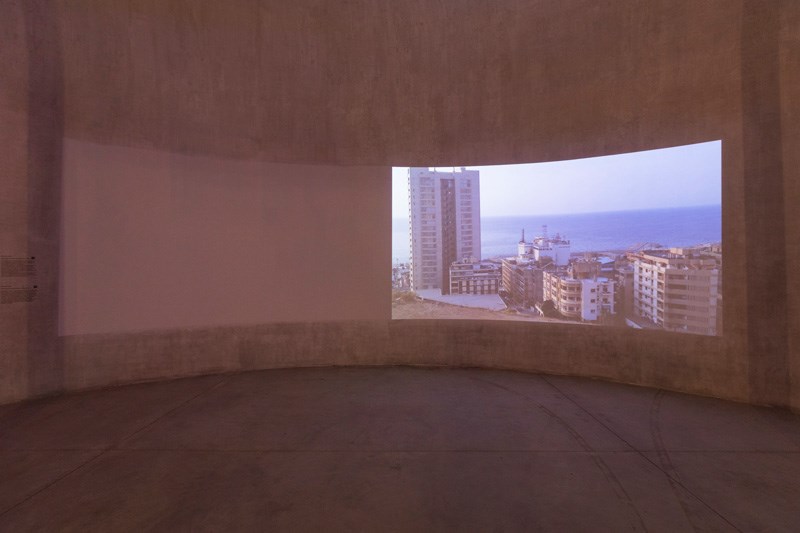
In video art, Daniel Arbid's mother's voice playing in video art symbolizes the struggles Beirutians face to earn an income due to the financial crisis. The income cannot be earned through the official economic system of Lebanon, so one should look for other ways to earn it. Arbid states about her work at the Lebanese pavilion: "My mother’s life resembles the economic life of Lebanon today".Another part of Danielle Arbid's video shows her mother roaming Beirut's streets. As with many other citizens, she is trying to find an answer to a question but is forced to cling to pious hopes on the way. In her heart, however, she knows that her city is in an endless state of despair.
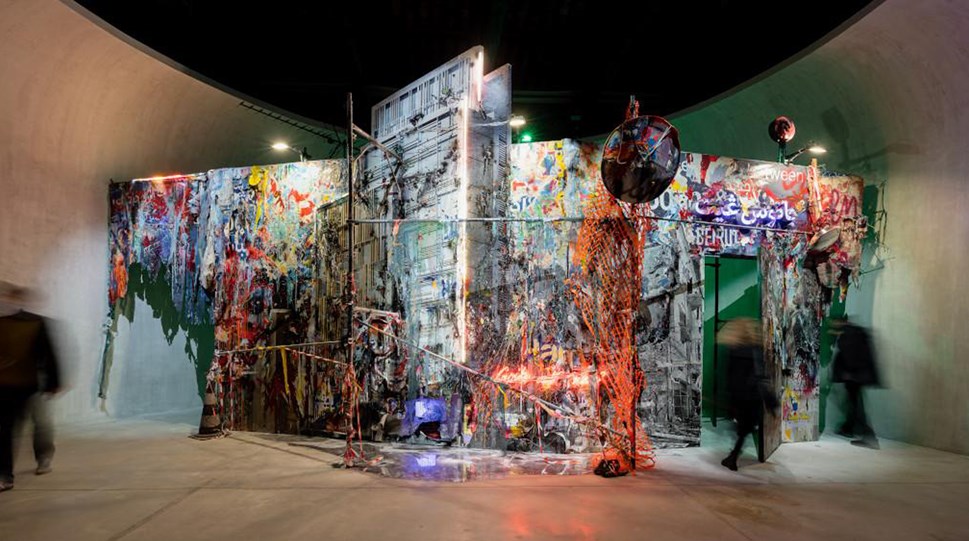
The giant installation entitled "Janus Gate", which stands on the other side of the pavilion, is the result of Ayman Baalbaki's effort to present two aspects of Beirut. His inspiration for this installation came from the facade of the city building. There are also banners known as "Media Pannels" that have been used in the process. Usually, these pannels are placed in front of buildings to indicate general facade information and different directions. The whole installation consists of a wood facade and an interior space with a security kiosk. Janus is a mythological goddess of Roman culture; The Roman god of beginning and end, transition and time, often depicted by a two-faced head. Janus's faces look at opposite directions; one part of the head looks back, and the other part looks forward. Through this feature, Janus is introduced to the audience as a symbol of beginnings and endings. As part of the reason for choosing Janus is the location of this installation, the geography of Italy, which has been part of Roman mythology for centuries.
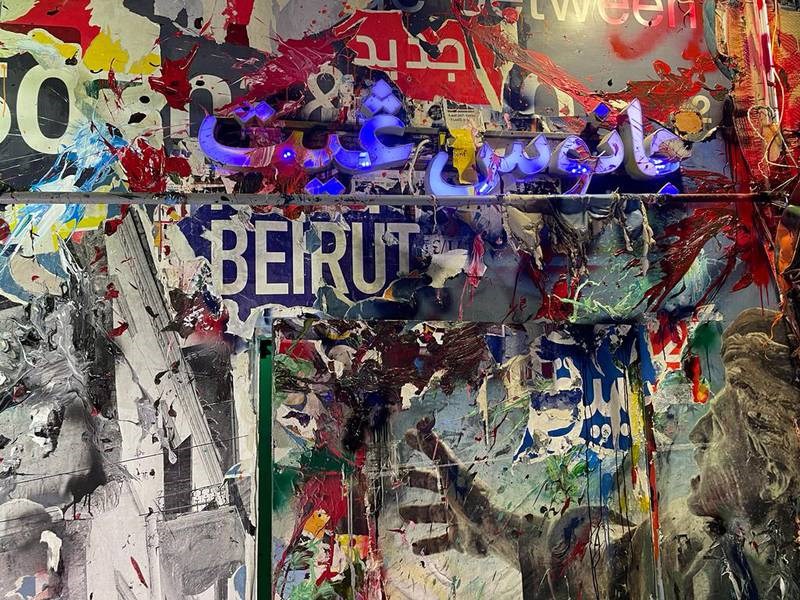
The general facade of this building is a perfect imitation of one of Beirut's buildings. A few changes were made by the artist, including the location of the main door; as the entrance to Janus' security kiosk has a special importance and the artist has mentioned a common proverb from Latin, French and Italian: "Close the Gate of Janus". The phrase has been used in the past to create peace and was associated with Janus, the god of war and peace. During ancient Rome's wars, the doors of the temples were symbolically opened.
In this installation, there are small components that, according to the artist, all have samples that were collected in Beirut at different times and a part of them dates back to the Beirut explosion. All speak about Beirut, even about a geographic region larger than the capital; from lamps, and neon lights, to the wooden billboard from 1999 bearing the title of "Abboud on the borders." When visitors enter the Installation, they feel as though they are in an Arab Levanti atmosphere. About the nature of this work, according to the artist everything the audience encounters in this work, including objects, colors, and lights, is a representation of the damage and destruction done to the buildings in reality. Damage and destruction are the main focus of the work. He says: "We owned a city similar to Berlin and Belfast between 1989 and 1990. Despite the promises of a free society after the Cold War, the reality turned out to be quite different."
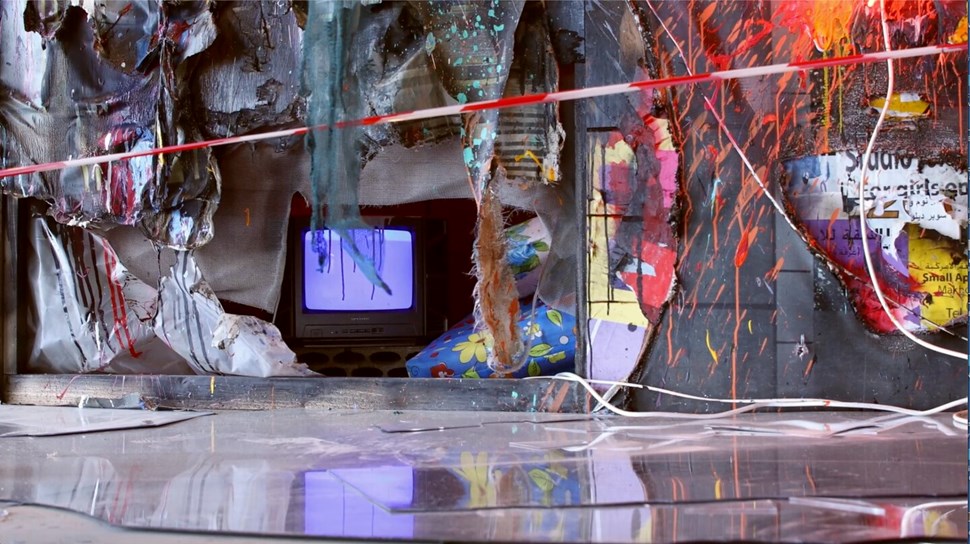
Lebanese pavilion's installation by Baalbaki is designed so that the audience will initially see the building's facade; It is a facade that has been colored in an Expressionism and Abstract style. The color symbolizes everything but life. It is a sign of living in a city full of chaos that is laden with unfortunate events instead of economic corporations promising a brighter future.
It is unique about Baalbaki's installation that elements from other countries can be seen in the whole structure. Of them, we can mention the neon lights in their Installation and content.On a part of the structure, you can see the Latin phrase "Capita Aut Navia" from one of the neon signs; it refers to two sides of the coin(heads or tails) in ancient Roman mythology. This phrase conveys a double meaning. In one meaning it refers to Janus's identity; two sides of a coin with an image of Janus. According to the artist, he also refers to his older works alongside the concept of money.
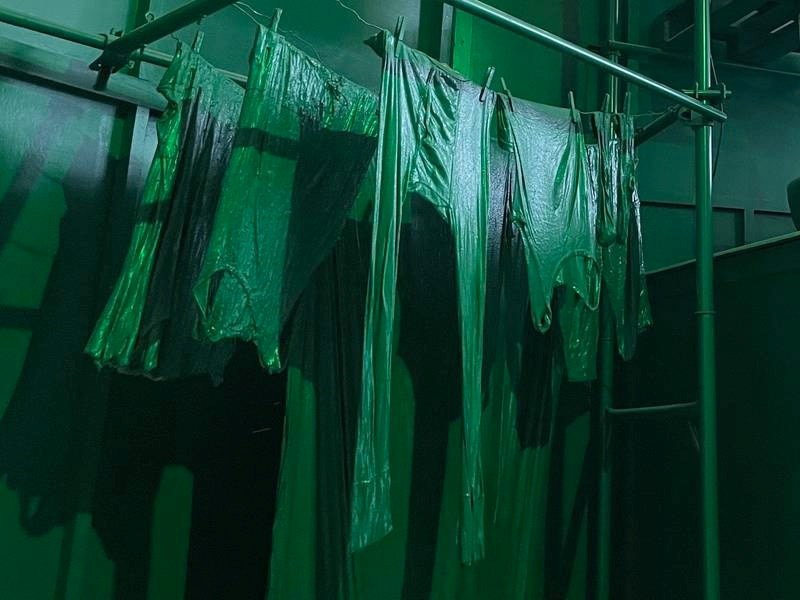
On the other side of the installation is a security kiosk that can be accessed through the main structure's entrance. A single color, Olive-green, is used to depict the conflict of war and peace in this space, unlike the many colors on the facade. Furthermore, the green color in this space is a reference to the country's army; it is how civilians were forced to wear military uniforms during the civil wars in Lebanon and Syria and were suddenly caught up in a war without their consent or intervention.
A large bed lies inside the security room, next to a TV with static noise. Red light fills the security room, which according to Baalbaki is a symbol of the heat of living creatures as well as an implicit reference to thermal signatures visible through night-vision scopes.
Apart from the red beam of light emanating from the security room's window, all interior elements are olive green; clothes hanging on clotheslines, a bird cage, a water storage tank, and...
Ayman Baalbaki whispers in his mind about what he created: "Every capital city has its own story. While Beirut has passed through them all."
In its axial position between East and West, Lebanon has experienced a lot of tension with its neighbors and the countries of the region. Having experienced both tradition and modernity, the city is now known worldwide for its countless political, economic, and social unrest.
According to Nada Ghandour, curator of the Lebanese Pavilion at the 59th Venice Biennale: "This year, the Lebanese Pavilion comes to life in spite of the extremely challenging times that Lebanon is going through, and the political, economic, and social turmoil that the Lebanese are facing. By placing the Lebanese Pavilion in the Arsenale, I wanted to show that Lebanon still exists on the world art map and also to send a strong message to artists in Lebanon to encourage and motivate them; to show them that there is support for them, and also promote Lebanon’s contemporary art scene, an important sector for the country."
An interesting point regarding the details of the Lebanese pavilion at the Venice Biennale is that the pavilion was financed by collectors and curators of the private sector. Until now, it is one of the most visited pavilions of the Venice Biennale 2022.
Sources:
- www.labiennale.org/en/art/2022/lebanon
- www.theartnewspaper.com/2022/04/20/venice-biennale-2022-the-must-see-pavilions-in-the-arsenale
- www.thenationalnews.com/arts-culture/art/2022/02/27/lebanon-pavilion-at-venice-biennale-evokes-the-chaos-and-beauty-of-beirut
- selectionsarts.com/the-lebanese-pavilion-at-la-biennale-di-venezia
- www.arabnews.com/node/2090821/lifestyle
Cover and slider image:
- www.labiennale.org

05 Aug 2022
Placeless Geography; Japanese Pavilion at the 59th Venice Biennale
28 Aug 2022
Mythological Culture; The Visual Theme of the Mongolian Pavilion at the Venice Biennale 2022