






A Review on Richard Serra's art
04 May 2024Richard Serra, the American artist who played a significant role in the Minimalist Art Movement with his monumental steel sculptures, passed away recently at the age of 85. He took a fresh step forward in the world of art, by working in unconventional dimensions and surrounding his audience with massive metal spirals, cubes, and cones.
Although Serra's works have fascinated many around the world, their impact has never been without controversy. One of his artworks tilted "Arc" 1981 which is a 120 foot long steel bar installed in a square in New York, was removed after a while due to a lack of public acceptance. Today, this work is remembered as one of the most publicly despised pieces of art.
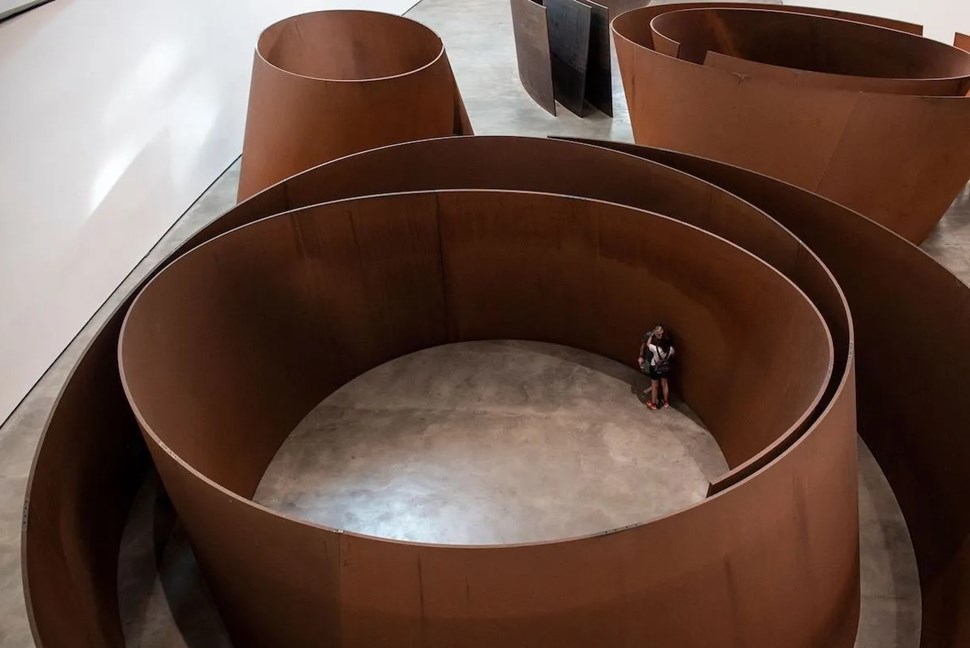
Nonetheless, the bold influence of Serra's works on critics and as a movement that brought sculpture into new conceptual territories, is undeniable. By creating a unique method, he produced works that not only exist in space but also transform its meaning, direct and shape how audiences interact with their surroundings. His sculptures impacted the movement of viewers, at times restricting or diverting their path, forcing them to change how they move in the showing space. Richard Serra once stated:
"I think that sculpture, if it has any potential at all, has the potential to create its own place and space, and to work in contradiction to the spaces and places where it is created in this sense. I am interested in work where the artist is a maker of "anti-environment" which takes its own place or makes its own situation, or divides or declares its own area".
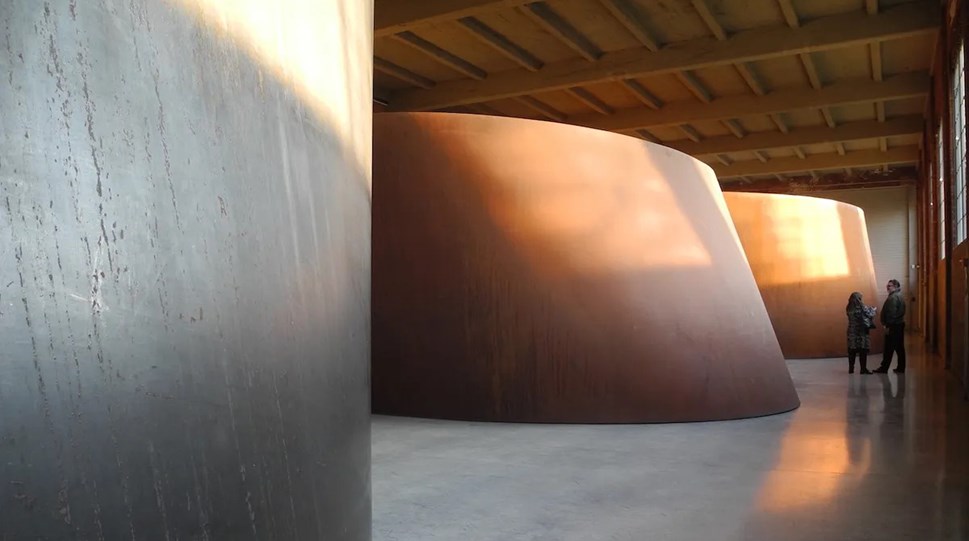
Serra's sculptures are hard, cold, and monumental masses that reflect no figurative or psychological aspects. They appear entirely in contrast with the viewer, who seems condemned to acknowledge their inferior power in the face of a steel mass, forced either to submit to it or to resist by ignoring the disparity.
Serra described his works as "not feminine." His artistic style became a symbol of masculine audacity for many minimalists, which led to repeated criticism from feminist art critics in the 1970s. Despite this, his reputation as an artist remained untarnished.
Richard Serra was born on November 2, 1938, in San Francisco. Some believe that his artistic style was directly influenced by the industrial materials and ships he observed as a child. Serra frequently visited the shipyard where his father worked.
The artist initially pursued a degree in English literature at the University of California and later took courses in art history at Yale University, where he took graduate a art program. Although he intended to become a painter, he struggled with the Abstract Expressionism of the era. After graduating from Yale in 1964, he shifted directions and worked briefly with composer Philip Glass.
Serra's artistic style in the late 1960s aligned with a movement called Process Art, which shifted focus from the completed artwork to the tools and processes by which it was created. His "Verb List" (1967–1968) is one of the most important works of this movement, along with his piece "Splashing".
Serra's lesser-known works beyond sculpture are also significant; He produced a number of short films, as well as collections of prints and designs. He also created several documentary films of Joan Jonas's performances, with whom he had a romantic relationship during that time.
For many, Serra's major artistic breakthrough came with his "Prop" series which he created in the late 1960s. He delicately balanced lead sheets on steel bars in this series.
In the 1970s, Serra began installing his works in urban spaces. However, the public often disapproved of these sculptures and demanded their removal. Many of these pieces were removed from urban spaces and are now stored in museums.
One of Serra's late-career successes was his 2015 installation "Equal", which was created with 40-ton boxes balanced on top of each other in pairs. The piece is currently displayed in a dedicated gallery at the Museum of Modern Art (MoMA).
Among Serra's honors are the "Venice Biennale Lifetime Achievement Award" and numerous exhibitions held in some of the world's most prestigious museums.
Source:
- artnews.com
Cover and Slide Image:
- artnews.com

24 Aug 2022
About Ornamenting and Ornamental Things
18 Sep 2022
"The Little Black Fish"; An Imagination Broad as Farshid Mesghali's Writing
14 Sep 2022
An Analysis of Shadi Ghadirian's Works