





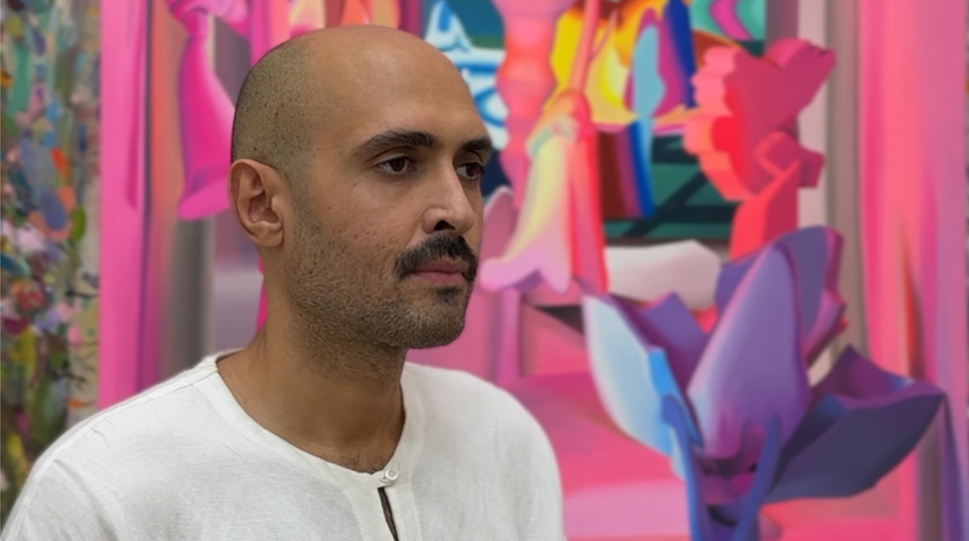
Interview-In Conversation with Yousha Bashir About Her Douet Show in Dastan: Outside - Focus Room 3
10 Aug 2026- This exhibition revisits a dialogue that first emerged at Liste Art Fair Basel in 2023 between your paintings and Rana Dehghan's ghost-like sculptures. How has your perspective on this pairing changed over the past three years?
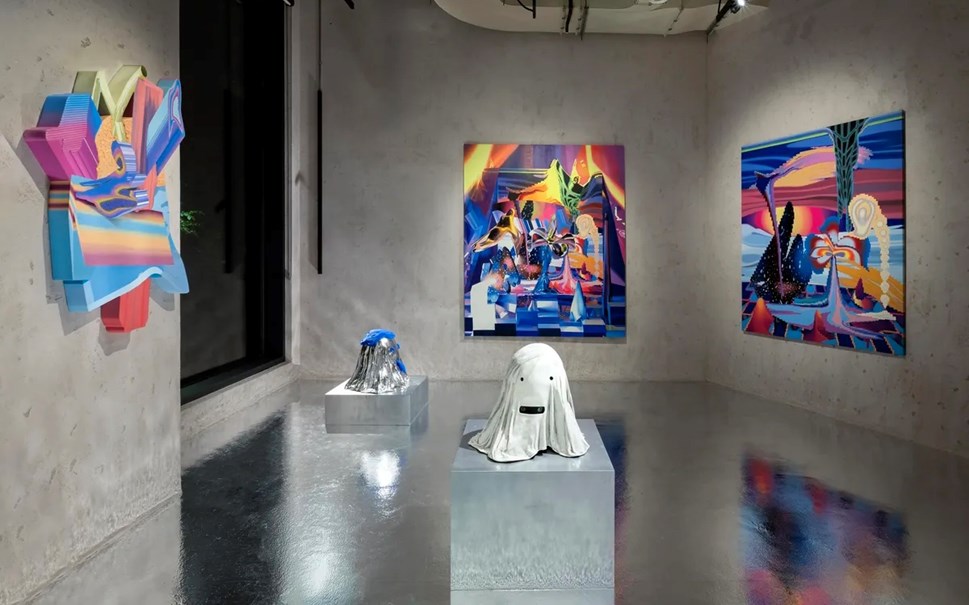
In a way, this exhibition continues the same dialogue that began between Rana's work and mine three years ago, only this time with different works from those same bodies of work. What I find interesting is that, in this exhibition, I feel our works have come closer together than before. I think there are two main reasons for that.
One is the installation itself, particularly the silver, reflective floor that has been created in the space. Reflective forms and the question of light have always had a strong presence in my paintings as well. The floor makes the colors in my work appear even more luminous, and that brightness, alongside the chrome-like quality of Rana's works, creates an interesting visual harmony.
The other thing is that even though Rana and I have quite different worldviews in our work, within this installation our works seem to enter a shared territory, a space in which they can begin to speak to one another. I find that coexistence very interesting.
My own relationship to painting has also changed over the past three years, and my work has followed a different path. Those changes may not be immediately visible in the works themselves, but what interests me is that despite the passage of time and the very different circumstances, this dialogue between our works has continued. Rana wasn't able to be present in Basel for the previous exhibition because of the circumstances at the time, and this time the situation in Iran made it difficult for me to be present. Still, our works have come together again, which is something I find worth reflecting on.
Another important factor is the context in which the works are being seen. The previous exhibition was in Basel and this one is in Tehran, so naturally they have different audiences and contexts. I feel that Iranian audiences, because of a greater familiarity with certain Eastern philosophical and spiritual roots, may be able to form a different, and perhaps closer, relationship with some of the conceptual layers in these works.
- Your work has developed through concepts such as the "First Space," "Second Space," and "Third Space." Could you explain how these spaces relate to the artist, the painting, and the viewer?
The concepts of the First, Second, and Third Space are really a way of retracing a path that developed through my own practice. For me, the First Space is the moment I encounter something as an artist. There is a boundary separating me from the world around me, but I can't actually locate it. The moment I become aware of that boundary, and if that awareness is accompanied by presence and stillness, a space begins to form in which an idea can emerge. One idea that has occupied my mind for a long time is the concept of landscape, not simply as an image of nature, but as a space for encounter and experience.
The Second Space is where I, as the artist, represent that idea. In other words, the experience formed in the First Space enters the painting and becomes an artwork. After some time, I took another step back and began thinking about what happens when a viewer stands in front of the work. If the work can establish a meaningful connection with the viewer, it can function like a window, allowing them to enter another world. I called that world the "Third Space."
So the Third Space is really my visualization of the viewer's encounter with the artwork, the moment when the artist's personal experience is transmitted to the viewer through the work. In these paintings, that encounter is represented through the presence of an abstract figure standing in front of the painting and interacting with it.
- Your works are often described as landscapes, even though they do not depict specific or recognizable places. What allows an abstract or digital image to function as a landscape for you?
I do consider these works landscapes, but not in the traditional sense of representing a particular place or a recognizable natural environment. For me, landscape is less an image of nature and more an experiential space, a space you can enter, become aware of, and experience differently through forms, relationships, and shifting perspectives.
Within my process, landscape becomes a framework for encountering forms. It gives me a space in which I can use different forms to construct compositions and create new relationships between elements. Although many of these forms are abstract, they can still evoke elements of landscape for me, such as a mountain, the sun, or the sky. Those associations allow them to remain connected to the idea of landscape.
Ultimately, landscape for me is less about a collection of recognizable elements within a space and more about the space itself and the position from which we encounter it. The way things are placed alongside one another, and the point from which we look at them, can create the experience of a landscape. That's why even an abstract or digital image can function as a landscape for me.
As for the digital aspect of these works, I don't see digital space as distancing us from the experience of landscape. Instead, it is a tool for constructing spaces that may not exist in the physical world but can still produce spatial and perceptual experiences. These constructed spaces offer another way of encountering landscape, one that is less about a specific place and more about a mental and sensory experience of space.
- Do you want the viewer to feel that they have entered the space of the painting, or to become more aware of their own position outside the work and of the act of looking itself?
I want the viewer, more than anything, to feel that they have entered the space of the painting. But for me, entering that space doesn't simply mean becoming absorbed in the image. The act of looking itself is also an important part of the experience.
I think becoming aware of the way we look is significant, not simply looking, but noticing how we are looking. I've been thinking about how this awareness might emerge through a small distance between the "self" and whatever we are experiencing, by not completely identifying ourselves with what we see or experience. That distance can allow us to look more consciously.
I think that if the viewer can enter the work with that kind of awareness, the possibility of actually experiencing the space of the painting becomes greater. What I hope is that the work isn't simply something the viewer observes from the outside, but that it can function like a window and bring the viewer into its own space.
- Your process often begins with a digital image that is then translated into a physical painting. At what point does the image become completely your own?
I think the image becomes mine at several different stages. When the process begins in digital space, a personal choice has already been made from the very first moment, the choice of forms, spaces, and relationships that shape the image. From that point on, the image has already entered my world.
But when it enters the physical stage and becomes a painting, something else happens. Material enters the image. Colors become matter and acquire a physical presence, and the qualities that existed in the digital image undergo a new translation.
I think the point at which the image becomes closer to what I'm searching for occurs when that translation is complete, when it is no longer simply a digital image, but you can sense within it the presence of a person, of time, of the hand, and of material. Of course, that doesn't mean that the digital stage doesn't belong to me. It is also part of my process. But in the physical painting, perhaps the viewer encounters the human aspect and the experience behind the image more directly. That's where the image takes on a fuller meaning for me.
- You have explored the idea of imperfect or incomplete translation between the digital image and the physical painting. Are these errors and mistranslations obstacles to be overcome, or are they necessary to the formation of the work?
I think my relationship with these errors has changed over time. At first, I saw them more as flaws, but gradually I realized that the distance and the changes that occur when an image is translated from digital space into a physical painting can become part of the work's own language.
The first time this really entered my work was through the pixel. When I first projected a digital image onto the canvas, I noticed that the closer I got to it, the more visible the pixels became. Initially, that seemed like an error or a defect. But then I began working with those pixels and with the transformations that occur when an image moves from digital to physical space. Gradually, the pixel became part of my visual language.
At another stage, I actually tried to reduce those errors and differences between the digital image and the physical painting as much as possible. I wanted the painting to become a more precise translation of the digital image.
But as the process developed, I began to realize that completely eliminating these errors was leading toward a kind of perfection that perhaps isn't really the point of painting. I think any attempt to reach absolute perfection is ultimately bound to fail, because there will always be a gap and a degree of uncertainty.
What also became interesting to me is that technology is largely defined by correction and by the attempt to move toward an error-free result, whereas human beings are defined by error, uncertainty, and incompleteness. At a certain point, those two things come into tension with one another.
So eventually, rather than trying to eliminate that distance and those errors, I decided to emphasize the human aspect of painting even more. Gradually, this began to change the visual language of my work, with visible brushstrokes and more dimensional textures appearing in later series. I felt that these differences and imperfections were precisely what allowed the work to move away from being merely a digital image and become a human experience.
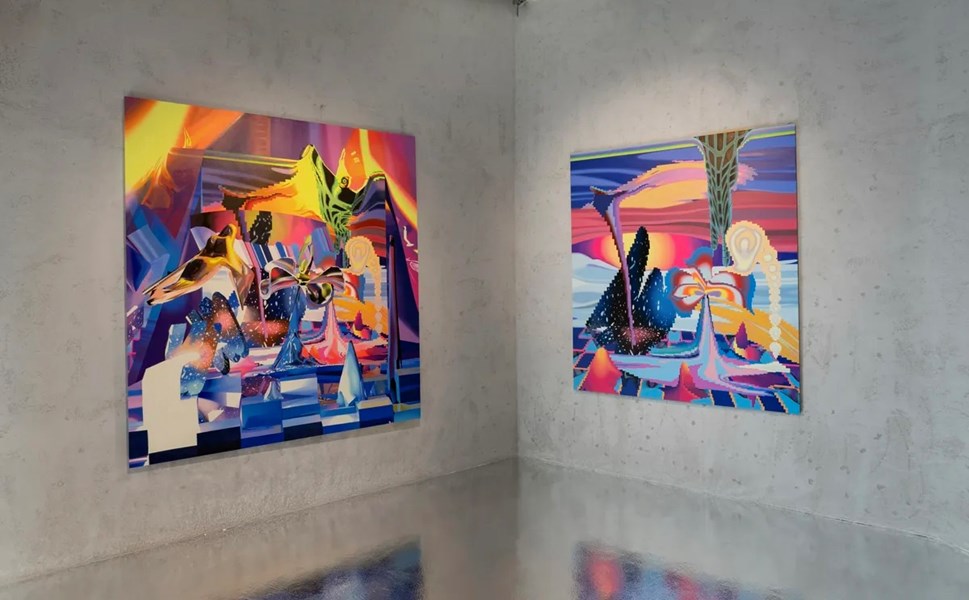
- Your use of luminous colors and strong contrasts can sometimes push visual perception toward instability. How do you know when a painting has reached the right balance between harmony and tension?
What you describe as visual instability feels more like a state of movement and transformation to me. I'm not really looking for a completely stable condition in the painting. I'm interested in a continuous sense of movement and change that keeps the eye engaged. That is also why I use luminous colors and strong contrasts. I think the eye has a certain capacity for taking in highly contrasting colors simultaneously, and when that intensity increases, the visual experience begins to shift. For me, this can create a sense of movement and even change the way the viewer looks at the painting.
So placing colors next to one another isn't simply about creating harmony. It is also a way of affecting the act of looking itself, influencing how the eye moves and how the viewer enters the space of the work. The same applies to opposing forms and concepts. What interests me is that when two contradictory ideas are present within the same work, a new meaning can emerge from the tension between them. We may not be able to fully comprehend two completely opposing ideas at the same time, but the attempt to hold them together can create a new experience. For me, that tension between opposites is part of what keeps an image alive.
- The frame and the idea of boundaries are important concerns in your work. Are you trying to dissolve the boundaries of the painting, or do you want to make the viewer more aware of the frame as a perceptual limitation?
I think the frame and the boundary are more things for me to investigate than questions I want to reach a definitive conclusion about. This concern begins with a very personal question, as a living being, where do I begin and where do I end? Where is the boundary between myself and the space around me? This boundary, which I can never fully locate, gradually became one of the central concerns in my work.
I then transfer the same question to painting itself. Where does a painting begin and where does it end? Where is the boundary between the artwork and the surrounding space, and how does the viewer experience that boundary?
What matters to me isn't eliminating boundaries, but becoming aware of the concept of the boundary itself. In everyday experience we draw boundaries between things, and those divisions seem completely real to us. But on a more abstract level, perhaps those separations aren't as absolute as we imagine.
Ultimately, what I find interesting is that on a more abstract level these boundaries begin to fade, and everything acquires a kind of unity. For me, being aware of those boundaries while simultaneously being able to perceive that unity is an important part of the experience I want to communicate through my paintings.
- In your recent work, you have considered the role of the human in relation to images produced by artificial intelligence. As technology becomes increasingly capable of imitating the movement of the hand and even human error, where do you locate the difference between an image made by a person and one made by a machine?
First of all, I think it's a very interesting question because it points directly to an important aspect of the relationship between humans and technology. For me, the essential difference isn't error. Even if artificial intelligence or robots become capable of imitating human mistakes, I think there is still a fundamental difference, an impulse. For me, it has more to do with something we might describe as a momentary drive or urge, something that comes from the body, from experience, and from human presence.
Even when a machine attempts to imitate the movement of the hand or human irregularities, I still feel that there is an underlying pattern or system behind it. In examples I've seen of painting robots, the movements are still very controlled, and even their irregularities seem to contain a kind of internal order.
What matters to me in a human painting isn't simply the final result or the appearance of a gesture, but why that gesture came into being. Why did the hand suddenly change direction at a particular moment? Why did a line stop? Why was a particular decision made? That part of the process comes from lived human experience, and I don't think it can emerge simply through imitating its outward appearance. So I think the primary difference between an image made by a human and one made by a machine lies in this human presence and impulse, rather than simply in the appearance of the work.
- The concept of the "in-between space" occupies a central place in your work. Is this a space that you consciously construct, or does it emerge through the relationship between forms, colors, bodies, and the viewer?
For me, the in-between space is the space that exists between two things, between two forms, two thoughts, between sound and silence. It is the distance that allows things to exist. We usually focus on the things themselves, but pay much less attention to the space between them, even though without that space, those things could not take shape in the first place.
For example, we hear sound, but what allows sound to be heard is the relationship between sound and silence. In the same way, there is a space between two thoughts that allows a thought to take shape and become present.
For me, paying attention to this in-between space is a way of understanding the hidden relationships between things more clearly. I try to use the same idea in painting, not only paying attention to the forms, colors, or bodies themselves, but to the relationships that emerge between them. This in-between space is where I try to shape the relationship between forms, colors, the space of the canvas, bodies, and even the viewer. What happens between these elements is just as important to me as the elements themselves, because I don't think meaning exists only within things. It also takes shape through the relationships that form between them.
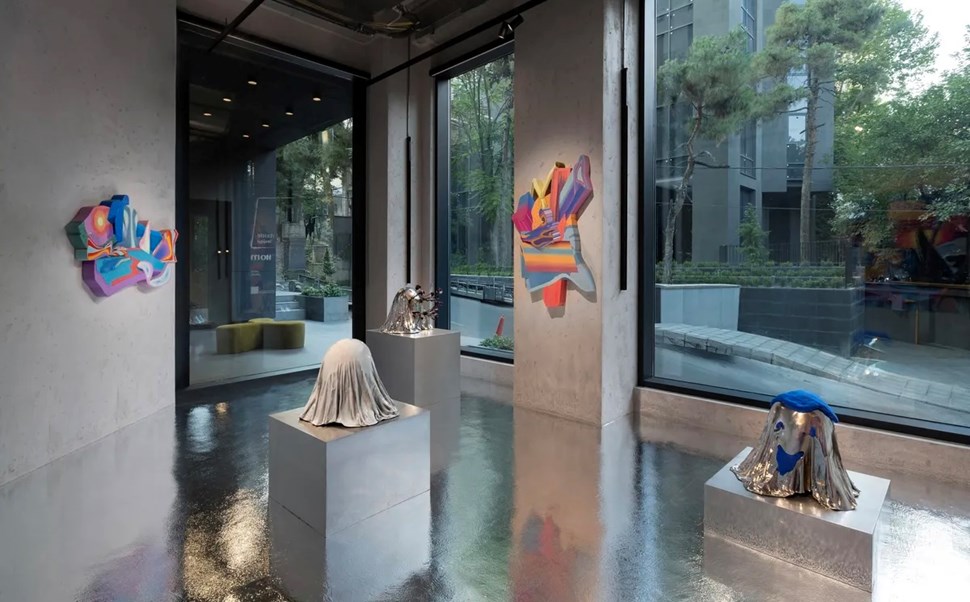
Cover & Slider Image:
- Darz Archive
Installation Views:
- dastan.gallery

