





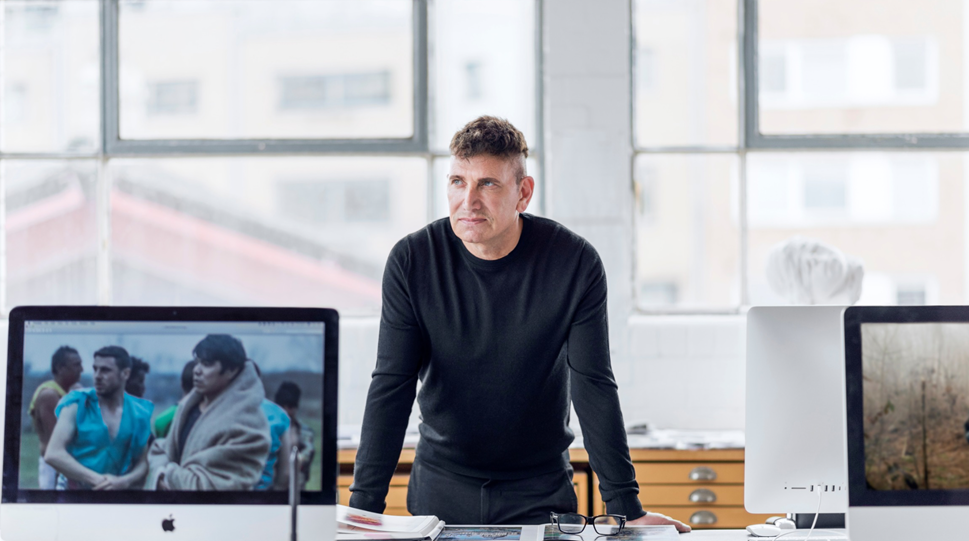
Interview-In Conversation with Reza Aramesh about His Solo Show "To Be Made Flesh Again"
22 Dec 2025- Your artistic practice spans various media, including photography, sculpture, and performance, all of which engage deeply with themes of violence, power, and memory. Could you share how your practice evolved over time, and what drives you to address such intense and complex themes in your work?
At a relatively early stage in my artistic journey, I realised that, for me, art is less about producing a purely sensory experience and more about communicating ideas. Once that became clear, it also became obvious that no single medium could hold everything I wanted to articulate. Each medium opens a different channel of communication, a different way for the viewer to enter the work and bring their own experiences, fears, and memories into it. Photography, sculpture, performance, they are not separate territories so much as different registers of the same ongoing conversation.
My engagement with violence, power and memory comes from trying to understand how historical events and political structures are written onto the body, how bodies are disciplined, humiliated, celebrated, or erased. Photography, especially archival or found imagery, often forms the point of departure: it offers these frozen, apparently factual moments. Sculpture then allows me to slow those images down, to condense them into a physical presence that shares space with the viewer, while performance reactivates them in real time, in lived flesh. Moving between these media is a way of testing how far an image can travel, from document, to myth, to something deeply personal.
Addressing such intense themes is not about illustrating horror, but about acknowledging that we are all implicated in the systems that produce it. I’m driven by a need to probe the gap between institutional narratives and private experience, and to ask how images of suffering circulate, who they serve, and what they do to us. If the work is sometimes difficult, it is because I believe art can create a space where we are compelled to look again, to confront not only the violence done to others, but also the fragile possibilities of empathy, responsibility, and transformation.
- Your new exhibition at Dastan Gallery, titled To Be Made Flesh Again, showcases two new works. Could you share with us the core concept behind this exhibition? What is the main idea you are exploring?
In To Be Made Flesh Again I’m thinking about fragments not as broken or incomplete things, but as entities that are whole in themselves. Historically and culturally, we tend to treat fragments, of bodies, sculptures, memories, as leftovers from a past that has somehow disappeared. I’m interested in reversing that perspective: a fragment is not simply what remains after loss, but a concentrated form of presence. It carries its own integrity, its own power to speak about what has been done to bodies and images, and how history survives in pieces.
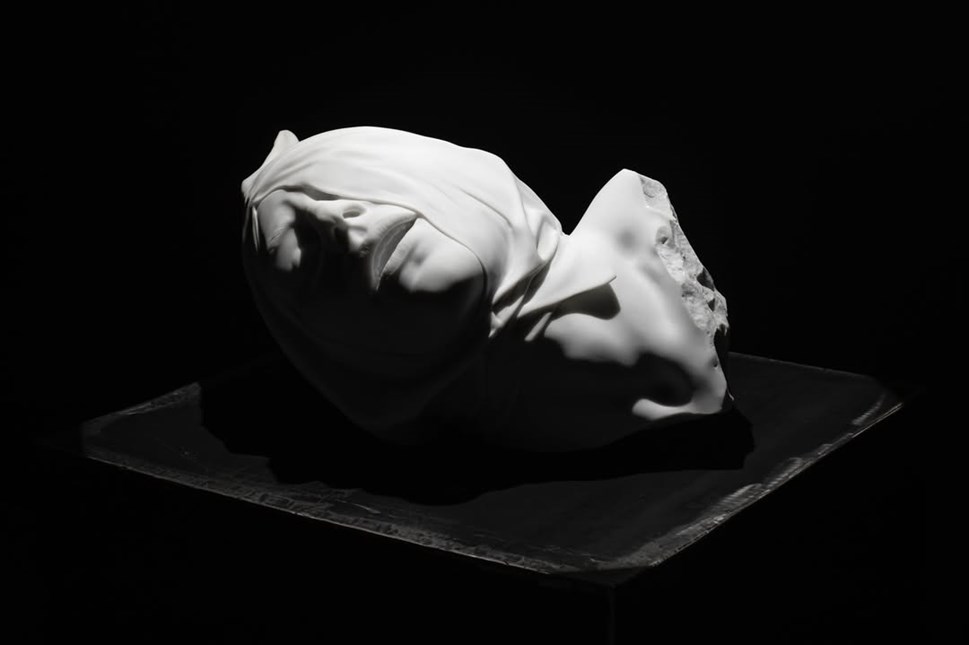
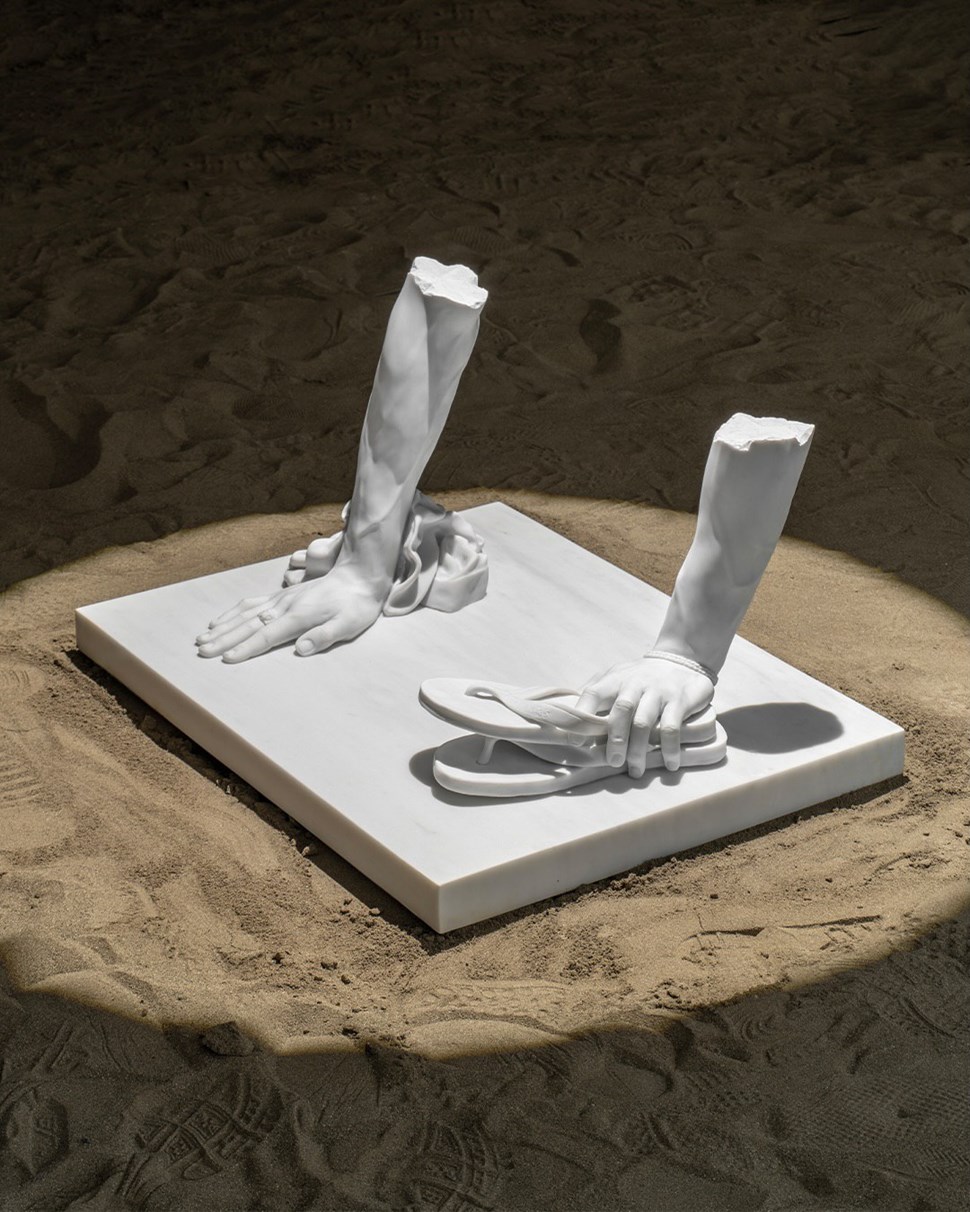
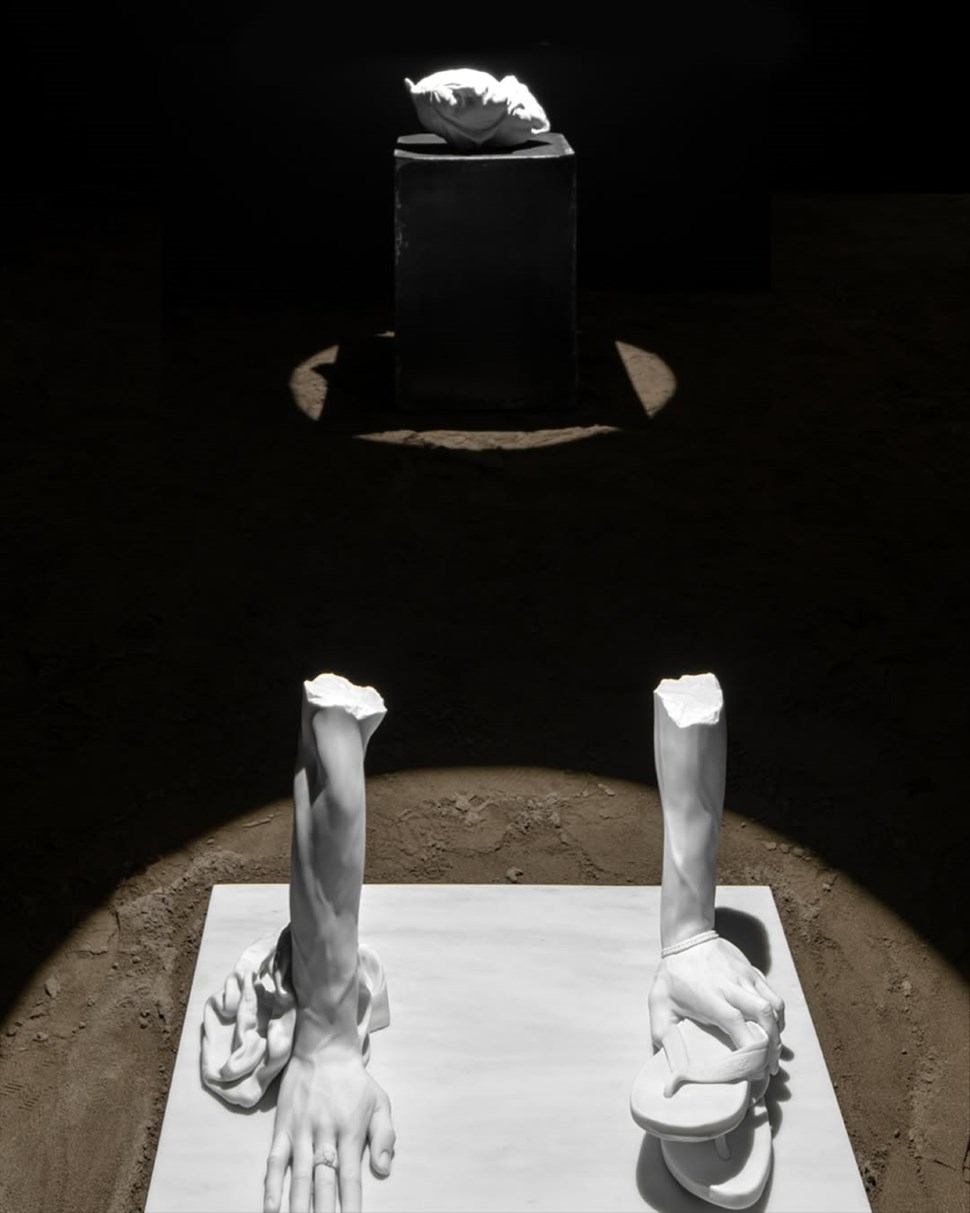
The exhibition brings together marble sculptures, bronze elements and drawings, which collectively form a single installation. Each work functions as a fragment in its own right, but when encountered together they create an environment that the viewer has to move through physically. In that sense, the “wholeness” of the show is not just formal, but experiential: it is completed through the viewer’s body, their movement and their gaze. The title, To Be Made Flesh Again, suggests that these partial forms, whether sculptural or drawn, are attempts to return something to the realm of the embodied, to allow what is usually distant or abstract to stand before us once more, insistently, in the present.
- The title of your exhibition, To Be Made Flesh Again, is inspired by James Baldwin’s The Fire Next Time. How does Baldwin’s influence come through in this work, and how does it inform your exploration of historical and contemporary trauma?
The title borrows its cadence from James Baldwin’s The Fire Next Time, where he reflects on the Christian idea of “the Word made flesh” and asks what happens when words like freedom, love and equality never really become real in people’s lives. For Baldwin, “to be made flesh again” means dragging these abstract religious, political and moral promises back into the vulnerable reality of the body, where history is felt rather than just spoken about.
This exhibition takes that challenge seriously. The body is not an illustration of an idea but the site where power, violence and desire are inscribed. By translating archival images into sculptural form, the work insists that what has been relegated to distant memory or spectacle must stand before us once more, exposed and undeniable. “After James Baldwin” signals both an homage and a continuation: a demand that the ideals we inherit are tested against flesh—our own bodies, and the bodies we are willing, or unwilling, to see.
- Much of your work engages with European art history, particularly classical European sculptures. How do you navigate the intersection of these historical references with modern-day issues, and what do you aim to achieve by merging them with contemporary themes like violence and oppression?
I see art as a continuum of communication; I don’t recognise a strict division between past and present in literature, music or visual art. When I look at classical European sculpture, especially from the Renaissance, I see an ongoing language about the body, power and visibility. My work enters into that language in a critical way, asking what, and who, was considered worthy of being monumentalised.
Marble is central to this. It was historically reserved for noblemen, aristocrats and Christian saints; I use it to carve first, and second-generation immigrants and working-class men in Europe, bodies often marginalised or rendered invisible. Bringing these figures into dialogue with the classical canon allows contemporary violence, displacement and oppression to inhabit a material associated with beauty and sanctity. I’m less interested in nostalgia than in exposing ongoing structures of power and insisting that the conflicts of the present are also “made flesh” in the very forms that once upheld a different order.
- Your sculptures often create a strong juxtaposition between beauty and brutality, especially as you transform images of conflict into permanent forms. How does this duality reveal the absurdity and futility of violence? What does this tension say about the role of art in confronting societal issues, and why did you choose sculpture as the medium for these powerful, often difficult subjects?
For me, beauty and brutality are not opposites; they often coexist in the same gesture, the same body, the same historical moment. When I translate images of conflict into sculpture, I am not trying to aestheticise violence, but to expose its absurdity by slowing it down and giving it form. The moment of impact, humiliation or dominance that in a photograph might pass by quickly, or be consumed almost casually, becomes, in marble or bronze, something you cannot scroll away from. You are confronted with the elegance of the form and the horror of the situation at the same time, and that contradiction reveals how irrational and senseless the violence is. It shows that what is often justified in political or ideological terms becomes utterly absurd when you are face to face with vulnerable, fragile flesh, even if that flesh is now stone.
This tension says something about what art can do in relation to societal issues. Art cannot repair the damage or undo the histories it addresses, but it can insist on a different kind of attention. By freezing these scenes in a material associated with permanence, reverence and value, I am asking: who is remembered, who is monumentalised, and whose suffering is allowed to vanish into statistics or headlines? Sculpture creates a shared physical space where the viewer’s body is implicated; you have to walk around the work, negotiate its presence, and in doing so you become part of the scene. That embodied encounter can open a small space for reflection, discomfort and, hopefully, responsibility.
I chose sculpture precisely because of this corporeal, time-consuming dimension. Working with marble or bronze is slow, resistant, and demands a kind of care that stands in stark contrast to the speed and disposability with which images of conflict circulate today. The weight, the surface, the labour embedded in the object are all part of the statement: these are not fleeting images; they have consequences. Sculpture allows me to turn scenes of violence into sites of encounter, where beauty is not an escape from brutality, but a way of making its futility impossible to ignore.
- In many of your works, such as Study of the Head as Cultural Artefacts, you present disembodied heads that serve as silent witnesses to conflict. What do you hope these heads communicate about the trauma and memory of violence, and how do you see them as a metaphor for collective and individual experiences of suffering?
In Study of the Head as Cultural Artefacts and related works, the disembodied heads function almost like witnesses or survivors rather than trophies. They carry traces of conflict, humiliation and resistance, but they do so in silence; there is no scream, only a kind of mute endurance. I think of them as condensed archives, sites where trauma has been inscribed on the surface of the face, the skin, the hair, but also where something of the subject’s dignity remains. They are not illustrative of a specific event, but they hold the memory of many events, many histories of domination and erasure.
Julia Kristeva, in The Severed Head, links decapitation to what she calls “the decisive moment in our individuation: when the child gets free of the mother … it loses her in order to be.” I’m interested in that idea of a primal separation, the fear of being cut off, abandoned, made disposable, and how it reverberates through political violence and war. A severed head is both unbearably intimate and brutally impersonal: it is a face, a person, but also an object, a symbol. For me, these heads become metaphors for collective and individual experiences of suffering, especially in communities marked by migration, class struggle and other form of violence.
By isolating the head, I also want to ask: what happens when a person is reduced to an image, a statistic, a “case”? The sculptures speak to that reduction, but they also resist it. Each head insists on its singularity, even as it stands in for many others. In this way, they operate on several levels at once, as portraits, as cultural artefacts, and as reminders that behind every narrative of conflict there is a thinking, feeling subject whose story has been cut short, but whose presence still confronts us.
- The concept of fragmentation is central to your work, and it seems to come through in both your sculptural forms and your choice of materials. How does the physical fragmentation of your sculptures relate to the emotional and psychological fragmentation that you explore in your work?
Fragmentation, for me, is never just a formal decision; it’s a way of speaking about how people and histories are broken up and rearranged. A fractured body in marble echoes the emotional and psychological fractures produced by violence, displacement and class struggle, the parts that are left out, silenced or cut away. At the same time, each fragment has its own integrity; it is still whole in its wounded state. By presenting the viewer with incomplete forms, I’m inviting them to “complete” the work with their own memories and associations, and to recognise that our inner lives are often composed in exactly the same way: from pieces, gaps and unresolved stories that nonetheless hold us together.
- You collaborate with non-professional models to reenact scenes of war and violence. What does this collaboration bring to your work, and how does working with non-professional models change the way violence is represented and understood in your pieces?
Working with non-professional models brings lived experience, vulnerability and unpredictability into the work; the scenes stop being theatrical “performances of violence” and become shared attempts to understand it. I love collaborating with people as a whole, models, craftspeople, curators, gallerists, because each of them enriches the work and shifts how these images of conflict are represented and felt.
- The exhibition explores the intersection of beauty and brutality, particularly through your use of marble and bronze, classical materials with deep historical roots in European art. How do these materials contribute to the tension between beauty and brutality in your work, and how does their enduring nature help convey contemporary issues of oppression and violence?
Marble and bronze carry a long history of celebrating power, virtue and beauty; they are the materials of emperors, saints and heroes. When I use them to depict scenes of conflict, humiliation or vulnerability, that history is still present, and it creates a strong tension: the surface is seductive, carefully crafted, almost tender, while the subject matter is brutal. This dissonance forces the viewer to hold both realities at once and, I hope, to feel how absurd and senseless the violence is when it is given the same “noble” treatment once reserved for victory and glory.
Their endurance is also crucial. Marble and bronze are made to last; they outlive fashions and news cycles. By casting contemporary bodies and moments of oppression in these materials, I’m trying to resist the speed with which images of suffering are consumed and forgotten today. The works insist on staying in the room, staying in time. They suggest that the people and histories they embody deserve the same permanence and attention that classical monuments received, and in doing so, they invite the viewer to reconsider who is remembered, who is honoured, and whose pain is usually allowed to disappear.
- You’ve often stated that art can be a tool to provoke thought rather than offer resolution. What do you hope the viewers take away from To Be Made Flesh Again?
I don’t hope that viewers leave To Be Made Flesh Again with a clear message or a sense of resolution; if anything, I hope the opposite. I would like them to feel that something has stayed with them, a discomfort, a tenderness, a question that doesn’t quite close. The exhibition is less about explaining violence than about insisting that its traces in bodies and images are encountered slowly, in real space and time. If the works function as tools, it is to disturb the way we usually consume images of conflict and suffering, and to make it harder to look away or to remain untouched.
At the same time, I hope viewers experience a sense of intimacy with the fragments, that they recognise their own vulnerabilities and histories in these partial bodies. The title, To Be Made Flesh Again, suggests a return from abstraction to embodiment. What I ultimately want people to take away is an awareness that we are all implicated: that the past is not over, that the hierarchies embedded in classical materials and forms are still active, and that our responses, our looking, our not-looking, are part of the story the work is trying to tell.
- Looking ahead, are there any new directions or themes you plan to explore in your work? How do you see the evolution of your practice in response to global conflicts?
I’m always looking, searching and excited about where the work takes me, so I don’t plan in a linear way, but stay open to what emerges from each project.
- Cover and Slider Image: dastan.gallery

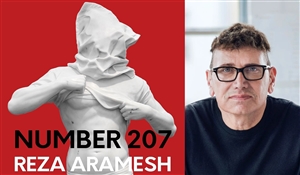 News-Reza Aramesh's "NUMBER 207" on the occasion of the 60th Venice Biennale
