Interview- In Conversation with Mohammad Piryaee About His Solo Exhibition "The Fig Temple", Parallel Circuit (Deh-Vanak)
Interview
Author : Kimia Akhtari
Translator : Baran Norouzian
Architecture is a recurring presence in your work. How does The Fig Temple extend or alter that relationship?
In my previous exhibitions, architecture was seen from a greater distance. At times it had an imagined quality, or occupied a space between reality and imagination. In this series, I have moved closer to the buildings and worked directly from actual photographs. I began at the tips of the domes, looking closely at their details.
Your works often move between formation and disappearance, solidity and fragility. What draws you to these in-between states?
These are the conditions we live in. Whether I want to or not, I accept them because they are part of our lives. I have always lived with this sense of presence and absence, and with the possibility of something happening at any moment. I think I will continue to live with it. It has become part of my way of thinking, and it is what I build the central idea of my work around. Yet within this condition there is a fleeting moment that I am looking for: the moment between presence and absence.
The fig tree carries historical associations, but it also has a personal connection to your studio. How did it become central to this exhibition?
It comes from a personal, lived experience. As I moved between studios over the years, the fig tree and the courtyard pool were two elements that remained with me. While making this series, I would place the works on a stand in the courtyard, and the fig tree in the background would create a different image. I felt that a composition was beginning to emerge between the tree and my works, and I could not ignore it. Through its branches and leaves, the tree was somehow entering into a relationship with my work. I felt that perhaps this exhibition could be a way of paying tribute to it, to a tree that has grown alongside me over the years. The fig tree has been a companion, and eventually I felt that it had found its place at the centre of the exhibition.
What drew you to the form of the Iranian stone lion, and what does it mean to you in this exhibition?
Most of my works begin with a question. Lived experience and the circumstances of my life play a part in shaping them, but sometimes a question suddenly emerges and sets the direction for an entire series. The question that began this series was: is there a body or volume within architecture that gives shape to its exterior?
My previous exhibition, Beyond the Seas, also began with a question: how can architecture be transparent? As I continued that series, I began to consider what might exist inside a structure that had become transparent, and how it might affect the external form. I was also interested in how the two would be read, and what form the opposition between them might take.
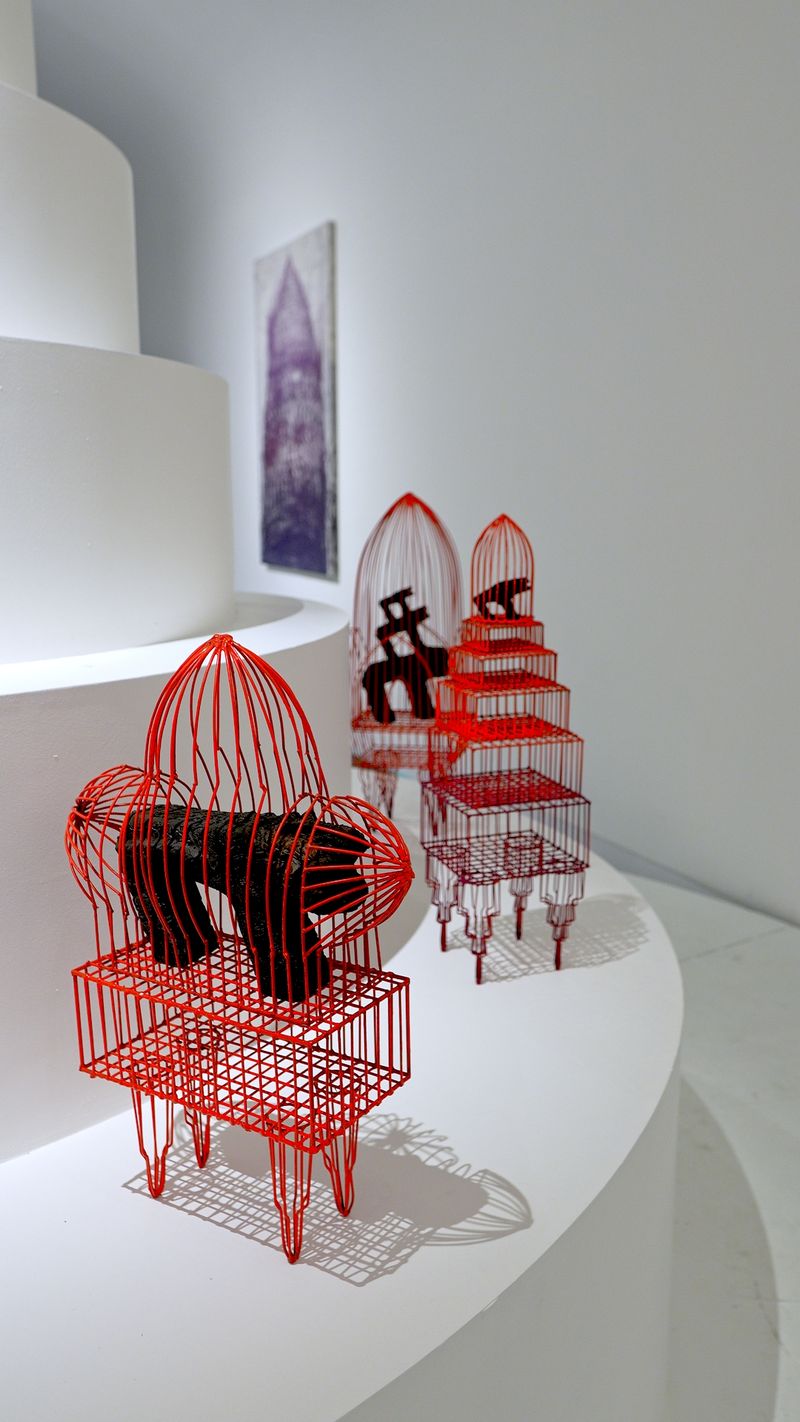
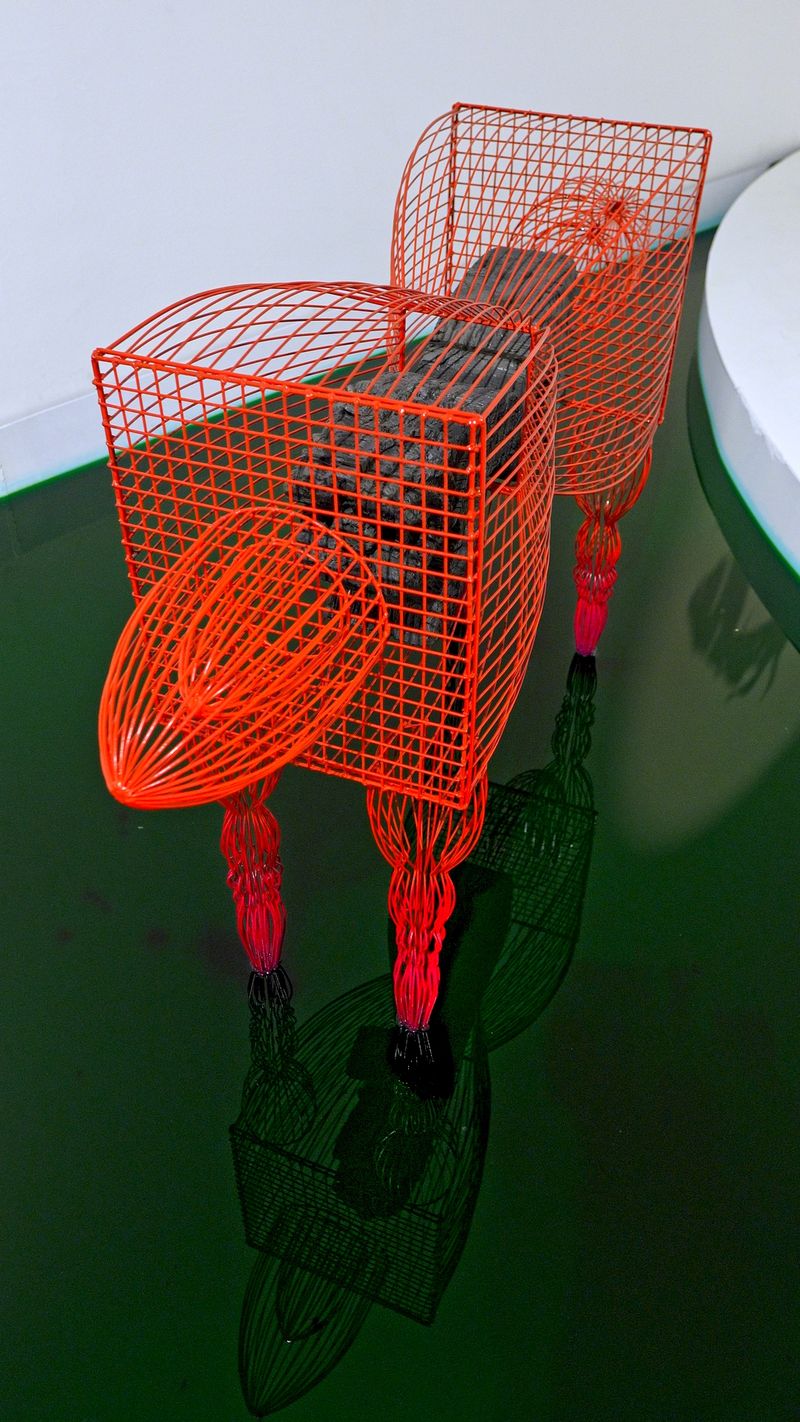
As I made studies and the works began to take shape, I arrived at the idea that a stone lion could occupy the interior of these structures. That choice is closely connected to the ideas I have always pursued. Iranian literature, thought and culture are woven into my work. Having begun with architecture, following that path has inevitably brought me into contact with Iranian symbols and signs. The stone lion is one of those symbols that I cannot simply pass over. I am also drawn to the ideas of steadfastness and endurance that it embodies.
I began to ask how a stone lion might inhabit an architectural structure. Are the two connected? Do they evolve in relation to one another? Do they give each other form, or does one conceal the other? Through making studies and exploring these questions, I came to feel that they needed to be brought together and arrive at a kind of accommodation.
The red lattice structures blur the boundary between inside and outside. How does this relate to your understanding of body and spirit?
I am not seeking obscurity in my work. Rather, I try to create a multiplicity of meanings that allows for different interpretations. In thinking about my work and the subjects I explore, I am always attentive to the relationship between inside and outside: what happens within a structure that finds expression on its exterior.
This question also exists in our lives and in our relationships with others. We can always ask what is happening inside the people we encounter, and what shapes the personality they present to the world. As I said, this series began with questions of that kind.
The ideas and motifs I work with include presence and absence, and the fine line between standing firm and being suspended. The lattice structures create a delicate moment between seeing and not seeing. You can see the figure inside the work, while also imagining that you do not see it and attending instead to the external form. This makes two different readings possible.
I am drawn to the idea of polyphony: the presence of different narrators within a single work, each acting independently while remaining connected to the others. I think this is one of my central concerns: to create a delicate threshold, a moment in which viewers find their way into the work while still being able to see its exterior. They can set the internal figure aside entirely, or retain it as part of their experience.
Water, light and reflection continually alter how the works are seen. What role does the viewer’s movement through the space play in the experience of the exhibition?
My works inevitably take the form of installations, and in an installation the viewer’s role becomes especially important. The viewer’s presence also contributes to the polyphony of my work. Just as the works retain independent roles alongside one another, their encounter with a viewer can establish a new relationship and produce a new reading. Creating that relationship is one of the most important things I hope to achieve in my work.
Your practice moves between drawing, painting, sculpture and installation. How do forms move from two dimensions into three?
This brings us back to my interest in giving the works multiple voices. I try to sustain a polyphonic rhythm, bringing distinct characters into relation with one another. I do not want my work to be confined to a single voice. That is why it moves towards installation, which is also a direction I consciously want to pursue.
In an installation, you cannot be indifferent to drawing, light and shadow, the stand you use, or the route the viewer takes. It matters where viewers begin, where they arrive, and how they discover and encounter the work’s different characters, layer by layer. In the process, they may arrive at a reading that even I had not considered. The transition from two dimensions to three happens through the combination of these visual elements.
Your work draws on Iranian history, philosophy and architecture without representing these sources directly. How do you engage with them without allowing the work to become nostalgic?
That certainly has to do with the artist’s intentions and lived experience. I think these ideas have become deeply embedded in our lives as Iranians. Sometimes they emerge from within us and from our collective memory, and it is not always possible to identify their origins in a concrete, precise way.
Another part of the process comes from the experience of making work. Sustained practice, reading, close examination and comparison of works lead to an understanding that allows an artist to express these ideas at deeper levels or closer to the surface. The choice belongs to the artist, and both approaches can be valid.
My preference is to keep these ideas on the threshold between presence and absence. I am not so absorbed in the past that I long for its former grandeur. I accept and examine what is there. For instance, in the series where scaffolding stands in front of the domes and obscures them, this condition is something we accept because we have seen scaffolding around our historic monuments for years. I think viewers also accept it, even if they have travelled a long way to see those monuments.
Rather than dwelling on the glorious past of our culture and history, I am interested in encountering it in the present. I accept what exists, examine it, and perhaps capture and preserve it at a particular moment. I try not to make our own culture and civilisation too central to the work. These references are present, but they do not necessarily appear in a direct or explicit way.
Research and intuition both play important roles in your practice. How do they come together as a work takes shape?
Perhaps I could describe this process as ‘conscious instinct’. Research and analysis are present in my work through the reading I do, while a sense of freedom, feeling and instinct also plays an important role. Through sustained practice, I have been able to bring these two aspects into some degree of harmony.
During the research and analytical stage, I take notes, keep a notebook, make studies constantly and think about the work. If a part of it is to be a painting or a sculpture, I note its dimensions, draw it from different angles, and even consider how it will be made. This is the research side of the process.
When I am working on paintings, however, I work more freely and intuitively, responding to what I feel. Some of the ideas probably also take shape intuitively, perhaps because I have lived in these surroundings for so long that those experiences have settled into my mind and unconscious. Living in Kashan and in desert areas, including Na’in and Tabas, has certainly influenced this process. When you spend years in an environment like that, something of the experience finds its way into your images and works, unconsciously and intuitively.
From "The Red Temple" to "The Fig Temple", themes such as architecture, permanence and absence recur. Do you see these exhibitions as part of a larger inquiry?
Absolutely. I call this process life. Just as a person is born, grows, gains experience and gradually comes to understand the path they want to follow and the purpose they want to give it, my practice follows a similar course. An idea emerged at a certain point, and it continues to change and develop as it moves towards an aim.
This path began with The "Red Temple" and continued through the series The "Odessa Steps", "Beyond the Seas" and "The Fig Temple". These works share a common core, rooted in my thinking and in references to the ideas and motifs of our own culture and civilisation.
As your practice develops, what new ideas, materials or directions would you like to explore?
Improvisation is central to my work: trusting the path and seeing what it can bring to the work itself. I welcome the chance to experiment with new materials. One of the materials I have worked with, for example, is ceramic, and an appealing part of that process has to do with improvisation. Once you entrust a work to the kiln, you could say that around thirty per cent of the process passes beyond your control. You do not know what the final result will be. I am drawn to that part of the work that is left to fate.
There is a kind of improvisation in printmaking and painting, too. You wait to see what the process will bring and how the result might surprise you. I have not yet settled on a particular material for future works. I am sure that new elements and materials will enter my practice along the way, and I will work with them. Ultimately, I enjoy improvisation and the possibility of being surprised in the process of making.