
Loading magazine…
Loading magazine…

A city is more than its streets, buildings, and routes of passage. It also holds layers of expression and exchange that take shape beyond official narratives: a language rarely carried by the media or preserved in the authorized history of urban life. Its traces remain on neglected walls, beneath bridges, across the shutters of closed shops, inside abandoned factories, and in corners that attract little notice. Here, an image is never simply an image. It marks a presence, records a response, carries a memory, or voices a desire to be seen.
Much of this urban expression appears in informal forms that are seldom documented. Some messages disappear beneath layers of paint. Others survive in lettering legible only to those who know its codes. An image that looks like an ordinary painting to one passerby may recall an entire generation, period, or memory to another. Graffiti and street art therefore ask for more than a reading of appearances. They must be understood through the shifting relationship between the work, its maker, the city, and the moment in which it appears.
This is the ground on which graffiti and street art take on meaning. Neither fits comfortably within a single category. They belong to the visual arts, but they are also bound to protest, urban ornament, architecture, music, youth culture, and everyday experience. Moving between these fields, they have become among the most layered forms of contemporary cultural production.
At its most basic, graffiti names a range of written and visual practices made in public space, often through an artist’s chosen name, signature, lettering, or personal symbols. Yet such a definition says little about the social world that gives these marks their force. Contemporary graffiti is as much a culture as a way of painting. Names and styles matter, but so do location, speed, skill, rivalry, and the bonds formed among artists. Street art casts a wider net, covering interventions that range from stencils, posters, wheatpaste, and stickers to murals, installations, and urban projects. The line between the two remains porous, and many artists cross it freely. In general, graffiti is more closely tied to writing and the construction of a personal identity, while street art opens onto a broader field of image-making, narrative, and intervention in the built environment.
Note: The artists discussed here work across a wide and varied field. Individual examples have been chosen to clarify particular ideas, not to confine an artist to one category or overlook other practitioners and approaches. Graffiti and street art in Iran are fluid territories, and many artists have moved between different media and settings over the course of their work. No single label can fully contain their practices.
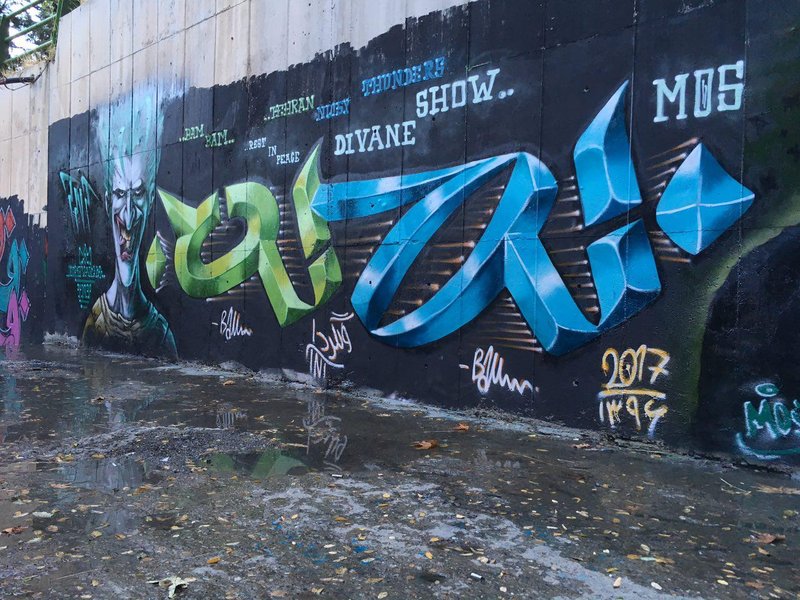
Bam Bam | Untitled
Accounts of modern graffiti usually begin in the urban culture of New York in the 1960s and 1970s. As hip-hop was taking shape, names and signatures spread across walls, trains, and other public surfaces, forming a new language of the city. TAKI 183 became one of the emblematic names of this early history. Later, artists such as Lee Quiñones and Futura pushed writing toward increasingly ambitious visual experiments. Subway cars, neighborhood walls, and the city itself became sites of rivalry and conversation. What began as an individual act gradually developed its own culture, codes, and vocabulary.
In Iran, the story unfolded differently. Contemporary graffiti and hip-hop first arrived through music, films, magazines, contact with international currents, the internet, and later social media. But the forms did not remain foreign for long. They met the social realities of Iranian life, the architecture of its cities, the Persian script, and the experiences of a younger generation. Out of that encounter came a distinct identity. Iranian graffiti is best understood not as an imitation of an imported model, but as a local reworking of a global visual culture.
To trace this history, we need to return to a time when “graffiti” still meant little to much of the public. The internet had not yet become part of everyday life, social media did not exist, and artists found one another through streets and music, scarce magazines, blogs, CDs, photographs, and word of mouth.
Graffiti in those years was less a recognized art movement than a private and often hidden urban experience. Some artists’ names were known more widely than their faces; the signature itself became an identity. A writer might remain invisible to the public while holding real standing within the small graffiti community. There was no formal path of instruction. Artists learned by looking closely at one another’s walls, searching out photographs and foreign magazines, experimenting, making mistakes, and sharing what they discovered with friends.
Hip-hop brought to Iran more than a new musical genre. It offered a different way of seeing and inhabiting the city. Its four commonly recognized elements—MCing or rap, DJing, breakdancing, and graffiti—had emerged from street culture as distinct forms of identity and invention. They did not develop in Iran at the same pace or follow a single route, yet they became closely linked in the imagination of a younger generation. Rap worked through words, DJing through sound, breakdancing through the body, and graffiti through image and space. The history of Iranian graffiti is therefore inseparable from the early history of hip-hop in the country. Both grew from the need to claim an identity and find a language for oneself within the city.
In the beginning, graffiti appeared in its most elemental form: the tag. A tag is the basic unit of graffiti writing, a personal signature made quickly with a pen, marker, or spray can. Its purpose is not primarily to display pictorial skill, but to place the writer’s chosen name and identity in public view. The name itself, the shape of the letters, the movement of the hand, the speed of execution, and the frequency with which it appears all give a tag its value. In New York, figures such as TAKI 183 demonstrated how central tagging was to the rise of writing culture. Iran’s first generations of writers, likewise used this direct visual language to mark their presence in the city before turning to larger and more elaborate work.
A tag said simply: someone was here. Yet that declaration could also be competitive. Names multiplied across the city, reached harder or more prominent locations, grew larger, and slowly gathered identities of their own. A tag was never only a signature. It belonged to a culture in which repetition, quality, speed, and placement could shape a writer’s reputation.
From the tag came the throw-up, a larger form designed to retain speed while commanding more space. Throw-ups usually rely on broad, simple letters, often rounded like bubbles or built from solid blocks. They take longer than tags, but must still be repeated quickly and remain visible from a distance. If the tag is a signature, the throw-up sits somewhere between the signature and the fully developed work. The artist’s name still anchors the image, though color, scale, and form now play a far greater role.
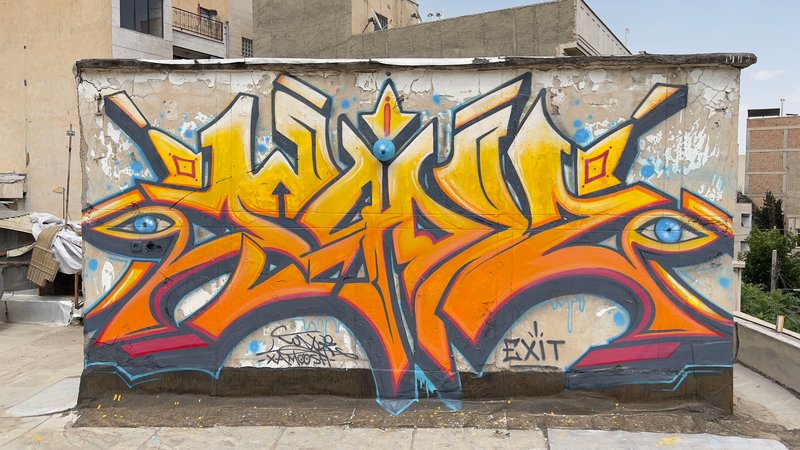
Xamoosh | Untitled
The piece, short for masterpiece, carries that development further. Larger, slower, and more intricate, it brings together lettering, color, shadow, volume, background, and composition. The name remains important, but the design of the letters, the handling of color, the balance of the composition, and the work’s overall visual character matter just as much. A piece can take hours and may be produced collaboratively by several artists.
Wildstyle stretches this language toward deliberate complexity. Its letters twist, overlap, extend, and fold into one another until the name becomes difficult for an uninitiated viewer to decipher. That difficulty is part of the form’s appeal. Legibility gives way to the writer’s command of a dense visual system. The work becomes a kind of puzzle, written in a language that reveals itself only to those familiar with its grammar.
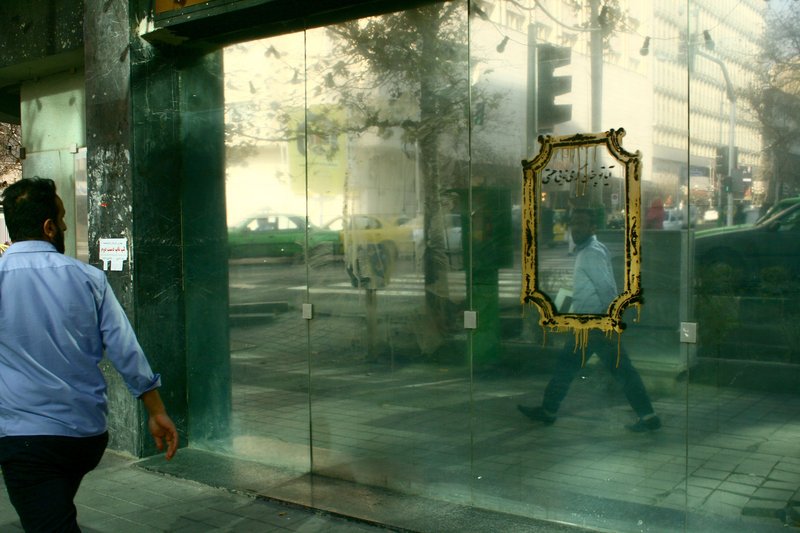
FRZ | Untitled
Iranian artists encountered these forms gradually, usually outside formal channels. Early writers learned the language without schools, manuals, or an established local tradition. A photograph of a wall in Tehran might serve an artist in another city as well as a textbook. The city itself became a classroom, while walls, underpasses, and other urban surfaces carried lessons from one writer to another.
Letters, however, are only part of graffiti’s visual world. The character—an invented pictorial figure—may accompany the writing or carry an artist’s narrative on its own. Cartoon figures, comic-book forms, imaginary faces, and strange creatures allow the artist to move beyond the written name. Repeated over time, a character can become a visual signature, sometimes more recognizable than the name behind it.
The history of graffiti is also a history of tools. Spray cans, markers, felt-tip pens, brushes, rollers, and improvised implements each leave a different kind of mark. Spray paint remains central because it is fast and can cover a large area, yet the result depends on the nozzle or cap, the pressure of the hand, the distance from the wall, and the pace of movement. Pens and markers suit tags and smaller work; brushes and rollers reach across broader surfaces. Street art widens the material field further, drawing on printers, paper, paste, stencils, wood, metal, fabric, and discarded or recycled matter.
In Iran, the Persian script has had a decisive effect on the form of graffiti. Its joined letters, fluid curves, and long horizontal extensions create possibilities unlike those of the Latin alphabet. Over time, Iranian artists began to build a visual language from these qualities—one that belonged neither to classical calligraphy nor to a straightforward imitation of Western graffiti.
Calligraffiti emerged from this space between writing and image. Letters no longer serve only to transmit words; they become images themselves. By stretching, turning, joining, and altering their proportions, the artist moves between meaning and form. Sometimes the word remains readable. Sometimes it changes so completely that only its movement survives. In either case, language is seen as much as it is read.
The meeting of a long calligraphic tradition with street culture has given Iranian graffiti and street art much of their visual distinction. Geometric forms, traditional motifs, Persian typography, architectural signs, and the textures of Iranian cities gradually entered the work. The result was not simple imitation, but the remaking of a global visual culture through local forms and conditions.
Nor did this development belong to Tehran alone. Across Iran, different architectural fabrics and social conditions produced different settings for street art. Tehran, with its scale, density, and visual disorder, became a major center, but other cities soon entered the story. Each offered its own walls, textures, restrictions, and forms of everyday life. The language shifted as it moved from one city to another.
The crew became another foundation of this culture. A crew brings artists together under a shared name, allowing them to collaborate on walls, projects, and related activities. Graffiti has always held individual identity in tension with collective life. The writer’s name matters deeply, yet friendship, rivalry, shared knowledge, and the formation of groups matter too.
Iranian crews and collectives appeared at different moments in this history. Velgarda, EXIT, and other active groups recur in accounts of the field, while early figures such as Khamoosh remain present in its collective memory. Their importance cannot be measured by the number of surviving works alone. They belonged to the period in which Iranian graffiti was discovering its own language and defining its unwritten rules. Much of that history is still fragile. It survives in artists’ memories, old photographs, and oral accounts rather than in established archives.
That absence made media especially important. When written records were scarce, personal photographs and private collections became the movement’s memory. As internet access spread, that memory began to migrate from the wall to the screen. Blogs, websites, and later social media gave artists new ways to document and circulate work that might otherwise disappear. Platforms such as Iran Graffiti helped record and introduce parts of the movement, and were followed by more specialized publications and projects. The documentary Divar offered one of the important attempts to tell the story of contemporary graffiti in Iran through the perspectives of its early generations. Divarnameh later carried this work into print, gathering material that had circulated in fragments online and giving part of the culture a form that could be kept, revisited, and archived.
Media soon became more than a vehicle for publicity; it entered the culture itself. Magazines, websites, channels, and dedicated pages served at once as archives, meeting places, and spaces of discussion. Podcasts and recorded conversations added the voices of artists to a history that had previously been told mainly through images, aliases, and signatures. This matters because the history of Iranian graffiti does not belong to walls alone. It also belongs to the people who stood in front of them, each carrying the story of a city, a neighborhood, a moment, and a generation.
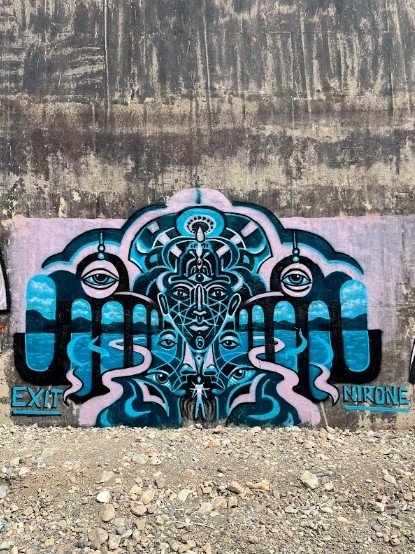
Nirone | Untitled
Street art gradually opened another path. Where graffiti remained closely tied to writing, signatures, and the construction of individual identity, street art made room for a wider range of images and ideas. Narrative, humor, metaphor, invented characters, and direct interventions in urban space all entered the field. Stencils, wheatpaste, stickers, and murals expanded the ways an image could be made, placed, and shared across the city.
Stenciling became one of its most recognizable techniques. A cut template allows an image to be transferred to a surface quickly and with relative precision. Banksy helped bring the method to global public attention, but its history and reach extend far beyond any single artist. Across different cities, stencils have carried widely different languages, subjects, and political meanings.
Wheatpaste made other scales and degrees of detail possible. An image could be prepared beforehand, printed, and then attached to a wall in public space. Stickers offered an even quicker and smaller intervention. Applied in seconds, a well-placed sticker might still linger for years in the city’s visual memory.
Murals changed the scale of the encounter. A wall several meters high could become a canvas capable of addressing a neighborhood or an entire city. Yet size and location alone do not make a mural street art. Its relationship to the site, to the people who meet it, and to the social life around it is what gives the work a street identity.
In Iran, murals have appeared both as official urban commissions and as independent artistic acts. This has sharpened one of the field’s enduring questions: where does street art end and official mural painting begin? If an organization commissions an artist to paint a designated wall, does the work still belong to the street? And if a piece conceived for a gallery is later moved outdoors, has its meaning—or its nature—changed? There is no final answer. What these questions make clear is that graffiti and street art are shaped less by technique alone than by context: by where a work appears, how it occupies public space, and how people encounter it.
The material character of Iranian cities has also shaped the work. Brick walls dominate many European streets, while concrete, cement render, stone, and metal shutters are more common across Iran. Rough surfaces absorb paint differently. Harsh sunlight, dust, pollution, and changes in temperature affect color, tools, line weight, and even the hour at which a work can be made. A street artist must first learn the surface. Paint behaves differently on concrete, stone, and metal; a shutter, a rendered wall, and a brick facade each resist and receive the image in their own way.
Light, scale, and location alter the design as well. A work made for a narrow alley cannot follow the same logic as one running beside a highway. Seen from a moving car, fine detail disappears, while broad forms, strong contrasts, and simpler compositions hold their force. At walking pace, the artist can invite a slower reading and build a denser narrative.
Graffiti is also governed by time in a way that painting on canvas is not. Speed belongs to the form. A writer may have only a brief window in which to complete the work, so preparation and technical command become essential. Designs are often drawn and redrawn before the artist reaches the wall, allowing the public act itself to unfold with as little delay as possible. Street art does not always emerge under the same pressure. Some urban projects take weeks or months to plan. The culture therefore contains radically different experiences of time, from the tag completed in seconds to the mural produced by several artists over days or weeks.
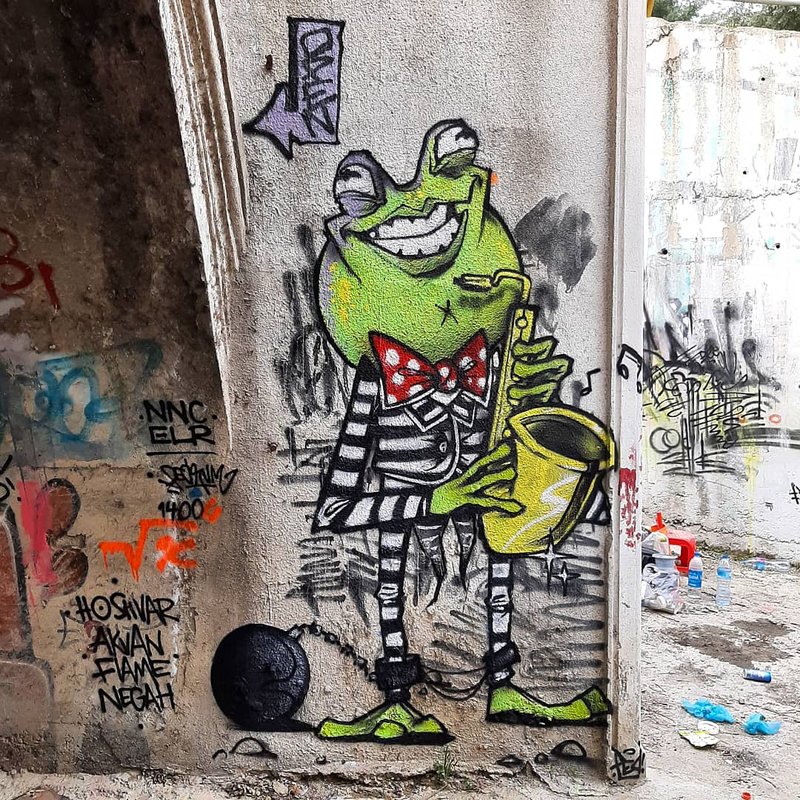
Ped | Untitled
A later generation began to imagine graffiti beyond the wall. For these artists, work might start in the street and continue through canvas, sculpture, print, clothing, design, music, video, installation, or digital space. Unlike the first generation, these artists had grown up with the internet. They could paint a wall and post its image to Instagram almost at once; they could make work in the street while keeping another version in the studio. The meaning of the “street work” changed accordingly, becoming inseparable from digital recording and reproduction.
Social media loosened the ties between a work and its location. Images reached viewers who might never stand before the original wall, and many works were photographed with their online life already in mind. The image could outlast the wall by years.Yet a digital image cannot reproduce the bodily e xperience of the work. To stand before an immense wall, feel its texture, and register the effects of light, distance, and scale is different from seeing the same image on a phone. Street art draws meaning from the world around it: traffic and footsteps, nearby buildings, the sound of the street, and even the hour of the day. This is why, despite the reach of digital media, some artists still want their work to be encountered in the street rather than only on a screen. There, the image enters a particular day, hour, and season. It may also enter, unexpectedly, the life of a stranger passing by.
Women also became increasingly visible within Iranian graffiti and street art during these years. Early histories of the culture often formed around male names, but any fuller account must include the women who worked across graffiti, murals, stenciling, calligraffiti, illustration, and other forms of urban intervention. Their presence cannot be understood simply by adding several names to an existing list. Women’s lived experience of the city, their access to public space, and their ways of thinking through the body, identity, society, and the urban environment have opened different possibilities within street art. Much of this history still needs careful documentation. Early work, in particular, often escaped official archives and remains scattered across personal memories and isolated pages.
Graffiti has also retained its bond with hip-hop. The field has grown more independent and often moves beyond that culture, yet it still carries an early commitment to invention, autonomy, the remaking of space, and the search for a language of one’s own. Seen this way, the city is not only inhabited; it is continually interpreted and rewritten. The movement’s entry into formal art spaces marked a major turn in its history. A language first developed on walls began to appear on canvas, metal, wood, fabric, and industrial objects. Prints, editions, sculpture, and installation extended its reach. Graffiti could leave the wall, it seemed, without leaving its identity entirely behind.
Not every artist understood this transition in the same way. Some within the graffiti community saw the gallery as a departure from the culture’s street roots. Others found in it the time, visibility, and resources needed to continue experimenting. For one group, the street had to remain independent; for another, the gallery offered a further space in which the language could grow.
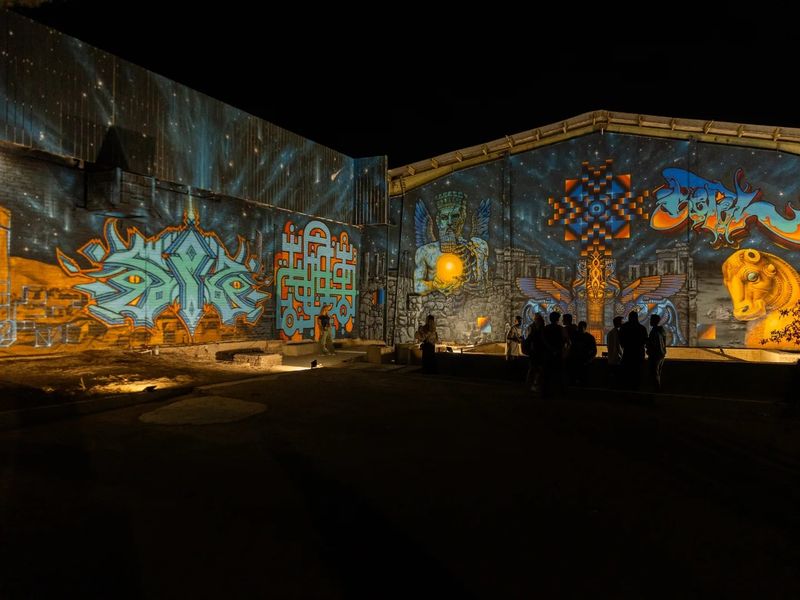
The two spaces also produce different kinds of attention. In the street, the encounter is unplanned. A person going about an ordinary day suddenly meets a word, an image, or a field of color. The work enters daily life without asking permission. In a gallery, viewers arrive intending to see art. The work receives a title, date, price, and owner and enters another system of value. The street places the work within life; the gallery places it within art history. These positions need not be opposed. The more difficult question is what happens in the passage between them, and how much of the first encounter survives. Exhibitions rooted in street culture, invitations extended to graffiti artists by formal institutions, and attempts to carry the wall into the gallery all belong to this passage. Projects such as From Wall to Work at Lika Art Factory are important for precisely this reason. They ask how the experience of the street might enter an art space without being stripped of the context and history that first gave it meaning.
Collective projects and independent events have become increasingly important in recent years. Dihim belongs to this development. Set within an industrial factory space, it brought several artists together to work with the site, its walls, and one another. The value of such a project lies not only in the finished images, but also in the collaboration and shared experience it makes possible. An abandoned factory becomes a place of cultural production; walls once embedded in an economic process become surfaces for art. This change of use continues one of street art’s oldest instincts: to find meaning in places others have stopped seeing.
Group projects have changed the social structure of the field as well. Where many graffiti artists once worked alone or within small crews, there is now more room for collective commissions, exhibitions, educational programs, workshops, public conversations, and interdisciplinary events. Perhaps the most important change has been a shift from making individual works to building a wider culture around them. Magazines, podcasts, websites, exhibitions, urban projects, independent spaces, and collective events have formed an ecosystem in which the work can circulate and be remembered. Iranian graffiti no longer lives only on walls. It persists in photographs, interviews, films, books, online archives, and in the memories of those who watched this history emerge.
The art market inevitably enters this expanded field. Once a graffiti artist remakes a work on canvas, wood, metal, or paper, it enters a system unlike the street. It can be priced, owned, sold, displayed, and collected. For some artists, this offers financial independence and the means to sustain a practice. For others, it raises the fear that an autonomous culture might be reduced to a commodity. The market and the street are not always opposites. Artists around the world have worked in both spaces and found ways to move between them. The real question is whether an artist can retain control of their language rather than allow the market to define it. In Iran, this negotiation is still unfolding. Exhibitions, sales, commissions, brand collaborations, and work across design, fashion, music, and other visual fields have made the borders of graffiti increasingly fluid. Such changes leave difficult questions behind. Does an artist remain part of street culture after entering the market? When a tag becomes a signature, and the signature a personal brand, what—if anything—has been lost? Perhaps this is simply one path through which an artist’s practice develops. The questions resist a single answer.
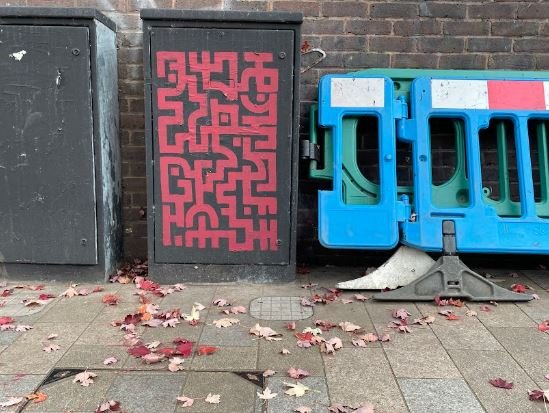
Ghaar | Untitled
Iranian graffiti can no longer be described as a small, marginal phenomenon. It now has a history long enough to contain several generations: those who first placed their signatures across the city; those who reshaped the language of letters; those who worked through stencils and wheatpaste; and those who moved toward large murals. Some treated the street as home. Others now travel between wall, studio, and gallery. Each generation has inherited the language, altered it, and passed something different forward.
Global movements have deeply influenced graffiti in Iran, but Iranian cities have transformed what they received. Persian script, local architecture, restrictions on urban space, and the social experiences of successive generations have all pressed the form in different directions. These differences do not separate Iranian graffiti from its wider history. They show how a visual language changes through adoption, pressure, and local reinvention. This is why no fixed definition or short list of names can contain graffiti and street art in Iran. Tags, throw-ups, pieces, stencils, stickers, wheatpaste, murals, calligraffiti, and other interventions overlap, while artists move continually between streets, studios, galleries, and other media. That movement is not incidental to the field; it is one of its defining conditions.The movement now faces the urgent work of documentation, education, and institution building. Too much of Iranian graffiti history remains dispersed among private photographs, vanished webpages, and artists’ memories. Without sustained attention, parts of it will disappear. Independent archives, books, magazines, documentaries, interviews, and serious research can preserve a history that the walls themselves cannot hold indefinitely.
Meanwhile, a new generation is entering the field with more tools and almost immediate access to global culture. Its difficulty is no longer finding images, but developing a language that does more than repeat them. Earlier Iranian writers might have searched for months to locate a single photograph or magazine. A young artist can now see thousands of images in minutes. That abundance does not produce an individual voice on its own. The old question remains: what does the artist need to say, and what form can make that language their own?
The future of this culture will not be found entirely in the gallery or entirely in the street. Its energy has always come from moving between the two, between sanctioned and unsanctioned space, survival and disappearance, documentation and erasure. That movement is not a crisis to be resolved. It belongs to the form itself.
Graffiti and street art have always occupied borders: between art and ordinary life, architecture and image, protest and beauty, the visible city and the histories that remain buried within it. The movement therefore cannot be known only through the images that still survive on walls. Its history also lives in the routes by which ideas and practices travelled: conversations among artists, photographs and films, publications that gathered otherwise scattered material, and networks that carried work and experience across cities and generations. Many of the artists who shaped Iranian graffiti may never appear in official histories of art, even though they helped form the visual culture of the city. Their works were painted over, lost, or erased when urban spaces changed and buildings disappeared. What remains can still be followed through personal archives, photographs, films, magazines, and oral histories. The movement from wall to gallery, and sometimes back to the street, reveals another part of this history. The first generation treated the city as a place in which art could be made and voiced. Later artists forged new relationships between street and studio, gallery and screen. The history of graffiti in Iran is, in this sense, the history of an urban culture carried across generations. Its works are temporary by nature, but for as long as they remain, they hold a fragment of the city’s experience and visual memory. To study graffiti is therefore to study more than images on walls. It is to study the relationship between art, public space, lived experience, and the ways a city remembers.
In memory of the loved ones lost in this land
In memory of Neesh, Naghsh, and Hanjar
Cover & Slider Images: