





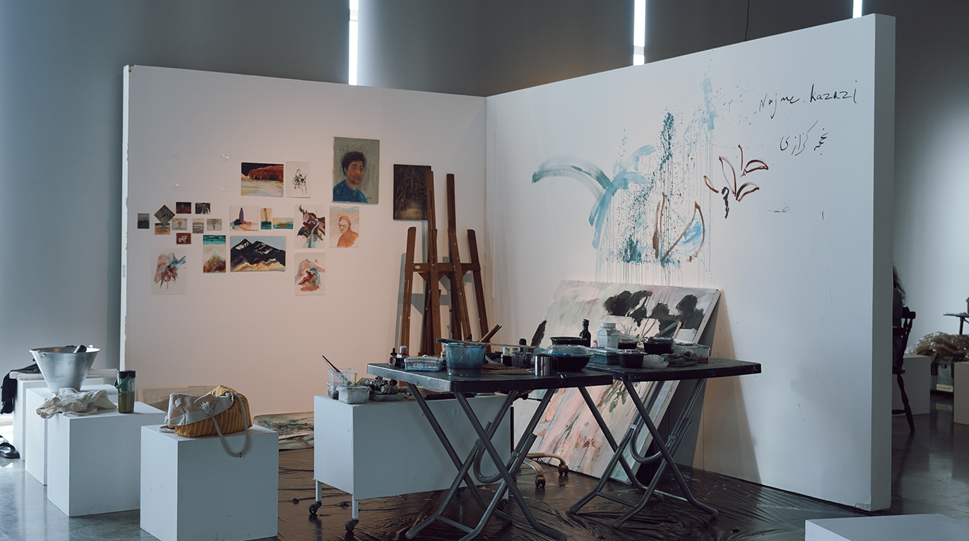
Beyond the Gallery: Redefining the Role of Iran's Art Community in the Shadow of War
01 Jul 2026The recent war in Iran has added another layer of pressure to an art scene already working within difficult economic and institutional conditions. In its aftermath, the suspension of gallery programs and the instability of studio spaces have drawn attention to a fundamental aspect of artistic production, that art is not made through individual practice alone, but through access to space, time, material resources, conversation, and community. For many artists, the question has not only been how to continue exhibiting, but how to continue working. Where to make work, how to remain connected to peers, and how to sustain artistic practice when the conditions that support it have been disrupted.
In response, a number of galleries, artists, curators, and cultural organizers in Iran have begun to create temporary structures of support. These initiatives do not simply represent a return to normal programming after a period of interruption. Rather, they suggest a collective effort to rethink the social role of the gallery and the wider art community. Through open studios, temporary workspaces, proposal-based residencies, zine and printmaking calls, and process-oriented exhibitions, the Iranian art scene has begun to reorganize around practices of proximity, mutual aid, public process, and shared responsibility.
This article examines these initiatives as part of an emerging cultural response to crisis. In Iran, projects such as Bostan Gallery's Artist at Work 2, TouchPoint No. 00: Self-Portrait at 8Cube Gallery, Didar Gallery's studio-based residency, Negah Gallery's Ravayat-e Asar and Tehran Zine's one-sheet zine Opencall each respond to the disrupted conditions of artistic production in different ways. Some provide space to work; others foreground process, narration, publication, or proposal-making. Together, they show how galleries and cultural organizers are creating temporary structures through which artists can continue to work, gather, and remain visible.
The closure or suspension of gallery activity during crisis is often described as an interruption in exhibition programming. Yet for artists, such interruptions extend far beyond the exhibition calendar. Artistic production requires a set of material and social conditions, that is access to space, tools, time, storage, conversation, public encounter, and institutional support. When these conditions are weakened, artists lose not only opportunities for visibility, but also the practical frameworks through which work is developed. A studio, for instance, is not merely a physical room. It is a site of routine, experimentation, failure, repetition, and thought. Its loss affects the continuity of artistic practice at a fundamental level.
The recent initiatives in Iran respond precisely to this problem. Rather than focusing only on the exhibition of finished works, they address the conditions that allow work to be made. They shift attention from the artwork as a final object to the artistic process as a shared social activity. In doing so, they also expand the responsibility of the gallery. The gallery becomes not simply a place of display, but a temporary workspace, a point of gathering, a space of study, and in some cases, a platform for mutual support.
Bostan Gallery's Artist at Work 2
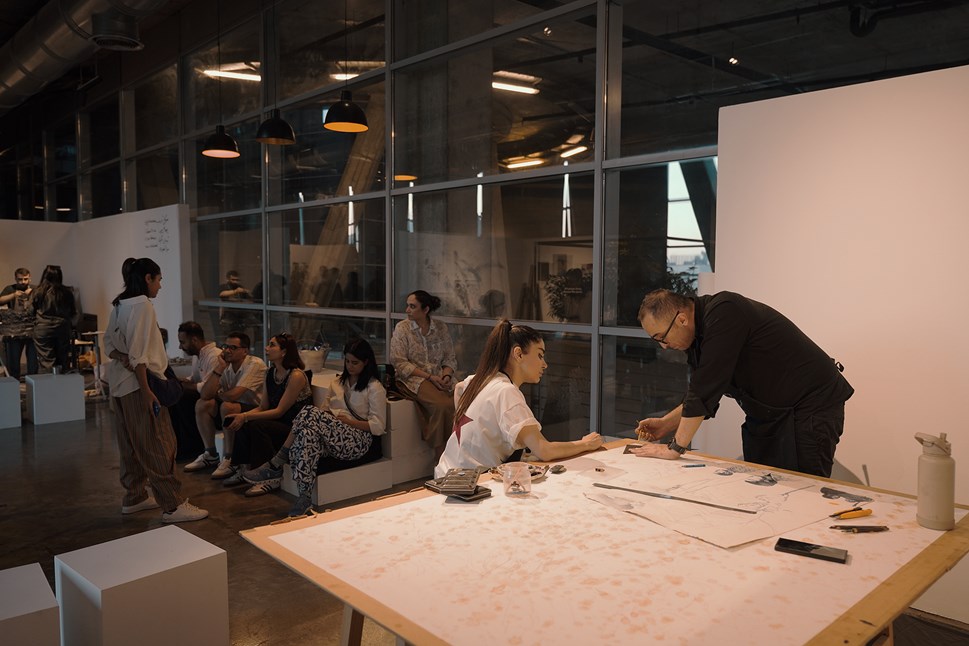
Bostan Gallery's Artist at Work 2 is the most dynamic example of this shift. The project, described as a temporary residency and daily space for individual work and encounter with audiences, invites one artist at a time to occupy the gallery from morning until night. The artist works in the space throughout the day, while visitors are able to observe the process. At the end of each week, the works and experiences of the participating artists are brought together in a group presentation.
What makes Bostan's project particularly significant is that it does not simply provide a studio, nor does it merely stage an exhibition. It places the act of artistic production itself at the center of public attention. The artist is not presented only through the completed work, but through the duration of working. The acts of choosing, hesitating, repeating, making, undoing, and responding to the space become significant. The project therefore approaches artistic labor as a form of performance. This is not performance in the theatrical sense, but performance as presence, duration, and process.
This emphasis on process is especially meaningful in the aftermath of war. In such a context, artistic production can easily be pushed to the margins, treated as secondary to more urgent social and material concerns. Bostan's project does not argue for the importance of art through direct political declaration. Instead, it shows the labor of art as an act of continuity. The artist's presence in the gallery becomes a way of making artistic work visible as part of everyday life and communal recovery. To work publicly is to allow the audience to witness not only an artwork, but the conditions, gestures, and decisions through which that work comes into being.
The daily and weekly structure of the project reinforces this reading. Each day centers on one artist's presence and process, while each week culminates in a group presentation of the works and experiences gathered in the gallery. This sequence of production, encounter, accumulation, and exhibition distinguishes the project from conventional programming. The final presentation is not detached from the making that precedes it; it extends that process. Visitors encounter artistic labor before the completed object, and this shifts spectatorship away from the finished work alone and toward proximity, process, and shared attention to making.
TouchPoint No. 00: Self-Portrait at 8Cube Gallery
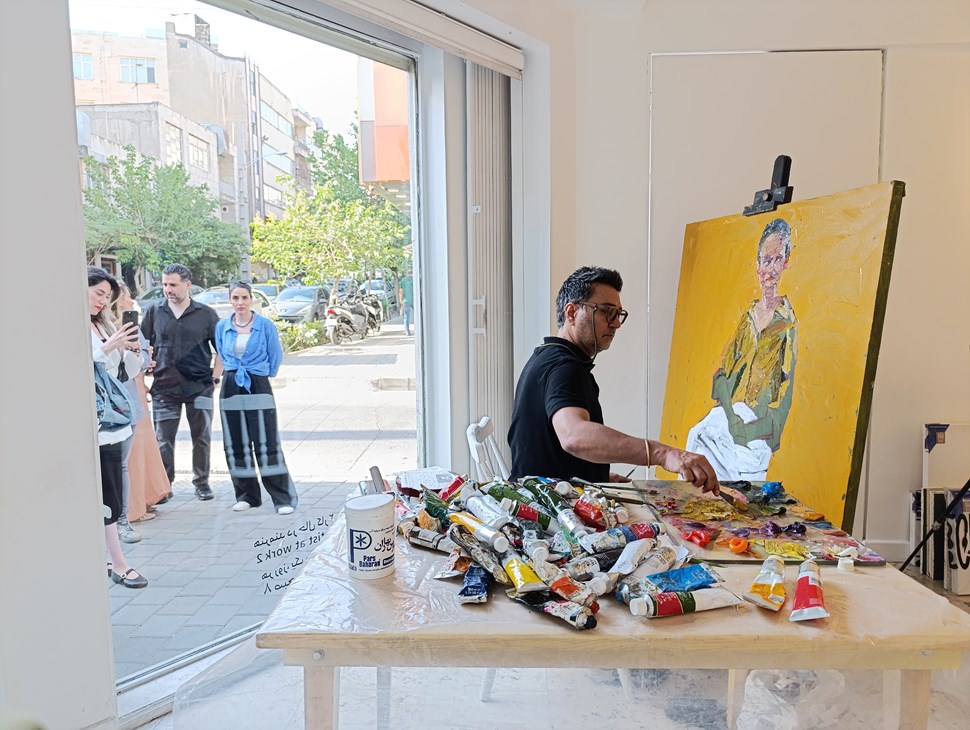
TouchPoint No. 00: Self-Portrait, the first edition of the TouchPoint project, took place at 8Cube Gallery and was curated and produced by Amin Davaei. Like Bostan's Artist at Work 2, the project is based on the logic of the open studio: artists are given a space in which to work, while the audience is invited to encounter the process of production rather than only the completed object. The edition gathered artists from different media in a shared setting, making the studio visible as a site of conversation, experimentation, and public encounter.
The title Self-Portrait is important because it expands the idea of portraiture beyond the image of a face or a finished representation of the self. In this context, self-portraiture becomes a process shaped by presence, material choices, pauses, doubts, repetitions, and exchanges with others in the space. The project therefore frames the artist's work as something that unfolds in real time and in relation to the audience, the architecture of the gallery, and the other artists working nearby.
TouchPoint also turns artistic production into a performative situation. The performance does not depend on spectacle; it is produced through duration, labor, and exposure of process. Visitors are able to see how ideas take shape, how collaborations and conversations emerge, and how the distance between studio and exhibition is reduced. After the open-studio period, the resulting works are exhibited, allowing the project to move from process to presentation while keeping the memory of production attached to the final works.
Other Structures of Support
Didar Gallery's studio-based residency call offers another model of support. In response to current conditions, the gallery announced that it would allocate part of its basement spaces to studio-oriented artistic residencies through an open proposal process. These spaces are intended to support the production of work, artistic research, focused practice, and experimentation. The project also allows for the possibility of open studios or exhibitions at the end of each residency period. Here, the emphasis is less on public performance and more on infrastructure. Didar's initiative recognizes that many artists require time and space before they require exhibition. By offering part of the gallery as a workspace, the institution redirects attention to the earlier and often less visible stages of artistic production. This is significant because the gallery's usual public function is reversed. Instead of waiting for completed works to enter the exhibition space, the gallery makes room for the process through which those works may come into existence.
Negah Gallery's Ravayat-e Asar similarly frames artistic production as both individual and social. Introduced in response to recent events and the pressures placed on artists in Iran, the project offered the gallery's workspace free of charge over several days. Artists were invited to bring their own tools and materials, work in the space, and prepare a short three-line statement about their work. The final exhibition of selected works therefore became not only a presentation of objects, but also a gathering of processes and narratives. By asking artists to articulate the story of the work without overburdening it with explanation, the project connected making, reflection, and public presentation.
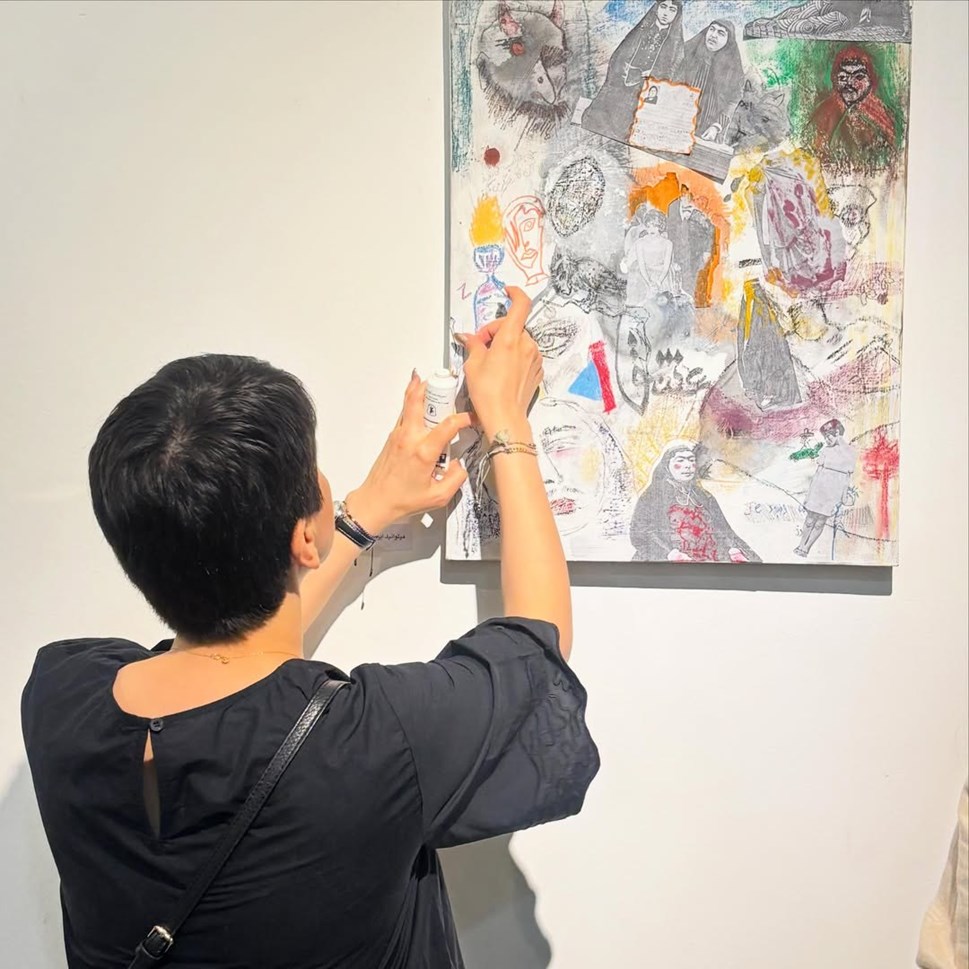
Tehran Zine's one-sheet zine call introduces accessibility as another form of cultural continuity. The call invited artists to create a zine from a single A3 sheet, using cutting and folding to transform one page into multiple pages. Unlike studio-based initiatives, this format does not depend on access to a gallery, large workspace, or expensive materials. Its small scale, portability, and reproducibility make it especially relevant when conventional infrastructures are unstable. The one-sheet zine becomes a compact space for expression: a visual essay, diary, archive, protest, or intimate publication. Tehran Zine's project shows that artistic participation can also be sustained through modest and easily circulated forms.
The importance of these initiatives lies in their shared effort to redistribute the conditions of artistic production. Under ordinary circumstances, the art world often organizes artists through competition. In these projects, competition does not disappear, but it is accompanied by another logic, that of proximity, support, shared space, and mutual recognition. Artists are invited to work beside one another, to be seen while making, to submit proposals, to fold pages, and to imagine future projects.
Rather than describing these initiatives only through the language of resilience, it is more useful to understand them as temporary cultural infrastructures. They reorganize space, time, labor, and community in order to sustain artistic practice under pressure. Their significance lies not only in the opportunities they provide, but in the model of artistic community they propose: one based on shared responsibility, public process, and care. In the aftermath of war, the Iranian art scene is not simply waiting for normalconditions to return. It is actively creating provisional forms of continuity through galleries, artists, and audiences learning how to hold one another together.
Cover & Slider Images:
- Darz Archive

