




Abbas Akhavan Refuses to Perform an Identity: In Conversation with Frieze Magazine
10 May 2026This conversation between curator Aram Moshayedi and artist Abbas Akhavan took place in the immediate aftermath of military strikes on Iran – an event that inevitably shapes the tenor of their exchange. While the discussion turns to Akhavan’s upcoming projects, including his Venice Biennale presentation at the Canada Pavilion (commissioned by the National Gallery of Canada) and an upcoming survey at the Walker Art Center in Minneapolis, it also reflects on the uneasy expectations placed on artists in moments of political crisis. Moving between questions of diasporic distance, cultural representation and the limits of artistic agency, Akhavan speaks candidly about the pressures to perform identity – and the possibility that withholding, rather than declaration, can itself be a position.
Aram Moshayedi I’m having a hard time wrapping my head around how to begin in light of the last few days in Iran. How to address the situation there obviously weighs upon me, but I also feel as outsiders we don’t have much authority on the subject. The tenor of this conversation would be so different if we’d spoken last week. While the focus is still you and your work, I want to ask before we begin: how do we deal with this military attack on Iran from your perspective as an Iranian Canadian artist?
Abbas Akhavan I currently live in Berlin. As I was walking home to get to this call, I was amazed at how everyone is going about their day as if nothing grave has happened. They’re just living their lives. And I thought: Oh yes, so am I. It’s as if it’s just another day, when obviously it isn’t. As of now, there hasn’t been time to reflect on what any of this means. Having said that, I feel like we’re still in the extended version of the ‘shock and awe’ strategy the US military used in Iraq in 2003. It is horrendous.
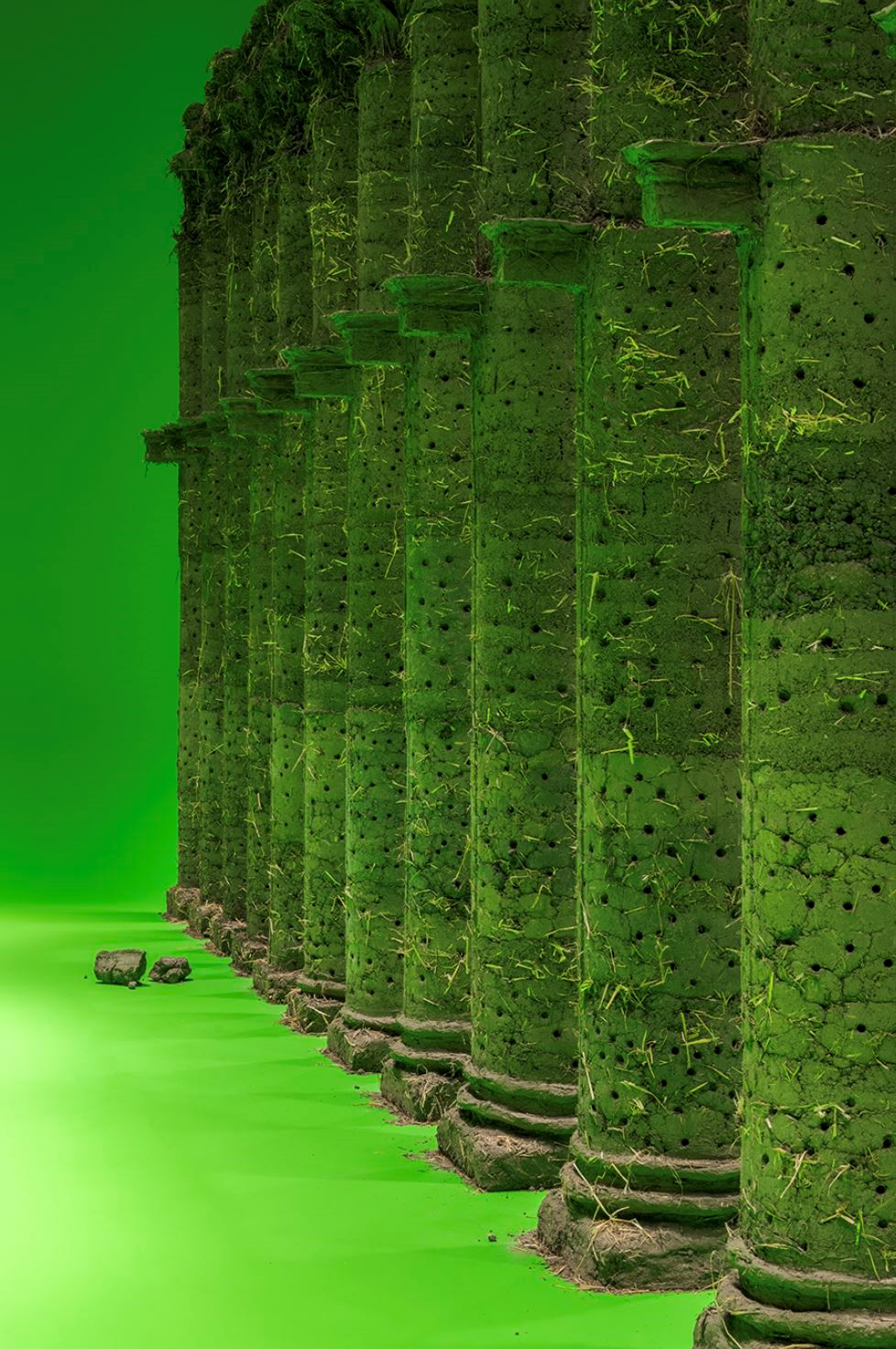
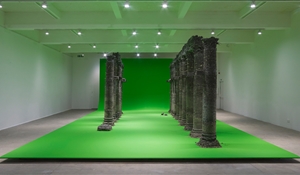
Abbas Akhavan | Curtain Call- Variations on a Folly | 2021
AM In my case, I feel an emotional heaviness around this, but I am also apprehensive or reluctant to speak in any direct way about my perceptions or how I feel about what is happening or what will happen in Iran. Perhaps there is a similarity in how you have navigated speaking about your own identity. None of this is made any easier when there’s a war going on and you’re called upon to speak on behalf of an entire population from which you are disconnected. But it’s also a question of how to navigate these conversations, even among other Iranians, and how to talk about something without having to talk about it.
AA Iranians do have two tongues. Our language has an underbelly – not necessarily a negative one, but we speak in funny ways, where what you say isn’t always what you mean, and what you mean isn’t what you say. An obvious example of that is taarof – ritualized politeness – and those models of spoken courtesy and etiquette. The long-standing political climate of post-revolution has further facilitated these cloaked means of communication, or lack thereof.
AM It’s interesting to think about that in relation to the ways artists cultivate a mythology or persona, or choose to assert or withhold an identity. Withholding isn’t simply a lack of participation; it can be a form of visibility on different terms.
AA I understood at quite a young age that withholding or irreconcilability can provide a lot of agency and space. But I think my reticence around national identity is partly a by-product of being Canadian. There’s an ambivalence in Canada about strongly identifying as Canadian; that patriotism or collective identity only really congeals in cases such as when the US becomes a point of opposition. I actually celebrate that ambivalence, even while recognizing Canada’s enormous failures, particularly around Indigenous histories and reparations. That context has calibrated my Iranianness in a specific way. I left Iran when I was 11 and have never gone back. And so, more and more, for obvious reasons, I feel a great sense of distance from my birthplace. I don’t think these are concerns I need to analyze or express in my work. It’s just how life has unfolded. People often come up to me to celebrate the work because they think it’s all about my biography. I usually just nod politely, realizing they have no idea what I’m doing.
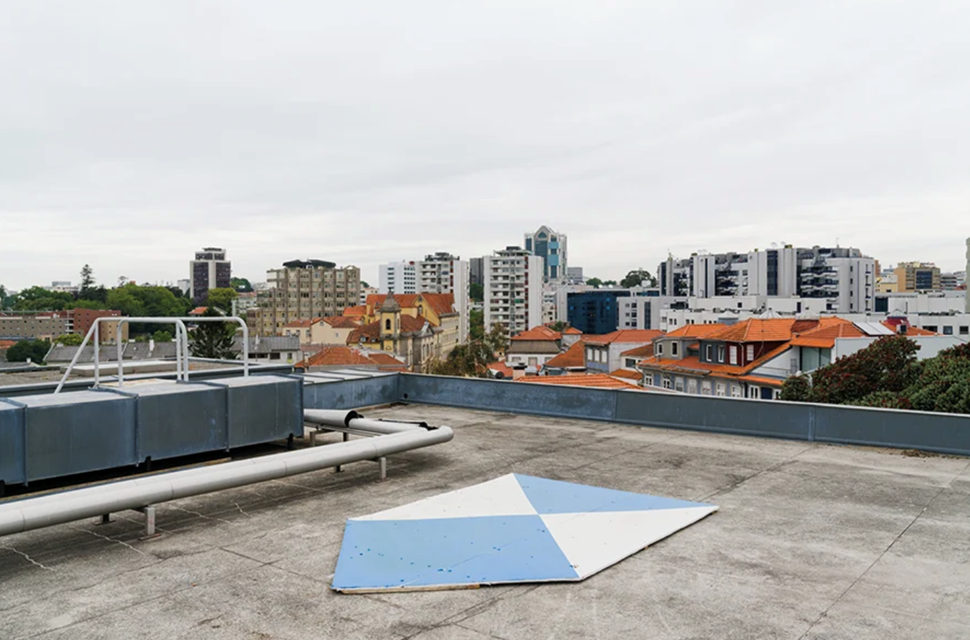
Study for a Blue Shield, 2010–17, installation view, ‘Deserted. Something that happened can happen again’, Porto Municipal Gallery, 2019. Courtesy: Catriona Jeffries, Vancouver
AM If anything, the question of identity is a dubious one. As Iranians living outside the country, we all have varied relationships to the place and its history. A reluctance to speak can be an awareness of instability, as opposed to the embrace of the diasporic Iranian who is hyper-present, hyper-visible, even flag-waving, occupying a position of their own assuredness and confidence when all we really have is misinformation and misrepresentation.
AA And distance.
AM Exactly. So the question is how to occupy that productively, rather than falling into the trap of claiming you are uniquely positioned to have an opinion about a political situation to which you are only proximate. Maybe that’s a productive place to begin: what self are we calling upon to participate in this conversation, in this moment?
AA I remember being at a biennial where, during the press preview, one artist was performing a very traditional dance. I won’t disclose too much, but they were performing in traditional garments while people on their cell phones walked by chatting and drinking coffee, carrying on as if nothing unusual was happening. I was struck by the indecency. If this thing is somehow a tradition that is potentially sacred, then why is it being performed at a press preview? And if it’s not sacred, then people are being duped into some hawked narrative of authenticity. The current, very market-driven art world produces these mannered exchanges that overshadow real and at times urgent connections.
AM Hearing you speak reminds me of Tirdad Zolghadr’s curatorial project and later book Ethnic Marketing [2007] and his critical engagement with what he described as American and European xenophilia towards the so-called Third World. That project has always been an important touchstone for me, because it questions the willingness of artists to satisfy those desires. It also brings up the idea that artworks won’t necessarily behave as intended. That seems potent in relation to the construction of one’s identity in this moment, and how I still find myself advocating for a type of practice that is inherently unresolvable.
AA You bring this up because we share a similar blurry way of moving through the world. To be honest, I find it a tired topic, yet one that is still very prevalent. Currently the art lens is rather myopic and reductive, and very ornamental. We’re in a moment when artists’ subjectivity has collapsed into endless self-excavation. There is a lot of demand to perform biographical confessions, conflated with identity, as a means to authenticity. Yet these expectations, which I think are infantilizing, come with inflated moral obligations to provide solutions for world problems. So artists aren’t given room to think about the world in complex ways outside of their autobiography. And often what is at stake is self-preservation.
When I show the work curtain call, variations on a folly [2021] – based on the colonnade from the Arch of Palmyra – I sometimes get asked why I care about Syria when I am not Syrian. So if it’s not directly related to my own biography – if I’m not protecting, say, atheist Iranians from Montreal, then I don’t have a right to speak about the world. The same goes for the work about Iraq.
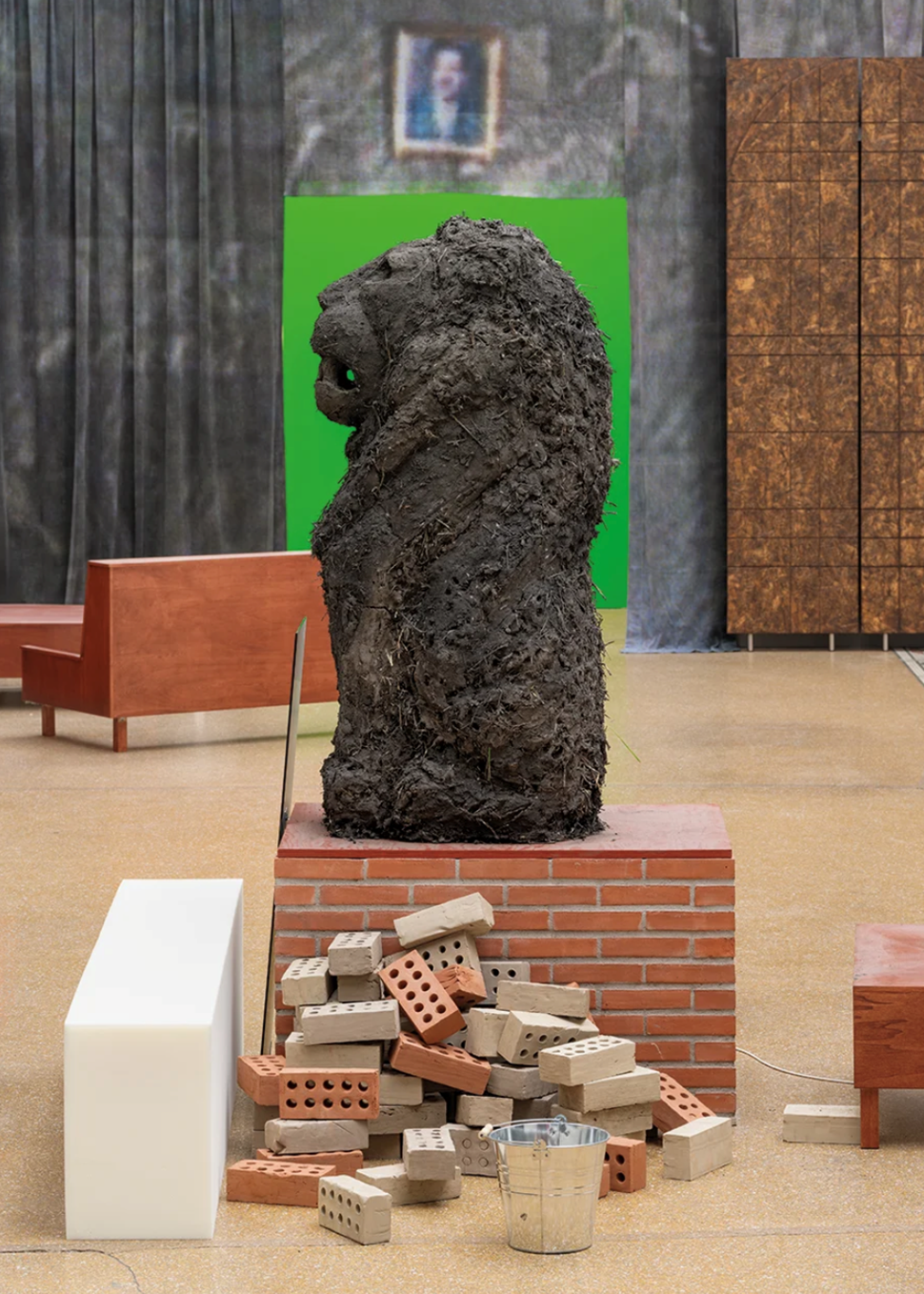
cast for a folly, 2023, installation view, ‘curtain call’, Ny Carlsberg Glyptotek, Copenhagen, 2023. Courtesy: the artist and The Third Line, Dubai; photograph: David Stjernholm
AM You’ve talked before about how certain historical moments come to possess your attention. Places like Syria and Iraq are part of that worldview, particularly in terms of the destruction of cultural heritage. How do you characterize your engagement with the historical traumas that present themselves to you as an artist?
AA Everything I have made about Iraq and Syria has been about and in defence of art. Whether it’s Study for a Blue Shield [2010], cast for a folly [2019] or curtain call, variations on a folly, these are works about places where art is held and preserved. These concerns came from reading the news in the UK or watching television in Montreal. They were histories revealing themselves before my eyes, be it the iconoclasms of ISIS, the destruction of museums during war, or how Iraqis saved ancient artefacts by burying them in their gardens.
I’ve been thinking more and more that what we do as artists is tell stories about what is happening, not necessarily directly around us, but in the world we inhabit. And that story does not have to exclusively be about us. One can witness with an analytical perspective on history without being the subject of it.
I think a lot about the preservation of art, and by extension culture, as a beautiful impossibility in a world increasingly governed by quantitative measures of value. So much energy goes into preserving things that are revered as ‘heritage’ and art, yet are moments away from becoming rubble. We keep seeing that on television: the slow progression of becoming, then the abrupt violence of unbecoming, then the immense effort to gather the fragments again, as with the National Museum of Iraq [which was looted following the US and UK-led invasion in 2003].
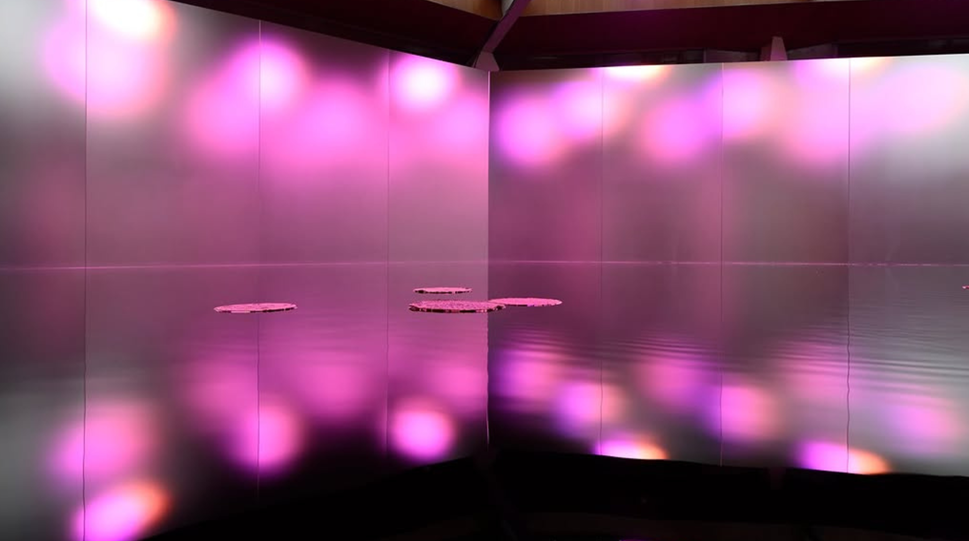
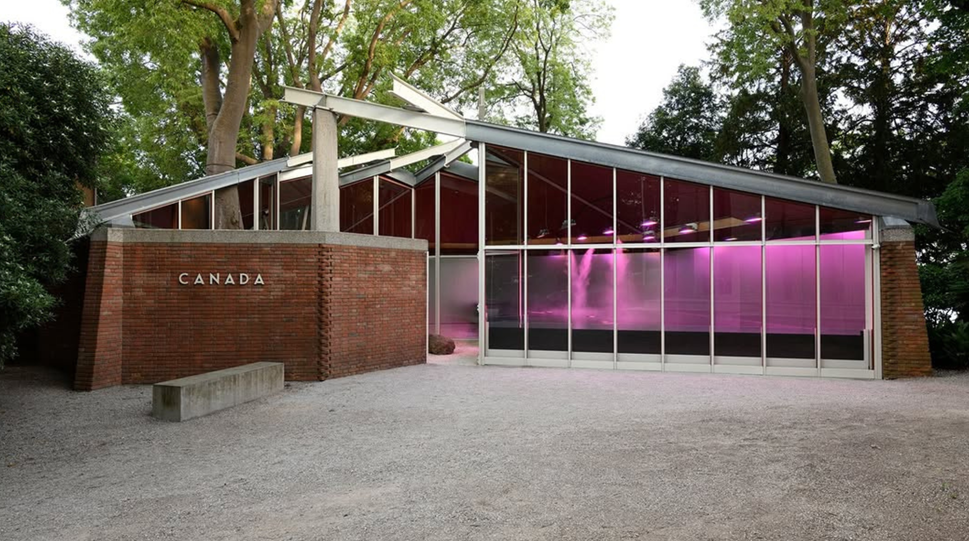
AM It feels like there are two significant points here. One is your presentation in the Canadian Pavilion at Venice: having to reconcile your reticence around national identity with the framework of national representation. The other is your survey exhibition at the Walker Art Center in Minneapolis later this year and the question of how to revisit works that were originally conceived site-specifically.
AA As I said to the director of the National Gallery of Canada, perhaps my ambition was never to represent a country; my hope was to be censored by a nation. Not in a strategic way, not by manufacturing provocation, but because it would mean something in the work is alive enough to create friction, to merit censorship.
A few years ago, I was told that I’d been shortlisted for the Venice Biennale, and I asked for my name to be removed. The jury changes every cycle, so you might never be nominated again, but at that point I felt I had nothing to offer. So when the opportunity came around again, I was genuinely surprised. Sometimes ambition gets calibrated for you. You get swept up by the professional river of art and suddenly land somewhere and realize you didn’t have enough time to consider this. In the case of Venice, it’s hard to predict. Only time will tell what this all means.
For me, when something is a no, it’s extremely loud. When I was younger, at times of real financial precarity, I had offers from very large galleries and immediately knew ‘no’. The yes is never as clear; it’s just not a ‘no’. In this case, I didn’t hear the no as loudly, so I let myself explore it. I am really trying to treat this as just another exhibition. There’s enormous pressure, especially with this platform, to take positions on world politics. Social media has intensified all this: it’s no longer about who is right, but who is the loudest. But I believe in these divisive times, art can still function as a form of diplomacy. It’s only in close contact that the deformations we project onto each other can begin to loosen.
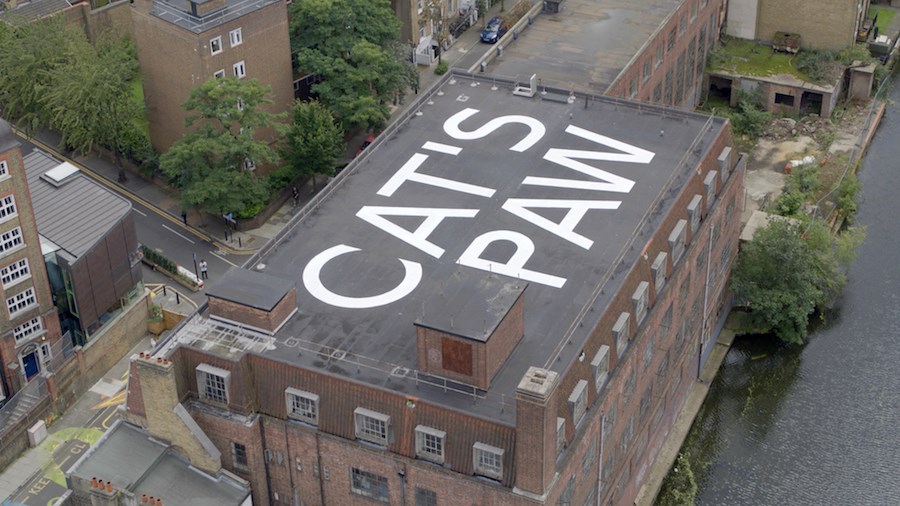
Abbas Akhavan | Cat's Paw | 2021 | white temporary graffiti paint
AM Personally, I would never as a curator find it interesting or politically uncompromised to collaborate with the US State Department. But still, what feels urgent one week can look completely different two weeks later. At a certain point, culture risks reproducing the very systems of coercion and violence it claims to resist. There’s an inflated idea of what artists, curators and writers can actually do politically, even though we work in forms that are structurally limited in relation to the violence of the world. To point that out risks sounding disengaged, but I think it’s more honest than pretending the institutions of art have a direct transformative capacity they often simply do not possess.
AA Exactly. And in the process, it can destroy whatever potential art might have. I keep thinking about the contradiction that I’m somehow supposed to save the world, even while the world places very little value on artists and what we do. Art, at its inception, was linked to magic. And whenever capitalism recognizes something truly alive, it moves to deplete it. We’re in a late stage of that now. Capitalism has realized that art has a certain potential, so it over-inflates its social importance while deflating its actual conditions of possibility. I keep thinking of how we no longer have ‘starving artists’, but we have a lot of well-fed yet malnourished artists.
And then there’s the survey.
I am 48, but by many definitions still a young artist. The survey also comes with a lot of ambivalence. One of the best exhibitions I’ve seen was Sherrie Levine’s retrospective [2011–12] at the old Whitney Museum in New York. The curators informed us that there was no linear chronology in the show because Levine had interrupted any straightforward reading of legacy with newly inserted works. She refused the patriarchal model of legacy-building. That opened something up for me. Since then, I’ve been reticent about survey shows. But with this one, I feel I may be, for better or worse, at the end of a certain chapter in my practice, and perhaps that is the reason I wanted to see this body of work come together under one roof. The works in the show are not my site-specific works; they’re the works with legs, the works that can be shown outside of context. I confess that I do feel strange about it, even as I’m grateful.
Cover and Slider Images:
- Alex de Brabant
- Francesco Barasciutti
- frieze.com

04 Mar 2022
Abbas Akhavan’s Solo Show at Chisenhale Gallery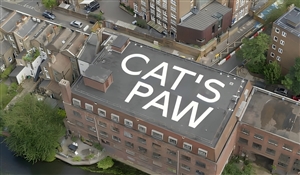 News-"Hnatyshyn Foundation Prize"
