Loading magazine…
Loading magazine…
Among the different forms of contemporary art that have emerged in the post-war period, performance art can be considered one of the most radical and experimental, continually challenging and redefining what art can be.
Performance art developed out of the visual arts during the 1960s and 1970s, gradually introducing a different relationship to the artwork and the art object. Within this context, the body once again became a direct medium of artistic expression. Conceptual art and event-based practices placed increasing emphasis on the immediate experience of time, space, and material, allowing the artist's presence and actions themselves to become part of the work. One manifestation of this approach was the idea of the "living sculpture," in which artists became both the subject and the artistic object.
Throughout the twentieth century, particularly within movements such as Dada and Futurism, performance was often understood as an unconventional mode of artistic production. Its live, mobile, and impermanent nature offered possibilities that could stand in contrast to the relative stability and permanence of painting and sculpture.
In recent years, performance has increasingly been understood as a way of confronting social reality directly, responding to the particularities of a space, and engaging with the politics of identity. In 2016, theorist Jonah Westerman wrote of this approach:
“Performance is not, and has never been, a medium. It is not something that an artwork can simply be, but rather a set of questions and concerns about how art relates to people and to the wider social world.”
Ichor: Memories of Great Falls makes use of this potential by transforming the idea of falling from an image into a condition. The performance moves the myth of Icarus away from the realm of a familiar narrative and into the territories of embodied experience, historical memory, and a wounded site.
“The work begins with a question about falling: what remains after a fall, once the moment of falling itself has ended?”
The performance does not answer this question by reconstructing the accident. Instead, it allows the body, space, sound, light, and each object within the installation to carry a fragment of the story of what continues after the event.
The title Ichor holds two meanings simultaneously. In Greek mythology, ichor is the divine, blood-like substance said to flow through the bodies of the gods. In medical terminology, the word refers to a watery or pus-like discharge from a wound. The performance therefore unfolds within a space suspended between the sacred and the wounded.
Within cultural memory, Icarus is associated with the sky, flight, and falling. Ichor, by contrast, introduces the substance that remains in the body after it has come into contact with catastrophe.
The performance also draws on Gavin Bantock's poem Ichor, which follows Icarus through the memory of his fall and the traces it leaves behind.
The poem opens with the image of mould in the palm of a hand: a substance emerging from the surface of the body, suggesting the presence of something decayed, residual, and returned. It evokes something similar to the pus or fluid that seeps from a wound.
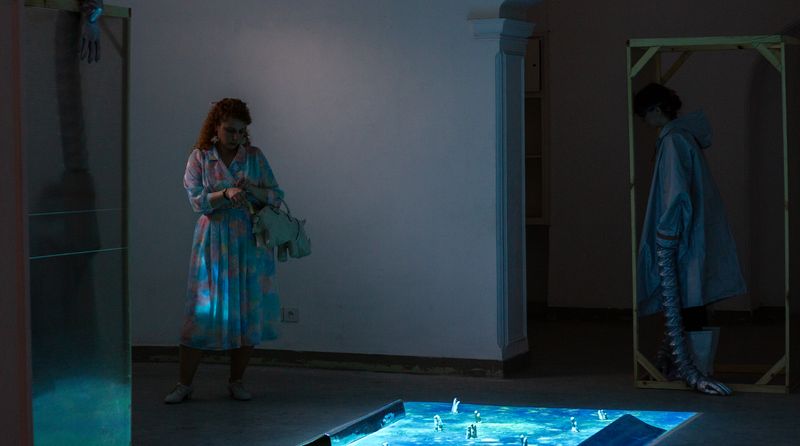
Within the installation, a pink, mould-like mass emerges from the threshold of a doorway at the far end of the space. On closer inspection, we see that this sticky material has also attached itself to the performers' shoes.
The substance is carried along through movement, preventing the body from forgetting the past.
Within the structure of the work, this object functions almost like an inflamed memory: a memory that has moved beyond the surface of the mind and become dense and material, bringing everything beneath the pressure of its limiting gaze.
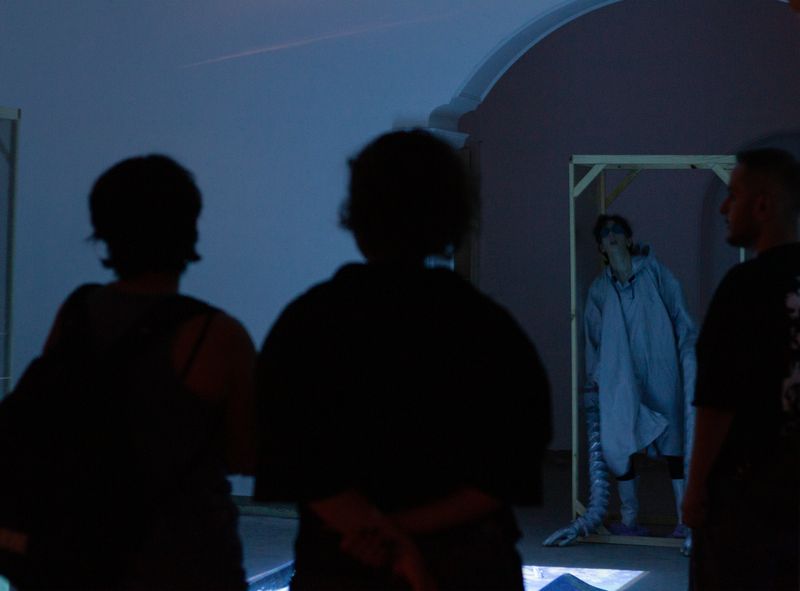
Two performers occupy two extremely narrow enclosures.
The physical space restricts the body's range of movement and turns every gesture into a visible effort. The body does not merely produce an image of suffering here. Instead, suffering is generated through the individual elements of breath, pressure, stillness, repetition, and exhaustion.
Raincoats, swimming goggles, and elongated metal hands form a collection of equipment designed to prepare the body to survive within an uncertain environment.
Each object performs a double function. The raincoat prepares the body for contact with water. The swimming goggles suggest the possibility of seeing within an aquatic environment. The metal hands extend the body's limbs.
Together, these devices construct the image of a body that has been equipped to endure the conditions in which it finds itself.
Visually, the metal hands can also be connected to the wings of Icarus.
Their elongated form evokes a desire for elevation and for separation from the ground. At the same time, the weight and rigidity of the metal make movement more difficult.
The body possesses tools that appear to enable flight, yet those very tools place additional pressure upon it. Flight is transformed from a simple possibility into a difficult task.
In another sense, these bodies seem designed to exist within an intermediate space: between land and water, between standing and falling, between remaining and moving.
The metal hands can therefore be understood as a kind of prosthesis for this condition: extensions that increase the capacities of the body while simultaneously making the weight of its circumstances more visible.
Sound, like flight, also remains on the threshold of becoming. The performers hum a melancholy melody, but their breath is interrupted before the song can fully take form. Language confronts the limitations of the body before it has the chance to produce meaning. Between the two performers lies a sea, with hands emerging from its surface. This image connects the story of Icarus to a much broader network of falls. In the myth of Icarus, the sea is the site where the falling body eventually lands. In Ichor, however, the sea becomes a space inhabited by disappeared bodies.
The hands rise above the water, suspended within an unfinished gesture. They may be read as hands asking for help, struggling to survive, or making a final movement before drowning. Opposite them, the performers' elongated metal hands reach outward. Their height suggests the possibility of rescue. Yet the distance remains.
This distance introduces one of the fundamental ideas within the structure of the work: the body that survives is not necessarily a body capable of saving another. This proposition also complicates the relationship between performer and victim.
The performers, who are themselves placed in vulnerable conditions, simultaneously become witnesses to the hands emerging from the water. The ability to see does not guarantee the ability to rescue. Likewise, the ability to move does not necessarily make it possible to reach another person.
Within this structure, the sea also becomes a form of collective memory for the drowned. The hands can represent a multitude of bodies, memories, and absences. The moving light of the water projects this image from the centre of the stage onto the gallery walls. As a result, the sea shifts from being a visual element into an environmental condition that affects the entire exhibition space.
The spectator occupies a particular position within the structure of Ichor. They enter a space in which two bodies have been placed under restrictive conditions, while their attempts to breathe, hum, and fly remain exposed to observation.
The spectator watches while maintaining a physical distance between their own body and those of the performers. This situation foregrounds the question of what it means to look at the suffering of others. The suffering of others has repeatedly been represented in art and media, and the image allows catastrophe to be viewed from a safe distance.
Ichor turns this distance into a subject within the performance itself. The spectator encounters bodies that cannot reach them for help, while the spectator, in turn, cannot fully enter the space occupied by those bodies. Just as the two performers look toward the hands of the drowned, the audience looks upon the scene from outside.
Three positions are therefore established: the trapped body, the drowned body, and the observing body. This structure confronts the spectator with the responsibility of looking. The act of observing becomes the possibility of witnessing suffering, and therefore develops into one of the ethical dimensions of the work.
At this point, the idea of the "spectator of suffering" can be connected to the history of performance art and the critique of images. The work moves the viewer away from the position of a passive consumer of images and toward the more complicated position of the witness. A witness has only a limited capacity to intervene, and that limitation becomes part of the experience itself.
Ultimately, the spectator is confronted with the same questions posed by the structure of the work:
What does life look like when it continues alongside catastrophe?
What is the relationship between seeing catastrophe and participating in it?
What relationship can the surviving body establish with the drowned body?
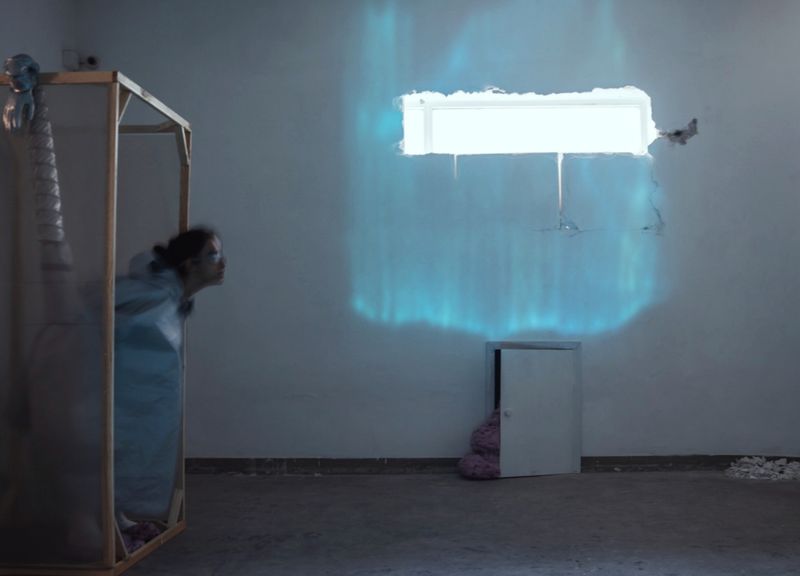
The choice of Didar Gallery as the site of Ichor is also part of the work's conceptual structure. The gallery had previously been damaged during the war, and part of its ceiling had collapsed.
The performance took place while the building was undergoing reconstruction. Construction workers occupied the upper floor of the gallery while the performers worked below, bringing two different forms of bodily activity into the same space: bodies engaged in endurance and performance, and bodies engaged in repairing a damaged structure. This simultaneity moves the idea of falling from the realm of mythology into the realm of architecture. The damaged walls physically record the consequences of a previous event. At the same time, the reconstruction of the building projects its future onto that same architectural body. The building therefore carries both its ruined past and its reconstructed future at once.
From this perspective, the gallery itself becomes part of the narrative material of the installation. Here, the idea of "falling from nowhere to nowhere" takes on a material dimension. The fall is no longer limited to a direct movement from a height toward the ground. Within wounded architecture, the fall remains embedded in the wall. Within the performer's body, the fall continues through breath and movement. Within the hands of the drowned, it becomes an image. Within the pink substance, it becomes a sticky residue.
The partially ruined space also creates several simultaneous layers of time. The past remains present within the architecture. The present unfolds through the performance.
The future appears through the process of reconstruction. The coexistence of these temporalities disrupts the linear narrative of a fall and transforms it into a network of overlapping times.
Ultimately, Ichor: Memories of Great Falls presents an image of the human being after catastrophe: a person who continues to live with what remains of the event and whose body reorganizes itself in relation to those remains.
Perhaps the central proposition of the performance is that a fall does not mark the end of a narrative.
A fall is more like a substance that sticks to the shoe, remains in the wall, can be heard in an interrupted breath, and continues moving through the body. What remains after the fall is life itself, a life that continues to carry the fall within it.
This Performance and installation, featuring sculptures created by Saeed Rezvani, took place at Didar Gallery on July 30 and 31.
Cover & Slider Image: