





A Note on Hoda Kashiha's Show at Galerie Nathalie Obadia
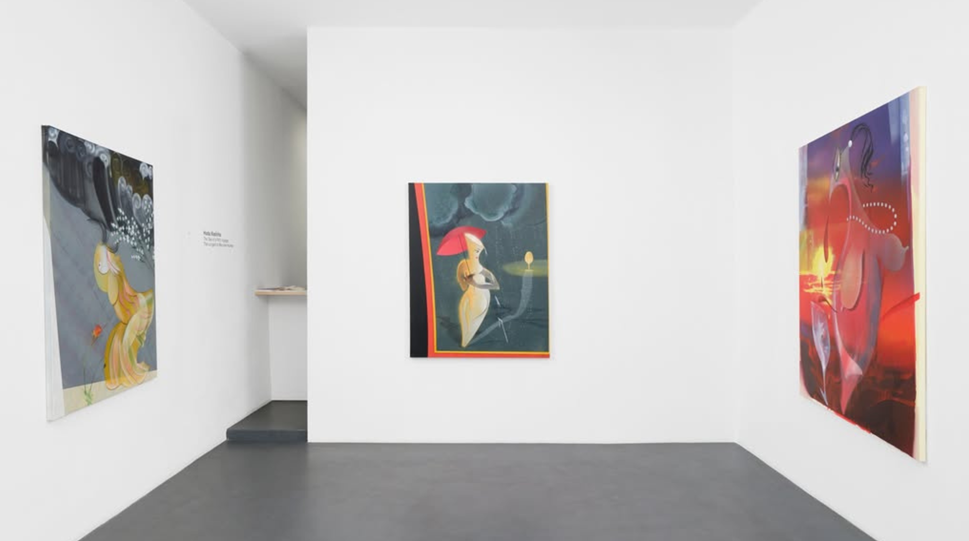
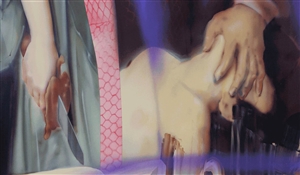
13 Feb 2026Hoda Kashiha’s The Tale of a Pot’s Voyage That Longed to Become Human is a compelling installation of five new paintings at Galerie Nathalie Obadia in Paris from 30 January to 28 March 2026. The canvases in this new body of work echo one another, like chapters of an initiation narrative. Drawing for the first time on imagery from eighteenth-century Indian miniatures, not as a simple ornament but as a symbolic visual language, the works mix this heritage with a contemporary digital aesthetic and surrealist flourishes, embracing themes of resistance, transformation, and political significance. Kashiha’s practice, shaped by her upbringing in Tehran during the Iran-Iraq War and her transnational experiences between Tehran, Boston, Paris and New York, intertwines memory and invention, with dispersed motifs and layered forms that reflect both personal and collective narratives.
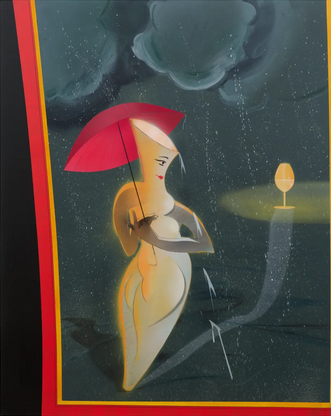
Hoda Kashiha | Gaze into a Glass of Wine in the Rainy Night | 2025 | acrylic and pastel on canvas | 150 × 120 × 4 cm
Born in Tehran in 1986, Hoda Kashiha grew up during the final years of the Iran-Iraq War, an experience that shaped her fragmented visual language. As Lillian Davies notes, this period was marked by a “dangerously fragmented narrative,” a rupture reflected in Kashiha’s layered compositions where motifs appear and dissolve like memories. Influenced by Iranian artist Behjat Sadr’s call to use any means necessary to express the emotions of one’s time, Kashiha intertwines memory and invention. Her studies at Tehran University of Art, followed by an exchange at Boston University in 2014, where Dana Frankfort encouraged her transition from drawing to painting, further sharpened her engagement with image and narrative. She now lives and works in Tehran, traveling regularly between Tehran, Paris, and New York.
Her international mobility expanded her engagement with art history, particularly Indian miniatures and the Kangra school, which she encountered notably at the Metropolitan Museum of Art in New York. Rooted in the Pahari tradition, Kangra painting is known for its refined lines, delicate colors, and its expression of shringara, the “original rasa” of Indian aesthetics associated with love and emotional nuance. This intimate yet universal sensibility resonates deeply with Kashiha’s practice, where miniature painting becomes not merely a reference but a poetic and conceptual foundation
In this new body of work, objects transcend their functional roles to become animated characters. A recurring motif, the vase, evolves from ritual object to feminine figure, embodying both body and object in a meditative, animistic narrative. Colors intensify and forms become metaphors for transformation, flowers caught in storms, petals and fabrics in fragile balance, all suggesting beauty and violence intertwined. Through these evocative images, Kashiha charts a renewed equilibrium: a world where we move forward, desire and transform ourselves, both towards and against the sky.
Cover and Slider image:
- nathalieobadia.com

26 Nov 2021
Hoda Kashiha at Parallel Circuit: In Appreciation of Blinking Review-I'm Here, I'm Not Here-Hoda Kashiha-the Passerelle Centre d'Art of Brest
 News-"Another World is Waiting for Us"; Hoda Kashiha's solo show at Galerie Nathalie Obadia
