Loading the archive.
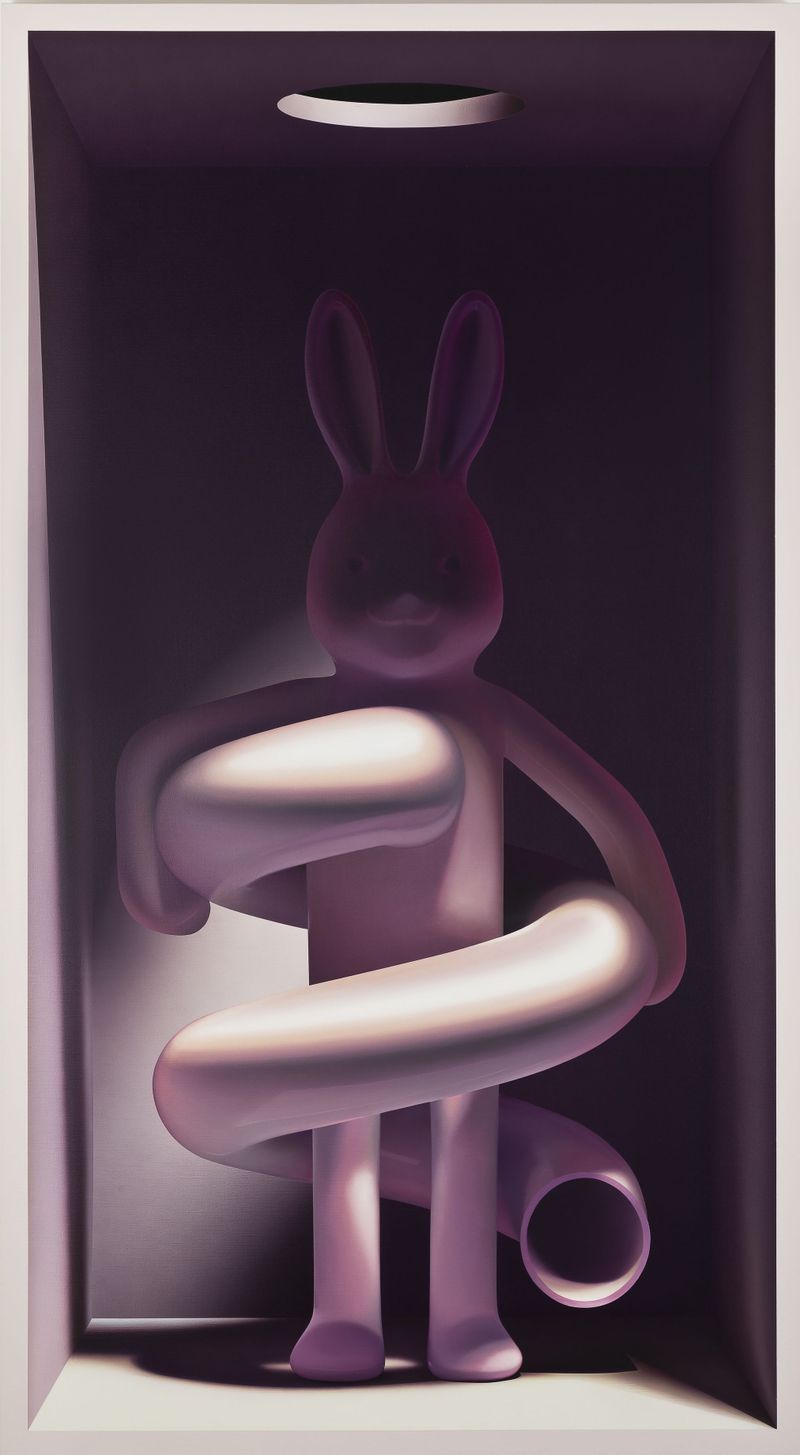
2025 | The Rolling Dream
235 × 130cm
Loading the archive.
Mehdi Ghadyanloo - Solo Show
22 days to the ending
5 Nov - 4 Dec, 2026
Statement:
Perrotin Seoul presents Paradise Opens Tomorrow, the first solo exhibition in Korea by Iranian painter and muralist Mehdi Ghadyanloo.
Gaining international recognition for his unique paintings and public art that weave surrealist imagination with optical illusions, this exhibition surveys Ghadyanloo’s artistic universe and brings together a diverse body of works that examine the anxiety and hope of human existence through meticulous architectural spaces and subtle interplays of light.
Ghadyanloo is Iran’s most renowned artist working with public art. His colossal murals have transformed over a hundred concrete façades into signature trompe l’oeil scenes: playful, serene, sometimes uncanny.
After the 1979 revolution, Iranian authorities organized the production of public murals, many of which now depict revolutionary scenes, fallen martyrs, and anti-western messaging.
Ghadyanloo’s muralist language is singular and recognizable: eschewing the typical spectacular propaganda imagery and hagiographic portraits, he prefers wide-angle landscapes that quietly subvert existing architectural and environmental elements, like daydreams intentionally anchored to blueprints.
The people in his murals are tiny but purposeful, full of verve and agency: cycling up sides of concrete towers, airborne on balloons, unrolling building façades like engineers of better worlds.
These worlds are replete with infrastructures of mobility and possibility: ladders, skylights, portals, planes of alternate gravity where a capsule of sky can almost double as a swimming pool.
Flying cars and trains hover high above real-time drivers mired in gridlock and the laws of physics.
One proposed mural of a lone cloud in blue sky was even rejected, the artist says, for being too political.
In 2015 multilateral sanctions against Iran were gradually lifted with the signing of the Joint Comprehensive Plan of Action (JCPOA) limiting Iran’s nuclear program.
Ghadyanloo has spoken about the effects of U.S. sanctions on Iranian artists who could not find specific art materials such as purple paint.
He insists that he is not a diplomat, but also that an artist’s work cannot be non-political.
“Iran is like an island,” he said, because many were forbidden or unable to travel there.
Now, he is now one of Iran’s most recognizable cultural ambassadors, having chalked up sixteen solo shows in top-tier American and European galleries as well as a 186-meter triptych commissioned for the Congress Center of the World Economic Forum in Davos.
The triptych’s central panel depicts the back of a little girl alone in a large, anonymous open-air compound, holding a red balloon rising into a blue sky with advancing clouds.
To the left is a giant, antenna-like needle in another space of the compound, laced with a thread anchored in the rooms to either side; to the right, again a red balloon, whose string disappears into a side doorway.
They evoke a world on the edge, where even the simplest manifestations of innocence and freedom are invisibly tethered to greater systems of technology and power.
Around this time Ghadyanloo decided to take a break from producing public art and embarked upon a new phase of studio painting.
As he redirected his gaze from high-rise façades to conventional canvases, his use of space and form morphed from depicting collective utopias to investigating darker facets of human psyches.
The most notable line of inquiry in his studio art culminated in his signature universe of spiral slides and ladders, created during the Covid-19 pandemic, that catapulted him to significant commercial acclaim.
He dismantled his murals’ architecture of dynamic hope and isolated the elements—portals, ladders, skylights, balloons—within chiaroscuro-lit recesses, where they metastasized and re-emerged, shinier and brighter, in Barbie pinks, titanium grey-blacks, and Haribo multicolors.
The slides and ladders began to morph into their own energetic characters: robust, delicate, trying on crowns, intertwining, ditching gravity to float dramatically in their arched recesses.
Some larger playground permutations assumed the industrial configurations of engine rooms. The people disappeared.
Skylights ceased to be escape portals, serving only to illuminate the magnificent structures below them.
Occasional plastic semblances of toy hobbyhorses, rabbits, elephants, and octopi tentatively emerged, twice-removed memories of nature now rehomed in the funhouse.
Fittingly, the market offered resounding applause to these contemporary saints of late-stage capitalism.
Even as the pandemic ebbed and life flowed back into the streets, Ghadyanloo’s paintings continued to mirror the collective unease of survivors who had lingered behind masks, before screens, and shied from human contact for over a year.
Paradise Opens Tomorrow places us squarely in the hotspot.
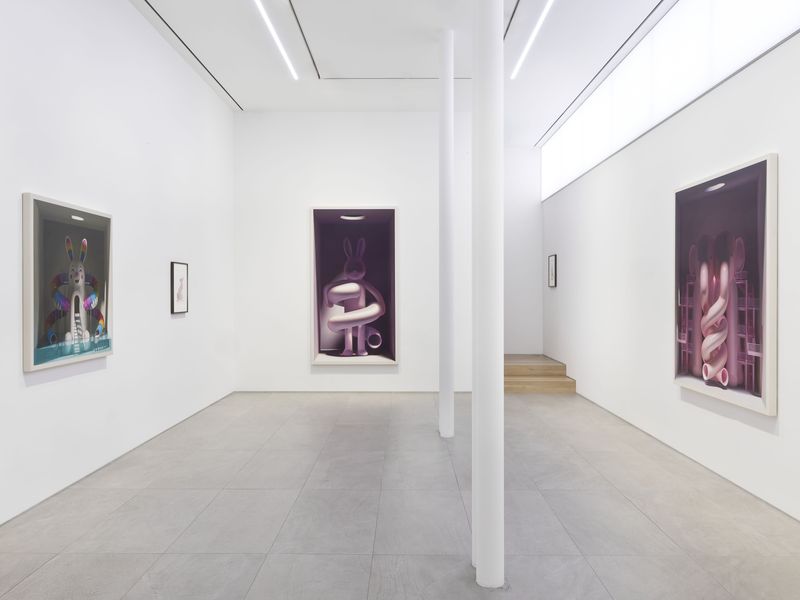
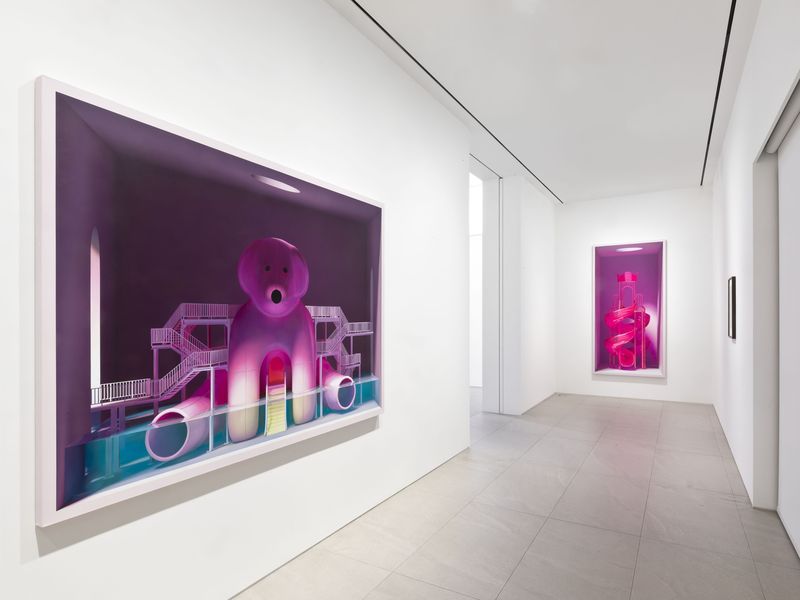
It centers around new hybrids of Ghadyanloo’s signature playgrounds with plastic-fantastic animal avatars and his recent, foreboding element of rising water.
There is a slender, powder-pink rabbit-human, somehow evocative of the six-year-old beauty queen JonBenét Ramsey, with a spiral slide protruding from its chest.
Another rabbit’s cartoonish fingers hold up a multicolored slide composed of cheap plastic units whose rainbow hues are reflected in the rabbit’s ears.
A submarine-like green-grey bear rears up as his insides spill from his torso, cascading earthward in an array of ladders and twirling slides.
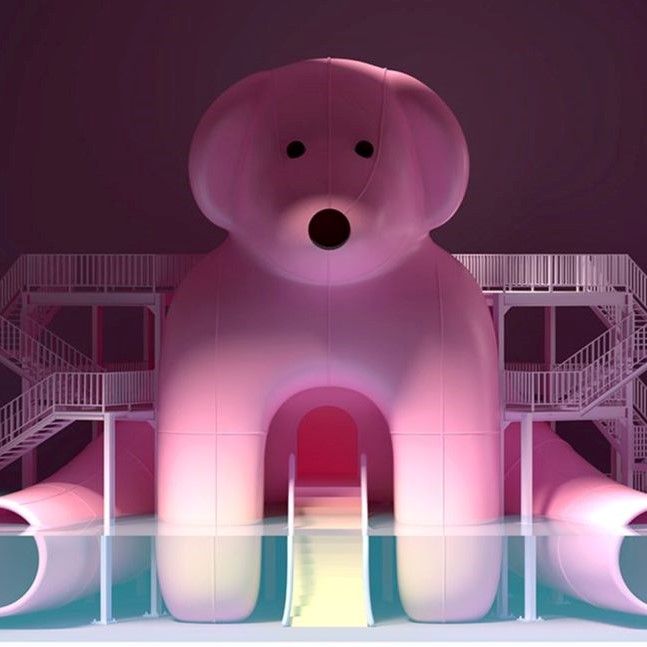
Finally, an oversize pink dog towers over a tiered playground; stairs lead directly into its groin, from which one can slide down its hollow limbs.
In the last three works a few inches of water rise from the ground, effectively rendering the playgrounds death traps.
In fact, the motif of animals and the flood harks back to one of Ghadyanloo’s earlier murals on a four-storey Tehran residential building.
A giraffe’s lower half is submerged in water while its neck stretches toward a skylight; perched on its head are two men who are just able to reach the aperture.
The giraffe is the unwitting non-human that will predictably perish in order for humans to survive.
Now, in Ghadyanloo’s paintings, bona fide animals have given way to their defanged and sanitized likenesses in the philosophical lineage of Mickey—the world’s most famous mouse whose face adorned a series of child-sized gas masks during the Second World War, and who now presides over a global network of theme parks that have destroyed large-scale wetlands and wildlife habitats.
Aesthetically, Ghadyanloo’s animal avatars bear closer resemblance to Kaws’ Companion or Squid Game’s giant animatronic doll from the “Red Light, Green Light” elimination round.
Their seamless plastic components and rivets are immacu- lately rendered; their faces are mostly mouthless and expression- less, allowing us the precious luxury of non-communication.
They are dramatically illuminated by artificial light from multiple sources that emphasize their pristine and monumental character, but also destabilize our very modes of perception.
Who are these gilded minotaurs—half prophet, half beast—beckoning us to the funhouse, into the flood?
Again, to summon Baudrillard: we see our life in them.
235 × 130cm
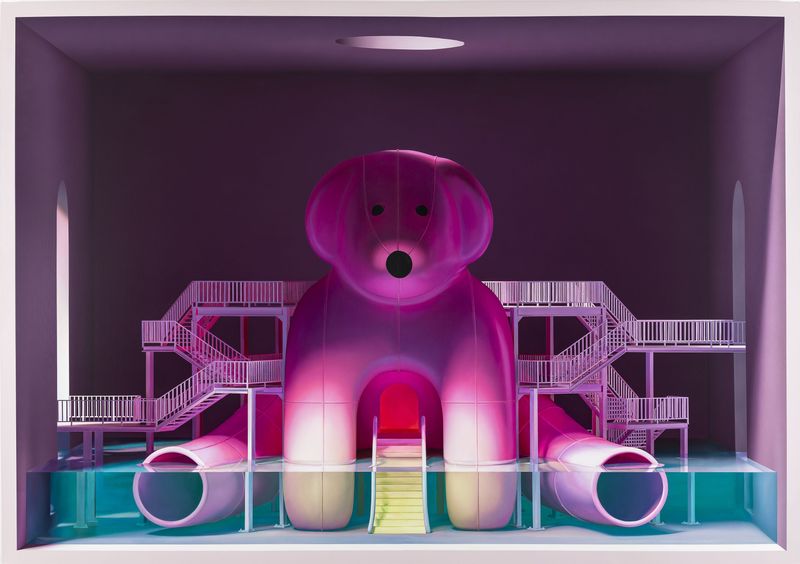
160 × 230cm
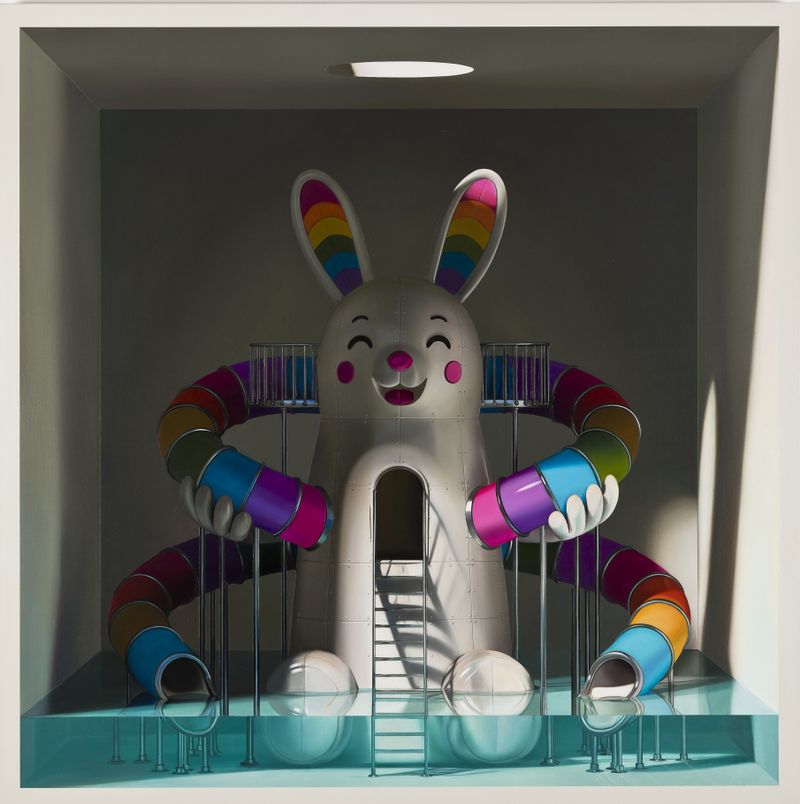
120 × 120cm
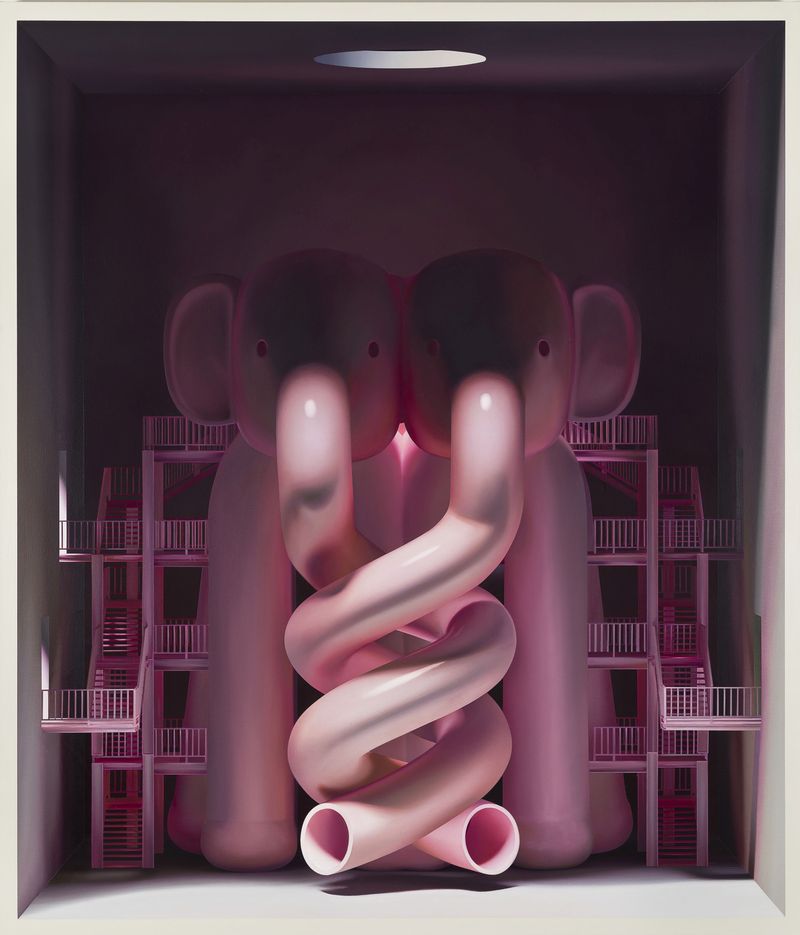
180 × 155cm
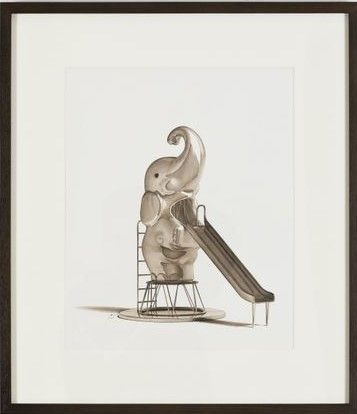
52.5 × 45.5cm
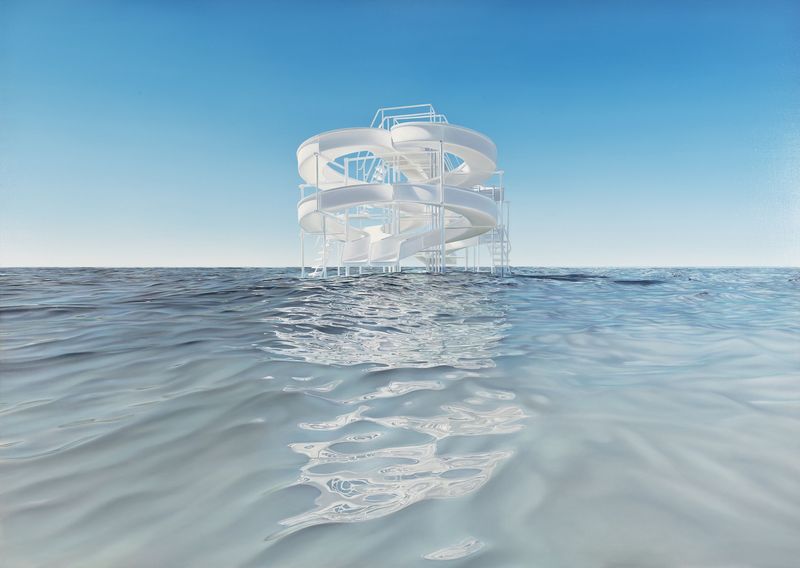
200 × 300cm