

28 May - 27 Jun, 2026
Statement:
"There was a Door to which I found no Key:
There was a Veil through which I could not see:
Some little Talk awhile of Me and Thee
There seemed -- and then no more of Thee and Me."
Omar Khayyam (1048-1131): "Stanza XXXII", translated into English by Edward FitzGerald in "Rubaiyat of Omar Khayyam", 1859
-----
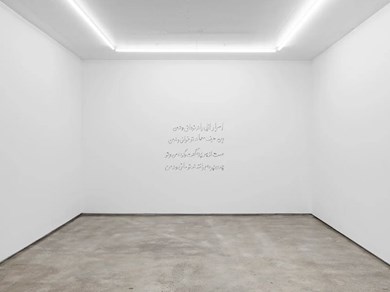
These words - which were puzzled together by the Persian poet and polymath, Omar Khayyam, some thousand years ago - are drawn across the end wall of the gallery.
That is to say, the words are written in the language he wrote them - Farsi, that is - in a porous and parched charcoal onto the solid white wall.
The instructions were provided by the artist of this exhibition, Asal Peirovi. She, however, is some 5600 kilometres away from the gallery, with no way of travelling to the country where her exhibition is taking place.
Asal Peirovi lives in Tehran, Iran. That is where she studied, that is where she established herself as an artist, and that is where she built a home with her husband, the fellow painter Meghdad Lorpour. The distance between here and there was always a testing reality. ///
However, over the past eight years of the artist and the gallery working together, we were able to make two full-scale solo exhibitions and a publications happen.
When planning for a third solo exhibition, a number of reasons made the situation more demanding: a heightened sense of isolation brought on by the boycott of her country; a limited access to tools and materials;
limited set of possibilities for travelling and shipping; a mounting pressure from inflation; a worsening set of political conditions and ongoing social upheaval: plus an unpredictable internet connection that is the only means of communication with the world outside.
This exhibition was repeatedly rescheduled, hoping there would be some calmer days ahead.
Days of all kinds came and went during 2025 and early 2026. Then came the morning of February 28. I woke up to an email from Asal reading: "Dear Eivind, I wanted to let you know that the shipment has been sent."
The very same moment that I was reading these words, I also received the news that American and Israeli military forces had launched airstrikes on Iran. I instantly wrote back, to ensure that Asal and her family stayed safe.
There was no response. The internet in Iran got cut. And the possibility of the paintings going missing instantly became the tiniest piece in the vast mosaic of tragedy that now was to unfold.
Several waves of attacks on Iran and counterattacks against Israel and American bases across the Middle East, took place between February 28 and April 8.
It resulted in the death of more than 3636 Iranians, according to Human Rights Activists News Agency, HRANA, as well as 52 Israelis and 15 American soldiers.
In addition, there have been reports of thousands of killed and wounded because of this war in the nearby countries of Lebanon, Iraq, Palestine, United Arab Emirates, Kuwait, Bahrain, Saudi Arabia, Oman, Syria and Yemen.
It seems such a paradox that a country like Iran, which has witnessed so many wars and has seen such destruction and devastation from earthquakes and natural disasters, is the country from which the word 'paradise' has its origin.
Dating back to the Assyrian King Sargon II (721-705 BCE), this territory developed a sophisticated water supply system, of wells and underground aqueducts, that made arid land readily available for agriculture.
The Qanat system, as it became known, both allowed the Assyrians to expand the liveable land, to harvest bigger crops and to cultivate elaborate gardens.
These landscaped gardens soon became a recurring element of Persian architectural design - permitting the owner in the company of others to relax, read or spend time with one's own thoughts in what was given the name 'pairi-daeza'.
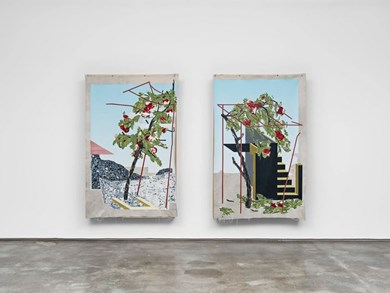
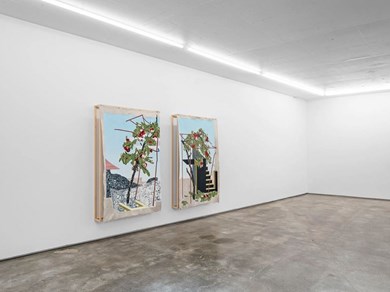
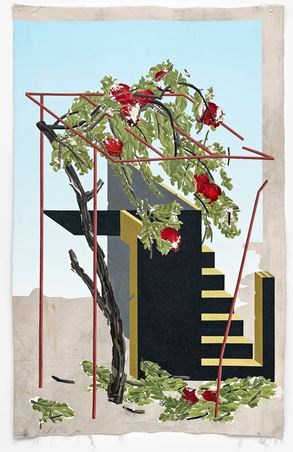
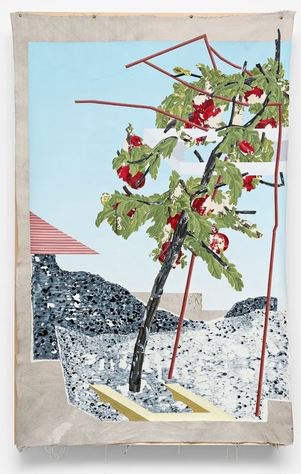
Installed across from the poem, are two paintings of a garden. Astoundingly, these two paintings managed to leave on the same day that American and Israeli drones, rockets and fighter planes first flew in over Iran.
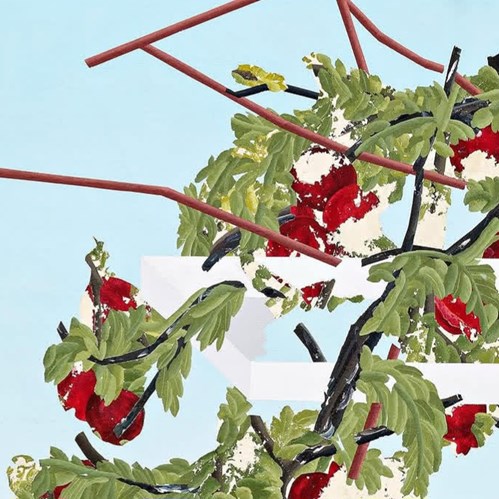
Unaware of what was to come - with Asal having completed the paintings days before February 28 - the two paintings depict variants of an act of violence. In both cases we are presented with a pomegranate tree.
Each of the trees are supported by a pergola, which is painted in the same bright, blood-red colour as the fruit itself. However, the pergola is coming apart.
Some forces that are not visible to us as viewers, has this framework shattering. The red metal is twisted and turned. Branches have snapped from the tree. Pomegranates have fallen to the ground. What has been tore down is not just a tree, in Iranian tradition, but the very symbol of prosperity of promise.
Yet it is a scene of serenity as much as it is a scene turmoil. Somehow the surroundings seem undisturbed by the heightened sense of drama. The sky is painted in a cloudless blue.
The buildings in the background are untouched. There are pomegranates to be picked from the tree. The paintings appear as still lifes, even if they do not comply to such a term in the strict art historical sense. Rather, 'still life', seems to apply in how the paintings present us with a scene that is painted of life but also rendered eerily lifeless.
It is as if a set of opposite forces are holding the motif in a tremendous sense of tension, between real and unreal, calm and disorder, growth and destruction.
These are paintings that treat the soft surface of the fruit and the harsh texture of the concrete architecture with the same amount of attention, light and detail. All comes into sight at the same time.
All pushes itself to the forefront of the painting. All is left in a suspended moment of time. Omar Khayyam did not know of this specific moment, but knew that life being a riddle was in itself a suspense.
Only those no longer being would be knowing what follows thereafter. In that sense we are all waiting. The calmer days have not yet arrived, but the paintings and their moment, somehow magically, have arrived.
In this show
Installation view