

15 May - 2 Jul, 2026

Statement:
Uffner & Liu is pleased to present What Remains, Arghavan Khosravi’s third solo exhibition at the gallery.
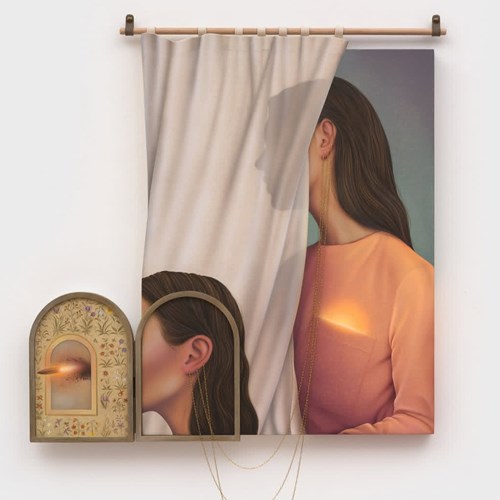
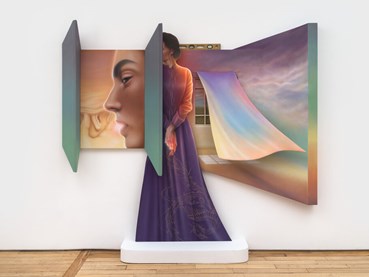
The exhibition brings together three large-scale wall works, one freestanding sculpture, and a suite of intimate, small-scale compositions from a new body of work inspired by altarpieces.
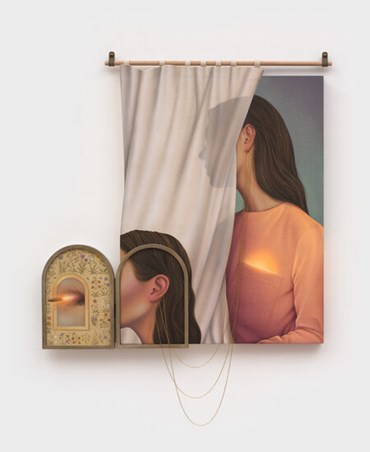
As always in Khosravi’s dynamic practice, each work is constructed as a system – panels hinge, surfaces divide, and elements pass between compartments, collapsing distinctions between image and structure.
Khosravi's practice has long operated at the intersection of the personal and the political.
Working across painting and sculpture, she constructs layered compositions that draw on Persian miniature painting and medieval European iconography to explore the pressures and contradictions that shape women's lives under systems of political, cultural, and religious control.
Her work is ultimately a celebration of female power and agency – and an ongoing investigation of the structures (both historical and contemporary) that regulate the body and limit autonomy.
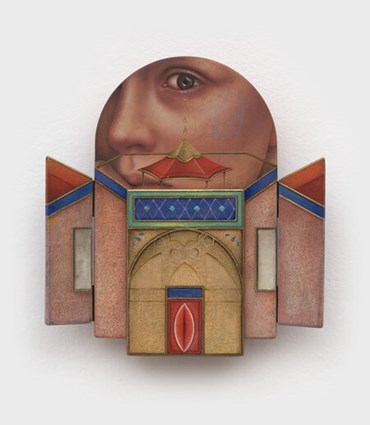
Central to this exhibition is the Altar Series, seven new works in the gallery’s front room that take devotional altarpieces as their formal point of departure.///
While adopting the scale and intimate viewing experience of their source – hinged panels, the suggestion of movability, the invitation to look closely – Khosravi reconfigures their symbolic function entirely. Where the altarpiece traditionally offers spiritual resolution, these works withhold it.
They operate instead through division, repetition, and interruption, staging moments that resist closure: psychological, formal, and political at once.
Khosravi began this series over a year ago, working through a process that differed markedly from her larger, more monumental pieces.
These are meditative works, born of immediacy. She has described them as reflections of "my own story and psychological state instead of religious narrative," made without prescriptive storytelling and without an assumed audience.
That inwardness is visible in the work. In Stillness, a hand emerges from the lower edge of the composition as if from another dimension, holding a paintbrush – a stand-in for the artist herself – while a sleeping figure occupies the layered space beyond the open windows.
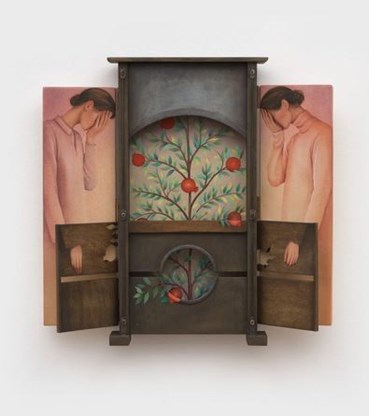
One bird (caught in a pair of hands) is captured; the other (sitting on the brush) is free. In Bound, the same female figure is duplicated across two panels that function simultaneously as doors and mirrored surfaces.
Her hands in the central panel are bound to the frame at the wrists. Here, the archway of the altarpiece is not a window but a cage. Hair, a recurring symbol of defiance in Khosravi's practice, becomes here both an act of self-possession and a site of constraint.
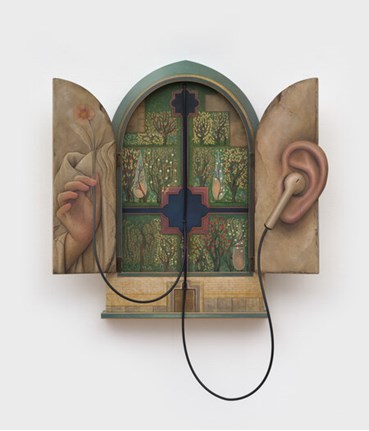
Other works in the series extend Khosravi's sustained engagement with iconographic cross-contamination. The Listener draws on the Persian tradition of Chahar Bagh, literally “four gardens,” a garden divided into four sections by paths or waterways.
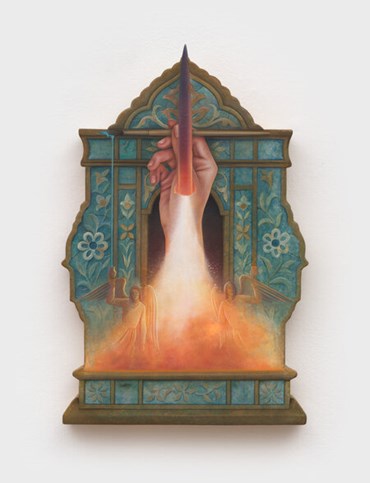
In Khosravi’s work, this paradisiacal garden is juxtaposed with a single AirPod, anchoring the historical image in the present with characteristic precision. Home reroutes a medieval devotional image – the wound of Christ – stripping it of its Christian signifiers and placing it within the architectural language of Persian miniature painting.
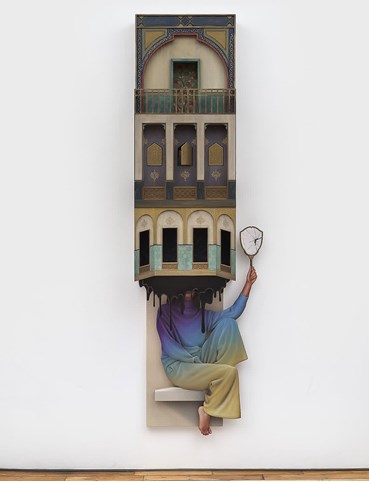
The larger works in the exhibition carry this logic into monumental form. In Bearing, a multi-story Persian-style building is borne aloft by a single figure – a literalization of the psychic weight of displacement.
Black liquid, often a reference to oil, seeps from the facade. An embedded mirror draws the viewer themselves into the composition. The heaviness of home travels with the immigrant, through longing, through war, through the quieter accumulatio
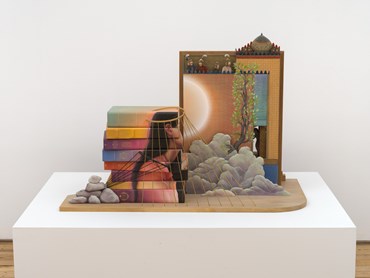
ns of diasporic life. Incision depicts a building resting on a cluster of trees, one emerging through the roof toward a bare canopy. The tree is being sawed in half, but there is a tiny sprout of green emerging.
A female fairy and a blindfolded male soldier (recurring characters in Khosravi’s mythos) scuffle at the base, a pairing that recurs throughout Khosravi's work as an emblem of opposing forces.
The works in What Remains were made prior to the current conflict in Iran and are not direct responses to it. They remain, nonetheless, rooted in Khosravi's ongoing reckoning with the conditions shaping women's lives in the region – conditions that long predate any single moment of crisis.
Many of the works operate in states of suspension, moments held just before or after an event, where action is implied but not completed.
What persists across the exhibition is not resolution, but residue: structures of control, gestures of resistance, and the forms through which they continue to take shape.
In this show
Arghavan Khosravi
Arghavan Khosravi
Arghavan Khosravi