

29 Jun - 8 Oct, 2025
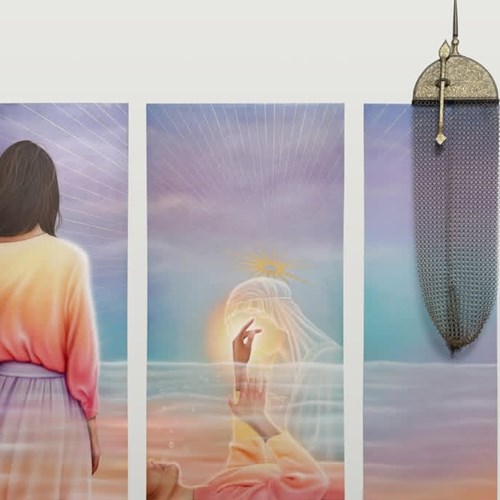
Statement:
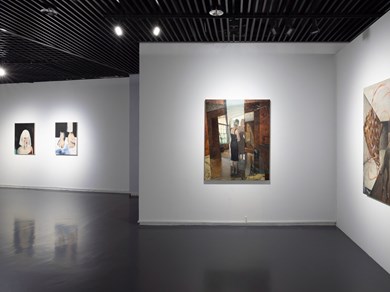
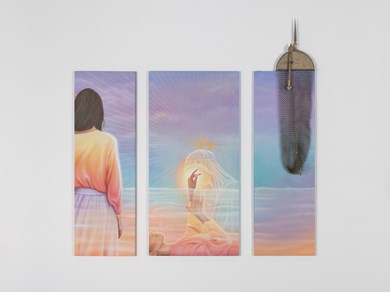
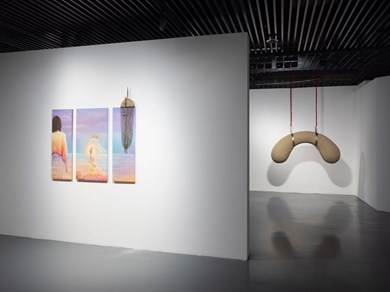
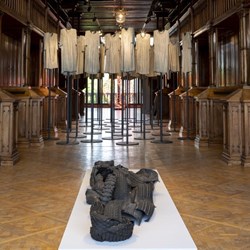
Carl Kostyál is delighted to announce ‘The Cloak of Dreams’ at SWCAC, a survey exhibition preoccupied with the shifting sands of expression in contemporary painting and sculpture from East to West, pre and post the digital revolution.
The SWCAC opened in 2017 and is a joint venture between the state-owned China Merchants Group and Great Britain’s Victoria and Albert Museum.///
The brainchild of the Pritzker Architecture prize-winner Fumihiko Maki, the SWCAC is an angular white-and-glass behemoth, with cantilevered levels, amid a landscaped park. Its mission: to be a lightning rod for cutting-edge art and design in China.
“Every work of art is a symbol of something beyond itself.”
— Béla Balázs
“The exhibition, curated by Carl Kostyál, takes its title from the collection of unusual, often startling and sometimes profoundly disturbing fairy tales, published in 1922, by Hungarian-Jewish film critic, Symbolist poet, political activist and prolific author, Béla Balázs.
Drawing on both the Western tradition (Aesop, the Brothers Grimm, the stories of Hermann Hesse and Thomas Mann) and those of the East, with his fascination for the Asian oral tradition and Taoist philosophy, they are darker and more fantastical than hopeful.
European literary chinoiserie flourished through the decades of Modernism – the artist Mariette Lydis made the series of watercolours depicting quasi-Chinese scenes in a style combining art nouveau and the dark distortions of German expressionism that accompany each tale.
Traveling through the country with fellow Hungarian Béla Bartók to collect traditional songs and folklore for the libretto he wrote for ‘Bluebeard’s Castle’ in 1911, Balázs began to develop his ideas of the fairy tale as a modern genre.
Among the stories, a man is changed into a flea and must bring his future parents together to become human again. A woman convinces a river god to cure her sick son, but the remedy has mixed consequences.
A young Emperor must choose whether to be close to his wife’s soul or to her body. And two deaf mutes transcend their physical existence in the garden of dreams.
His tales describe “the wandering protagonist seeking the essence of life, mysterious woods and mountains, haunting music, pure friendship, passionate love, solitude, alienation, magical objects and pantheistic ecstasy in a liminal state”, (Jack Zipes). To Zipes’ list, one could add transformation and transcendence.
The forces at work in Nai-Fe’s psyche shape the story’s events and define the relationship between emperor and his wife. It is a story about the erotic tug and pull of irrepressible but ungraspable desire. Nai-Fe “had a dreaming soul because she had died too early in her previous life.
This is why her gaze always roamed far away” beyond her husband. “Nai-Fe reproached herself bitterly, but she could do nothing about it.”
In a dream she saw her husband wearing a cloak “on which all the images of her dreams had been embroidered.” On waking, she tells her husband he must wear this cloak, which she will embroider for him, in order to integrate her dreams with her husband’s presence.
She embroiders the cloak for five years to blend the yearning of her soul with the yearning of her heart. But it doesn’t work out:
Now visible to her, “The entire spacious dreamland lay between her and the emperor, and she couldn’t come to him.” The emperor has two choices: “If you take off the cloak, you can hold me in your arms, but my soul will be far away from you.
If you wear the cloak, I won’t be able to approach you. But the longing of my soul will eternally cast its glances upon you.” The emperor chooses to wear the cloak.
Seen through this lens, this exhibition is an ambitious attempt to consider the artist as an essential conduit to the collective state of our interior and dream worlds and the desire, violence and tension that lies therein, as well as their often-harsh collision with reality.”
– Katharine Kostyál
Participating artists include Akitoshi Akamatsu, Jean-Marie Appriou, Rong Bao, Anastasia Bay, Gina Beavers, Ana Benaroya, Shane Berkery, Almendra Bertoni, Szabolcs Bozó, André Butzer, Brian Calvin, Camilla Engström, Alfonso Gonzalez Jr., Dhewadi
Hadjab, Alexander James, Jordan Kasey, Basil Kincaid, Maria Kreyn, Austin Lee, Studio Lenca, Rūtė Merk, Sarah Meyohas,
Desire Moheb–Zandi, Gus Monday, Ariana Papademetropoulos, Harrison Pearce, Marria Pratts, Stickymonger, Su Su, Felix Treadwell, Aico Tsumori and Sun Yitan
Artists
Installation view