

24 Jun - 29 Jul, 2023
Statement:
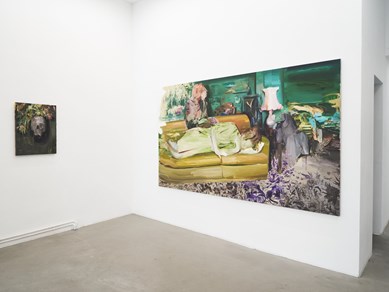
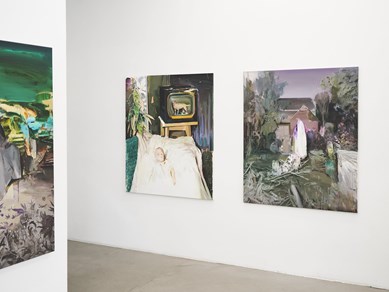
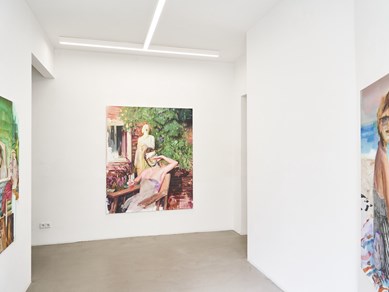
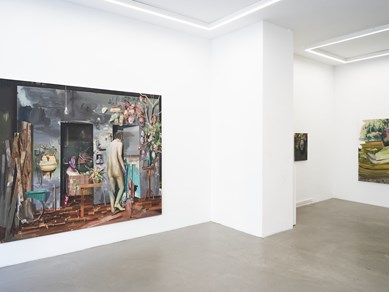
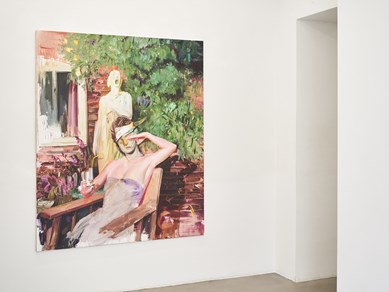
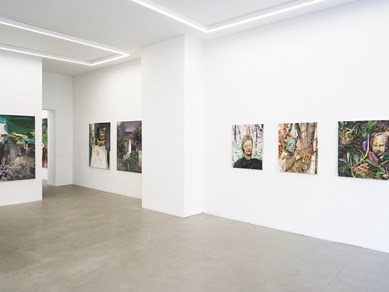
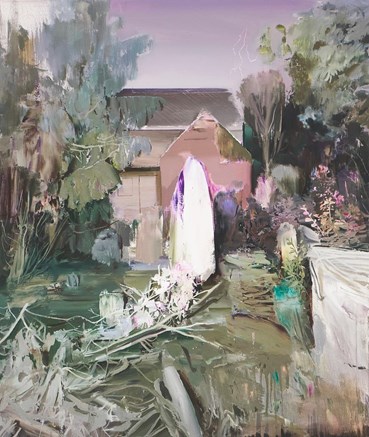
When you enter the gallery, you first encounter everyday scenes - people in the bathroom, on the terrace, in the living room, on the beach. The paintings, which are reminiscent of genre painting, including portraits, carry a melancholic, morbid mood.
As surreally beautiful as these paintings may seem at first glance, at second glance they leave a feeling of unease and irritation. The compositions have something dreamlike, sometimes even nightmarish. One is both attracted and repelled by the depictions. Deeply touching and at the same time disconcerting, they expose us to a rollercoaster of emotions.///
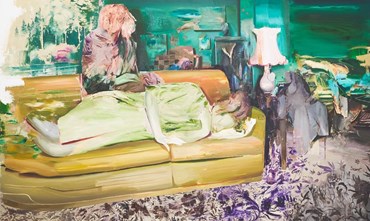
Only on closer inspection do we discover that the sleeping woman on the couch is not alone, but that something uncanny, intangible is sitting on her.
The man in the bathtub has no face, and behind the woman on the terrace stands a figure with its mouth agape. In his works, the Iranian painter Hamid Yaraghchi deals with an „aesthetics of the terrible“ and the possibilities of painting to depict abjects - terrible, ugly, even disgusting motifs. In doing so, he allows reality and fiction to merge into a sphere in which, as he says, reality is symbolically blown up.
The artist likes to generate contradictions and play with man‘s fascination with the horrible. Yaraghchi‘s paintings confront us with mysteries and inconsistencies.
He challenges our subjective perception and our way of dealing with the not-so-nice things in life such as pain, sadness or tragedy. In doing so, he questions the objectivity of our own perception, knowing full well that our perception of reality always reflects our personal memories and experiences.
In the works in this exhibition, the artist explores the concept of evil. He approaches the concept of evil through the lens of concrete figures and how they have found expression in the various epochs and contexts of art history or the media.
Be it vampires, the undead, ghosts or the numerous manifestations of the devil as the epitome of evil. What are these „fabricated evils“? Do we create these monsters and devils to imagine the unimaginable and make the incomprehensible a little more comprehensible? Is it an attempt to give form to the allegedly ‚evil‘? His seasonal vampires are tragic rather than evil figures.
Trapped in their infinite life and very similar to us, they again make us aware of our mortality. The sitting figure on the sleeping woman, based on the famous ‚Nachtmahr‘ by Johann Heinrich Füssli, also experiences a new interpretation in this case and does not necessarily have to be perceived as a threat.
In an age of social media perfection, photoshop, youth mania, and almost innumerable methods and means of confronting ageing, where death and tragedy are present every day through the flood of media, but are nevertheless suppressed, Yaraghchi‘s depiction of the ugly and the terrible is a rather unpleasant concept.
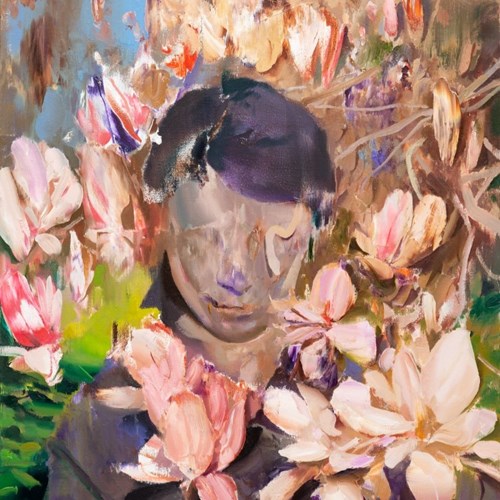
In his dream worlds, he contrasts the beautiful, the hopeful with pain, sadness and tragedy - both sides of our real world, which invariably also contains evil and ugliness. He draws inspiration for his works from stories, poems, images of classical modernism, romanticism, films and photos from the media. With a well-considered and reduced colour palette of rather monochrome brown, grey or green tones, interspersed with lighter shades of blue or pink as well as a skilful play with light, he succeeds masterfully in suggesting that melancholic-morbid and sometimes gloomy atmosphere.
His application of paint shows great precision and decisiveness. The perfect interplay of figuration and abstract elements - elaborated bodies next to distorted or coarsely structured representations of plants or objects – results in complex and contrasting pictorial compositions.
In this show
Installation view